Direct answer: choose a 3-phase, 3-position rotary changeover switch with a robust current rating and safe, secure wiring for your motor or equipment. This guide compares five top options suited for different loads, environments, and installation needs. Best for durable industrial use are models with higher current ratings and IP-rated enclosures; best for compact panels are smaller units with 12 terminals and modular designs. Read on to find the right fit for your 3-phase switching tasks and panel setups.
The following table provides a quick reference to the featured products, highlighting their key capabilities and intended applications.
| Product | Current (Ith) | Voltage (Ui) | Positions | Terminals | |
|---|---|---|---|---|---|
| KEYMOO 63A Rotary Changeover Switch | 63A | 660V | 1-0-2 (ON-OFF-ON) | 8 | Mid-range loads with IP65 enclosure |
| BAOMAIN 40A 3-Phase Changeover with Enclosure | 40A | 660V | 1-0-2 (ON-OFF-ON) | 12 | Three-phase control of smaller systems |
| KEYMOO 160A Rotary Change-Over Switch | 160A | 660V | 1-0-2 (ON-OFF-ON) | 8 | High-current motor equipment |
| Electrical Buddy GLD11 40A Switch | 40A | 690V | 2-position? 3-phase | Unknown (modular data) | Panel-level universal switching |
| Baomain 63A 3-Position 12-Terminal | 63A | 660V | 1-0-2 (ON-OFF-ON) | 12 | Organized wiring and three-phase distribution |
KEYMOO 63A Rotary Changeover Switch with Master Switch

The KEYMOO SZW26-63/D202.2D offers Ui 660V and Ith 63A with three positions (1-0-2) and a two-pole, eight-terminal configuration. The IP65 exterior box provides weather resistance for outdoor or dusty environments. Best for mid-range industrial panels, this model balances rugged construction with manageable wiring complexity. The compact 4.3 x 4.3 x 5.2 inch footprint is suitable for smaller control panels. Caution: ensure wire gauge does not exceed AWG 8 for safe operation.
Who this is best for: technicians needing a reliable, weather-resistant switch for moderate three-phase loads in outdoor or harsh indoor settings.
BAOMAIN 40A 3-Phase Changeover With Enclosure

This model is rated at 40A (Ith) and 660V (Ui) and designed for AC 240V/440V systems. Its 3-pole, 3-stage design with a 12-terminal internal structure supports multiple circuits and complex configurations in a single unit. The stay-put mechanism ensures the switch remains in the selected position, reducing misoperation in busy environments. Best for compact, multi-circuit applications where secure, non-momentary switching is required. Limitation: lower current rating compared to high-end 63A or 160A units.
Who this is best for: panel builders and installers handling three-phase loads with moderate current where a robust enclosure is important.
KEYMOO 160A 660V Rotary Change-Over Switch With Box

Designed for large motor equipment, this 160A switch supports 2W, 2NO, 2NC configurations in a 3-position layout (1-0-2). The heavy-duty chassis and latching action provide secure, long-term operation in demanding environments. Ideal for high-current industrial machines where motor switching must be reliable and lockable. Caution: larger footprint requires bigger panel space and adequate mounting provisions.
Who this is best for: facilities needing robust high-current switching for large motors or equipment with demanding start-stop cycles.
KEYMOO 63A Rotary Change-Over Switch With Copper Cable Connector
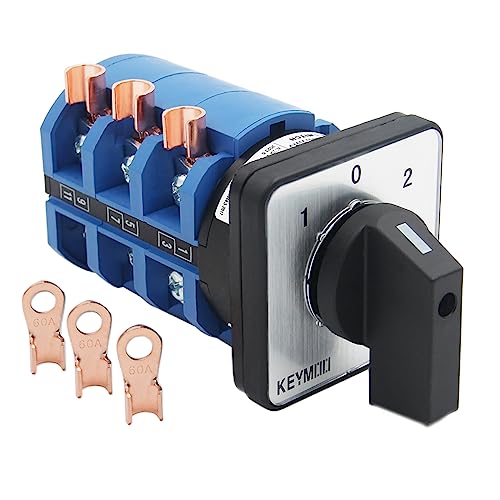
This model uses 63A and 660V with a 1-0-2 ON-OFF-ON arrangement across two poles and 12 terminals. The cam switch employs flame-retardant PC housing and heavy-duty hardware, including silver alloy contacts and thick copper connections for improved conductivity and wear resistance. Best for applications requiring multiple circuit connections in a compact package. Limitation: wire sizing and terminations must be carefully planned to avoid overloading the 63A rating.
Buying Guide
What current rating do you need?
Choose Ith to match the load of the controlled equipment. Higher current ratings support more demanding motors but require larger enclosures and wiring. For typical 3-phase motors, 40A to 63A covers many medium applications, while 160A suits large equipment.
Which voltage rating matters?
Ui indicates insulation voltage. Ensure Ui meets or exceeds the system voltage (often 660V in industrial settings). Higher Ui means greater insulation margin and safer operation in fluctuating supply environments.
Enclosure and environmental considerations
IP65 or stronger enclosures protect against dust and water jets. Outdoor or dirty environments benefit from weatherproof housings. If installation is indoors in clean spaces, a simpler enclosure may be adequate and more economical.
Number of poles and terminals
Two-pole or three-pole designs define how many circuits can be switched and how many terminals you must wire. More terminals help manage complex wiring, but increase installation complexity. A modular or 12-terminal design improves organization in crowded panels.
Positioning and reliability
Three-position switches (ON-OFF-ON) provide secure isolation when OFF, reducing accidental energization. A latching or stay-put mechanism prevents spring-back and enhances safety in busy control rooms.
Wiring practicality
Check wire gauge compatibility. Models typically specify maximum wire size (for example AWG 8). Plan for crimping, lugs, or open-ended conductors to match the terminal layout and prevent loose connections.
Best practice checklist
- Select a model that matches your current and voltage requirements
- Verify enclosure type suits your environment
- Confirm the number of terminals aligns with your wiring plan
- Prefer latching action to avoid accidental changes
- Ensure compatibility with your panel dimensions and mounting
FAQs
- What does “1-0-2” mean on these switches?
Answer: It denotes the three positions: 1 and 2 are ON, 0 is OFF, enabling a center-off isolation. - Can these switches handle three-phase loads safely in outdoor environments?
Answer: Yes, when paired with weatherproof enclosures and appropriate ratings (Ui, Ith) for the load. - What is the advantage of 12-terminals vs 8-terminals?
Answer: More terminals allow more circuit connections and neater wiring in complex configurations. - Is higher current always better for a changeover switch?
Answer: Not necessarily; it should match the connected equipment’s current draw to avoid overheating and wiring issues. - What maintenance is needed for these switches?
Answer: Periodic inspection of terminals for tightness, cleaning of dust, and verification of secure mounting. - Are these switches suitable for high-speed switching applications?
Answer: They are designed for reliable on/off control, not high-frequency switching; use per manufacturer guidance.