Choosing the right grid-tie inverter is essential for turning wind energy into reliable home power. This article highlights five well-suited models that support wind turbine input and feed clean, stable AC to the grid or your home. Each option emphasizes MPPT efficiency, pure sine wave output, and protections that help maintain safe operation in varying wind conditions.
Overview of selected products
| Product | Brand | Key Strengths | DC Input Range | Output | Link |
|---|---|---|---|---|---|
| Solinba 300W On-Grid Tie Inverter (WGT3-12V-US) | Solinba | Grid-friendly integration, clean sine wave, simple setup | 12V DC | AC grid connection | Amazon |
| Marsrock 1300W MPPT Pure Sine Wave Grid-Tie Micro Inverter | Marsrock | MPPT optimization, compact design, stable output | 20-50V DC | 110V/120V AC | Amazon |
| 1000W Grid Tie Inverter (20-50V DC to 90-140V AC) | YINZINR | High efficiency, robust MPPT, reliable performance | 36V DC | 90-140V AC | Amazon |
| Marsrock 2000W Wind Grid Tie Inverter with Limiter | Marsrock | Wind limiter, safety protections, high-capacity output | 45-90V DC | 240V AC | Amazon |
| IOENC 700W Grid Tie Inverter | IOENC | Full digital control, reverse power transmission, safety isolation | DC 54V | AC 110V | Amazon |
Note: The table above summarizes five options chosen for wind grid-tie capability, MPPT efficiency, and robust output range. Each product page provides complete technical specs and installation details.
Solinba 300W On-Grid Tie Inverter

The Solinba WGT3-12V-US is designed to draw wind energy from a turbine and connect to the home grid via output cables. It monitors the grid’s voltage, frequency, and phase to generate a pure sine wave matching the network, with a slight headroom to maintain stable current. When wind activity causes output within the inverter’s rated input range, it transfers power to the house grid seamlessly. This model emphasizes straightforward installation and reliable grid interaction for small-scale wind setups.
Marsrock 1300W MPPT Grid-Tie Micro Inverter
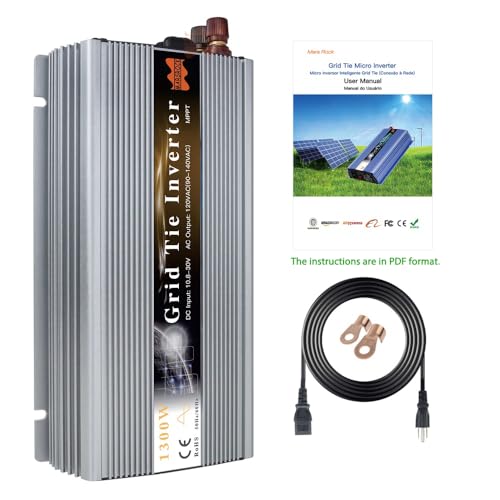
This compact unit leverages MPPT to maximize energy harvest from wind or solar inputs up to 50V. It produces a pure sine wave output suitable for sensitive electronics, ensuring steady performance in home energy systems. The design prioritizes installation simplicity while delivering dependable grid-tie operation in mixed renewable setups.
1000W Grid Tie Inverter by YINZINR

With an emphasis on high efficiency and isolated high-frequency transformer design, this inverter features an advanced MPPT and a robust output range. Its construction utilizes durable materials and industrial components, designed for long-term operation in home wind or solar applications. The device aims to deliver stable power delivery with minimal voltage fluctuations.
Marsrock 2000W Wind Grid Tie Inverter with Limiter

This high-capacity wind-oriented inverter includes a limiter to prevent excess current from feeding the grid during high wind conditions. It also features protective logic that unloads power to safeguard the system and a temperature-based auto restart. The result is a reliable option for mid-to-large wind-driven households seeking grid-tied operation.
IOENC 700W Grid Tie Inverter

IOENC’s inverter emphasizes digital control and environmental considerations. It offers full isolation between input and output, reverse power transmission to maximize grid usage, and safety-focused architecture. Suitable for modest wind or solar installations, it provides reliable grid-tie performance with advanced control features.
Buying Guide: Key Purchase Considerations
- Voltage and power range: Match the inverter’s DC input range with your wind turbine output and storage plan. Higher wattage models handle more wind energy but may need more robust electrical connections and proper cooling.
- MPPT performance: Look for models with robust MPPT to maximize energy capture in fluctuating wind conditions. A sharp MPPT response can significantly improve overall system efficiency.
- Output waveform: Pure sine wave outputs are recommended, especially for sensitive electronics and modern appliances, ensuring clean, stable power delivery.
- Grid compatibility: Check voltage and frequency compatibility with your local grid standards (likely 110V/60Hz in the U.S.). Ensure the inverter can synchronize with the grid without backfeed issues.
- Protection features: Overload protection, overtemperature shutdown, lightning surge protection, and anti-islanding safeguards are critical for safety and reliability.
- Installation environment: Consider IP rating and enclosure quality if the setup is outdoors or exposed to weather. Waterproof or weather-resistant units help in wind-prone locations.
- System integration: Some inverters include anti-backfeed protections and load priority logic. Ensure compatibility with existing wind turbines, batteries, or solar systems if used in a hybrid setup.
- Maintenance and support: Look for products with accessible documentation, customer support, and warranty terms to address potential service needs over time.
- Physical size and mounting: For limited spaces, select a compact design with straightforward mounting options to simplify installation.
- Cost of ownership: While initial price matters, consider long-term efficiency, durability, and maintenance requirements when evaluating value.
In evaluating wind turbine grid-tie inverters, prioritize models with strong MPPT control, reliable protection mechanisms, and compatibility with your wind resource. The five products featured here provide a spectrum of capacities and features to accommodate small to mid-size wind setups and mixed renewable configurations.