For Americans seeking reliable, high-purity drinking water at home, a robust countertop or under-sink purification system can make a meaningful difference. This guide highlights five top options, featuring advanced filtration like reverse osmosis (RO), ultrafiltration, and remineralization to balance taste and health. Each model emphasizes portability, ease of use, and certified filtration. Explore their key features, and use our buying guide to compare performance, efficiency, and long-term maintenance.
| Product | Brand | Filtration Type | Highlights |
|---|---|---|---|
| Bluevua RO100ROPOT-UV | Bluevua | 6-stage RO with UV and remineralization | Countertop, glass carafe, remineralization, 2:1 Pure to Drain |
| Purewell 3-Stage PW-OB | Purewell | 0.01 μm UF hollow fiber with carbon | NSF/ANSI 42 & 372, stainless steel housing |
| APEC ROES-50 | APEC | 5-stage RO | WQA certified, high impurity removal, long-lasting filters |
| Bluevua RO100ROPOT-Lite | Bluevua | 7-stage RO with UV and remineralization | Countertop, LED display, 3:1 pure to drain |
| Purewell PW-KS | Purewell | 3-stage 0.01 μm gravity | Stainless steel, water level window, 4 GPH |
The products above were selected for their strong filtration capabilities, certifications, and practical features suitable for everyday use in American households. Each entry below provides a concise overview, focusing on performance, installation requirements, and maintenance considerations. This format helps readers compare options quickly while keeping information balanced and objective.
Bluevua RO100ROPOT-UV Countertop System
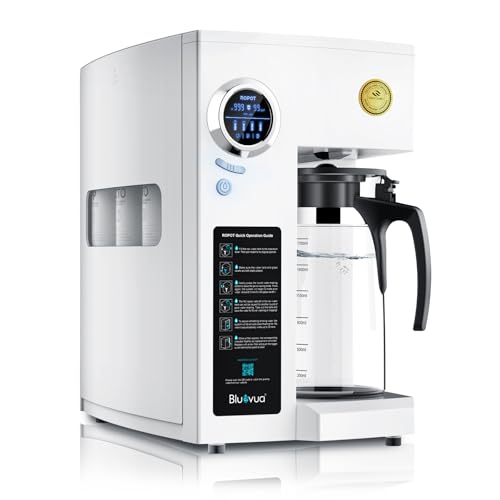
The Bluevua RO100ROPOT-UV Countertop system employs a 6-stage filtration process, including a 0.0001 μm RO membrane, UV disinfection, and a remineralization filter. Certified by WQA for lead-free construction and SGS-tested, this unit targets reductions in TDS, PFOS, PFOA, chlorine, fluoride, arsenic, and lead, while restoring essential minerals to improve taste. It stands out for counter-top convenience—no plumbing or installation required—and ships with a glass carafe designed to minimize secondary pollution. Power-saving standby mode helps reduce energy use, and the 2:1 pure-to-waste ratio minimizes water waste compared with some RO systems.
Key considerations: portability is a major benefit, making it suitable for apartments, offices, or spaces where fixed plumbing isn’t feasible. The included carafe supports portioned storage and reduces plastic exposure. Replacement filter costs and frequency depend on water quality and usage, and the unit relies on an electrical supply to power UV disinfection and operation.
Purewell 3-Stage PW-OB Gravity System

The Purewell 3-Stage Gravity Water Filter System uses a 0.01 μm hollow fiber UF membrane combined with activated carbon and silver ion membranes to reduce chlorine, rust, sediment, organic matter, and heavy metals. Certified to NSF/ANSI 42 and 372, this countertop unit emphasizes filtration precision with a smaller 0.01 μm pore size—capable of delivering high-quality water at a steady flow rate (about 4 gallons per hour). A complete accessory set, including a stainless steel housing and a non-slip stand, adds durability and stability for simple tabletop installation.
Key considerations: gravity-fed systems do not require electricity, offering utility in areas with intermittent power. However, space on the countertop and the need to manually fill the reservoir may influence convenience. The smaller pore size improves filtration accuracy but can affect time-to-pour if you’re serving multiple people quickly.
APEC ROES-50 Essence Series 5-Stage RO

This APEC ROES-50 Essence Series unit offers a five-stage RO filtration process designed to remove up to 99% of impurities, including arsenic, chlorine, lead, fluoride, heavy metals, and more. The system is WQA certified and engineered with premium components intended for durable, long-term performance. With a maximum TDS handling of around 2000 ppm, it pairs robust filtration with compatibility across various water sources, including municipal taps and well water. High-quality pre-filters and membranes aim to deliver consistently clean, crisp-tasting water.
Key considerations: RO systems like this typically require installation under the sink or in a dedicated space near a cold-water line, plus a drain connection. Replacement filter costs and intervals depend on water quality and household usage. Users should budget for occasional filter changes to maintain performance and taste.
Bluevua RO100ROPOT-Lite(UV) Countertop System

The Bluevua RO100ROPOT-Lite adds a seven-stage purification process to a countertop footprint, featuring UV disinfection and remineralization. The system boasts a 3:1 purified-to-drain ratio and a one-year filter replacement cycle with a stated daily filter cost around $0.22, underscoring efficiency and cost-effectiveness for households aiming to minimize plastic waste. A one-touch LED display provides hydration reminders and real-time water quality indicators, enhancing user awareness and convenience.
Key considerations: LED display and smart controls improve usability, especially for busy households. The 3:1 ratio helps conserve water, but actual performance can depend on feed water pressure. As with other RO systems, ongoing maintenance and filter replacement remain essential for sustained purity and taste.
Purewell 2.25G PW-KS Gravity System

The Purewell PW-KS gravity system emphasizes visibility with a water level window, allowing users to monitor the reservoir without opening the unit. Its 0.01 μm hollow fiber UF membrane, combined with silver ion and activated carbon components, reduces chlorine, rust, sediment, heavy metals, and organic matter. This stainless steel housing and a 4 gallons-per-hour flow rate offer a stable, durable countertop solution that balances filtration efficiency with convenient access to purified water.
Key considerations: gravity-fed systems do not require electricity, appealing for space-limited areas or off-grid use. The stainless steel build enhances durability, and the window feature helps users manage water usage more effectively. Filter replacement schedules will depend on water quality and usage patterns.
Buying Guide: Key Purchase Considerations
- Filtration needs: Identify your primary contaminants (chlorine, fluoride, lead, PFAS, bacteria). RO systems excel at removing a broad range of dissolved impurities, while gravity UF systems emphasize microbiological reduction and sediment control without electricity.
- Water source and pressure: Municipal water typically works well with most countertop RO systems, but well water may require more robust filtration or pre-treatment. Check feed water pressure requirements to ensure compatibility.
- Space and installation: Countertop units offer easy setup and portability but require adequate counter space. Under-sink RO systems demand plumbing connections but save countertop space.
- Waste and efficiency: RO systems produce wastewater; consider models with favorable pure-to-drain ratios and features like standby modes to minimize energy use.
- Remineralization and taste: Some users prefer remineralization to restore essential minerals and improve taste. If taste is a priority, a model with remineralization may be beneficial.
- Certifications and guarantees: Look for NSF/ANSI certifications for contaminant reduction and lead-free construction, plus WQA certification where available, to ensure performance claims are credible.
- Maintenance and cost: Factor in replacement filter costs, availability, and intervals. Gravity systems generally have lower ongoing energy costs but may require more frequent cartridge changes depending on usage and water quality.
- Portability vs. permanence: Choose countertop models for flexibility or under-sink systems for a long-term installation with potential higher purification capacity.
In evaluating the five highlighted options, the best choice depends on your household’s priorities—portable convenience, advanced RO filtration, water-saving efficiency, or visible monitoring features. Each model offers a distinct balance of filtration depth, ease of use, and maintenance requirements, enabling an informed decision aligned with health, taste, and daily water needs.