Answering the buyer’s search intent: these ultra low temperature sensors and data loggers provide accurate temperature monitoring for vaccines, medicines, and laboratory samples. They’re best suited for healthcare, research, and cold-chain applications that require high-precision logging, Bluetooth or remote alerts, and audit-ready data exports. The top picks here balance accuracy, ease of use, and reliable data management across refrigerators, freezers, and storage rooms.
Product highlights at a glance:
- Elitech Bluetooth Ultra Low Digital Temperature Data Logger (GSP-6 family)
- MOCREO ST10 Ultra Low Wireless Freezer Thermometer
- Elitech Dual Temperature Probe for RCW-360Pro
- Elitech ISO 17025 Certified Bluetooth Data Logger Ultra Low Temperature
- Frigga T72 Real-Time Temperature Monitor
Product comparison table
| Product | Best For | Key Benefit |
|---|---|---|
| Elitech GSP-6-TLE Series | Vaccine storage, pharmacy, and hospital labs | Bluetooth data transfer and large data point capacity |
| MOCREO ST10 | Lab vaccine refrigerators with WiFi integration | Ultra-low range with external RTD probe |
| Elitech RCW-360Pro Dual Probe | Critical cold chain with dual-point monitoring | Automatic probe recognition and 16.4 ft cable |
| Elitech ISO 17025 Data Logger | Research and hospital inventory with ISO traceability | Calibration traceable to CNAS/ILAC on request |
| Frigga T72 | Real-time monitoring with remote alerts | 4G/5G remote data transmission |
Elitech Bluetooth Ultra Low Data Logger GSP-6-TLE
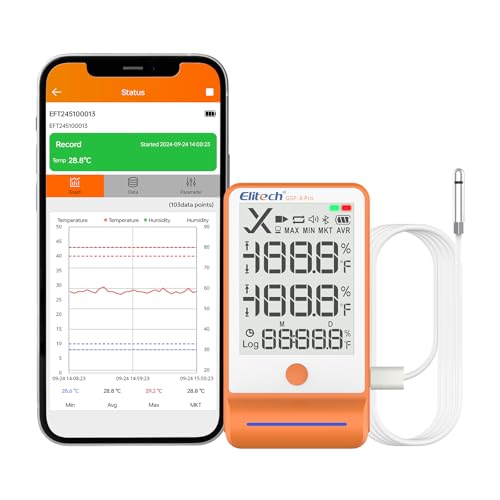
The Elitech GSP-6-TLE family features Bluetooth data transfer via the iCold app, a 3.3-inch display, and support for up to 100,000 data points. Best for vaccine storage and pharmacy use where audit-ready DDL certificates are required. The device is FDA 21 CFR Part 11 compliant and offers high-precision sensing at ±0.3°C/±0.6°F across a wide range (-85°C to 150°C). Caution: Bluetooth dependence may affect data access in environments with poor wireless connectivity.
Why it’s chosen: This model is ideal for users who need smartphone-enabled data access, downloadable reports, and automated export options for regulatory compliance.
MOCREO ST10 Ultra Low Freezer Thermometer

Best for laboratories and clinics using a MOCREO Hub for remote monitoring. It supports -328°F to 392°F, driven by an external PT100 RTD and offers several alert modes, including email and app notifications. The system requires a MOCREO Hub (not included) and 2.4 GHz WiFi. Limitation: requires hub and compatible WiFi network for full functionality.
Why it’s chosen: It delivers ultra-low temperature coverage with a robust alert system, suitable for facilities needing remote monitoring and centralized reporting.
Elitech Dual Temperature Probe for RCW-360Pro
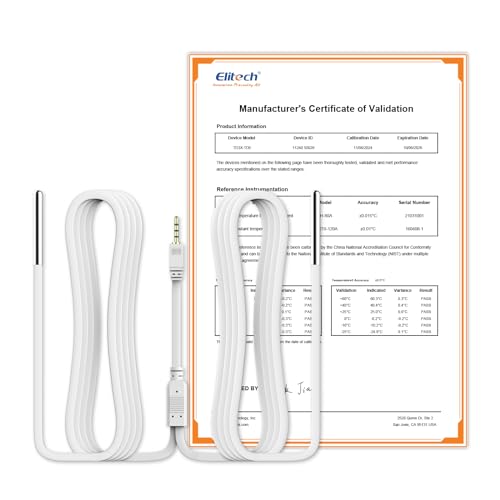
Best for expanding existing RCW-360Pro setups with a second probe for independent monitoring. Features automatic probe recognition, wide range (-40°F to 176°F) with ±0.9°F/0.5°C accuracy, and a 16.4-foot cable with a universal 3.5 mm plug. Limitation: designed primarily for use with RCW-360Pro; compatibility is essential.
Why it’s chosen: Offers seamless integration and enhanced data integrity when monitoring two locations or items within the same storage environment.
Elitech 5Pack Bluetooth Ultra Low Data Logger
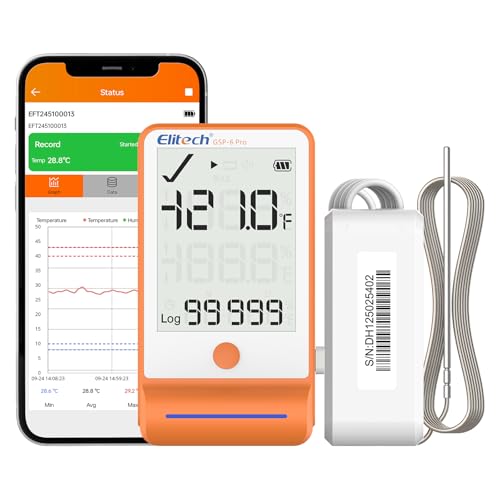
This five-pack extends the GSP-6-TLE functionality across multiple storage zones. It shares the same 3.3-inch display, 100,000-data-point capacity, and DDL calibration certificates. Best for facilities needing multiple, concurrent, audit-ready data streams. Caution: managing multiple units requires organized calibration tracking.
Why it’s chosen: Enables scalable monitoring across several refrigerators or rooms, preserving consistent data formats for compliance reporting.
Elitech ISO 17025 Certified Bluetooth Data Logger
Best for institutional use requiring ISO/ILAC traceability. This model supports calibration against CNAS standards on request and provides a continuous data visualization suite for vaccines, IVD, and cold chain logistics. It maintains a wide measurement range and high-precision probe performance. Limitation: ISO testing options may involve additional lead times for certification.
Why it’s chosen: Provides formalized traceability and documentation suitable for research facilities, hospitals, and vaccine programs needing regulatory-grade data management.
Frigga T72 Real-Time Temperature Monitor

Best for facilities needing real-time monitoring with remote alerts via a cellular network. It supports 24/7 monitoring, instant alerts, and remote start. The device leverages a built-in SIM for global LTE connectivity and offers quick reporting to prevent excursions. Limitation: data plans or SIM compatibility may affect long-term deployment in certain regions.
Buying Guide
What to consider when choosing an ultra low temperature sensor:
- Data logging capacity and export formats: Do you need PDF/CSV exports or direct app access?
- Connectivity: Bluetooth, WiFi, or cellular? Consider network reliability in your facility.
- Temperature range and accuracy: Ensure the sensor covers your storage temperatures with required precision.
- Calibration and traceability: Is ISO or CNAS/ILAC traceability important for your operation?
- Probe configuration: Single vs. dual probes and cable length affect placement flexibility.
- Alerts and automation: Email, push, or hub-based alerts help prevent unnoticed excursions.
- Audit readiness: Do you require calibration certificates and compliance documentation?
FAQ
- What is a typical ultra low temperature sensor used for?
Usually for vaccines, pharmaceuticals, blood products, and research samples requiring strict temperature control. - Do these devices require a WiFi network?
Some models use Bluetooth or cellular data; others need a hub or SIM-enabled network for alerts. - Can I export data for regulatory audits?
Yes, many models offer PDF/CSV exports and calibrated certificates suitable for audits. - What is the importance of probe type and placement?
Accurate reading depends on measure points; longer cables and multiple probes allow flexible placements. - Is ISO/ILAC traceability necessary?
Crucial for facilities that require formal quality management and external audit compatibility. - Are there any common drawbacks?
Some systems require hubs, SIM cards, or specific networks which can add setup complexity.