If you’re growing indoors, a precise timer is essential to ensure your grow lights run on a consistent schedule. This guide helps buyers choose the right timer for grow lights, forests of plants, or hydroponic setups. The top picks below are suitable for different needs—from simple daily cycles to multi-outlet control with surge protection. The best option depends on how many outlets you need, whether you want a digital or mechanical timer, and how programmable you require the schedule to be.
| Product | Outlets | Timer Type | Best For | Notes |
|---|---|---|---|---|
| BN-LINK 8 Outlet Surge Protector with Mechanical Timer | 8 (4 timed, 4 always-on) | Mechanical | Grow tents with multiple devices | Updated pin dial; 24-hour cycle |
| BN-LINK BND-60/U47 Indoor Mini 24-Hour Timer (2-Pack) | 1 outlet per timer | Mechanical | Small grows or plug-in accessories | Press pins up/down to set on/off |
| BN-LINK 24 Hour Plug-in Mechanical Timer Grounded | 1 outlet | Mechanical | Aquariums, grow lights, hydroponics | Built-in dial, no loose parts |
| BN-LINK Indoor Digital Timer Outlet (Dual Outlet, 7 Day) | 2 outlets | Digital | More complex schedules | 7-day programming, backup battery |
| BN-LINK 8 Outlet Surge Protector with 7-Day Digital Timer | 8 (4 timed, 4 always-on) | Digital | Grow setups with multiple devices | 7-day options, keeps settings |
BN-LINK 8 Outlet Surge Protector With Mechanical Timer
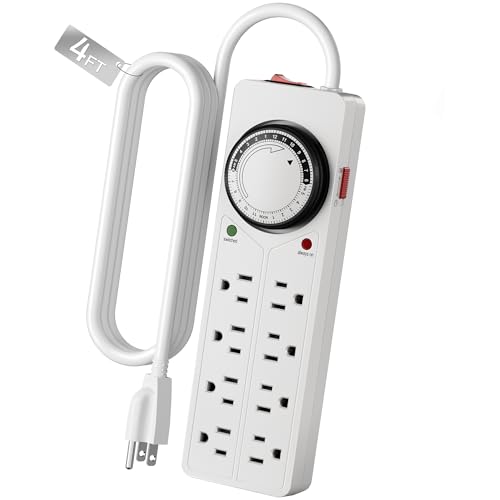
Best for multi-device grow setups that want a single surge-protected power strip with a timer. Four outlets learn a daily cycle while the other four remain on for devices that don’t need timing. The 24-hour repetition makes it ideal for consistent light periods and other routine equipment like fans or pumps. The timer dial supports 15-minute increments for flexible scheduling. LED indicators show which rows are powered.
Who it’s best for: growers needing a centralized timer plus surge protection for a compact grow tent. Why chosen: it combines protection and timing in one unit with clear indicators. Caution: the timer is mechanical, so it lacks the precision of digital programs for very strict schedules.
BN-LINK BND-60/U47 Indoor Mini 24-Hour Mechanical Timer

Best for small grow setups or single-device automation. Each timer controls one outlet with up to 24 on/off settings per day, repeating daily. Pins UP indicate OFF, pins DOWN indicate ON. The simplicity makes it reliable for basic grow lights or small fans. It tolerates a range of devices and can be set in 30-minute intervals for moderately precise control.
Who it’s best for: hobbyists or windowsill growers needing a cheap, reliable daily timer for one device. Why chosen: straightforward mechanical design minimizes setup complexity. Caution: no multi-outlet control; you’ll need multiple units for several devices.
BN-LINK 24 Hour Plug-in Mechanical Timer Grounded

Best for growers who want a built-in pin dial with no loose parts and a straightforward schedule for one outlet. Uses a 24-hour cycle, and the built-in dial allows manual control with tactile pins. It’s suitable for automating a single grow light, fan, or pump. Note that it’s designed for indoor use and an outlet with three-prong grounding is required.
Who it’s best for: growers starting with one critical device to automate. Why chosen: reliability with no dependency on digital networks. Caution: limited to one device; not ideal for multi-device grow rooms without additional timers.
BN-LINK Indoor Digital Timer Outlet (Dual Outlet, 7 Day)

Best for growers needing more scheduling flexibility across two outlets. This dual-outlet digital timer supports up to eight on/off programs and can handle short settings as fine as one minute. It includes a backup battery to preserve programming during outages. You can use pre-set days or create custom schedules with selectable days. Random Vacation mode adds a look of activity when you’re away.
Who it’s best for: grow rooms with two timed devices or a grow light plus an auxiliary device requiring synchronized cycles. Why chosen: advanced programming in a compact form. Caution: more complex than basic mechanical timers; take time to learn the interface.
BN-LINK 8 Outlet Surge Protector With 7-Day Digital Timer

Best for larger grow setups needing weekly programming across multiple devices. Four outlets are timed and four are always on, with full surge protection and a circuit breaker switch for safety. The timer supports up to seven days of programming for each outlet group, and a long-lasting backup battery preserves settings during outages. This model allows more sophisticated weekly schedules for lights, fans, and pumps.
Who it’s best for: growers with a multi-device tent or room that benefits from a broader, week-long schedule. Why chosen: combines a surge-protected strip with a robust 7-day digital timer. Caution: programming may be more involved than single-outlet timers.
Buying Guide: How To Choose The Right Grow Light Timer
- What schedule complexity do you need? If you only need a daily on/off, a simple mechanical timer may suffice. For more complex patterns, a digital timer with multiple programs is better.
- How many devices require automation? Choose an arrangement that matches the number of outlets you must control. For many devices, consider a surge-protected strip with multiple timed outlets.
- Is surge protection important? If you’re protecting a grow light and other equipment from surges, select a model with built-in surge protection and a circuit breaker.
- Do you need backup memory? Some digital timers include a backup battery to keep settings during outages. This is valuable for ongoing schedules in unstable power environments.
- Is manual control important? Mechanical timers offer simple, tactile control without digital interfaces, useful in low-tech setups. Digital timers are better for precise, repeatable schedules.
- Are you managing a multi-outlet grow room or tent? A network of timers (or a single timer with multiple timed outlets) reduces complexity and helps maintain consistent photoperiods.
Frequently Asked Questions
- What is a grow light timer best used for? It automates light cycles to maintain consistent photoperiods, reducing manual intervention and improving plant growth consistency.
- Should I choose mechanical or digital timers? Mechanical timers are reliable and simple, ideal for basic cycles. Digital timers offer more complex scheduling and memory features for larger setups.
- Can timers control more than grow lights? Yes, timers can automate fans, pumps, hydroponic pumps, and other devices in a grow room.
- Do timers require a specific outlet type? Most timers use standard 3-prong grounded outlets; check the product’s plug type before purchasing.
- Will a timer preserve settings during a power outage? Some digital timers include backup batteries that preserve schedules during outages.
- Is it necessary to have eight or more outlets on a timer strip? If you run multiple devices, a timer strip with several timed and untimed outlets helps streamline the setup.