Direct answer: use purpose-built outdoor surge protectors rated for wet or damp environments to shield pool pumps and related equipment from lightning and power spikes. This article highlights five reliable options that suit outdoor pools, spas, and HVAC gear, with clear guidance on who benefits most from each model. If you need protection for motors, compressors, and control systems, these picks balance endurance, weather resistance, and practical features for homeowners and maintenance pros alike.
Buyer types summary
| Product | Best For | Why It Stands Out |
|---|---|---|
| Intermatic PS3000 Pool and Spa Surge Protective Device | Pool owners seeking simple, entry-level protection | Watertight enclosure, visible status, budget-friendly |
| Intermatic AG3000 120/240 VAC Surge Protector | Outdoor HVAC and equipment near pools | Three-mode protection, TPMOV tech, durable enclosure |
| Wells 25kA Type 1 Surge Protector | Outdoor HVAC and pumps with high surge tolerance | High surge rating, robust NEMA 4X enclosure |
| BXST Heavy Duty Wiring Surge Protector | Refrigeration, appliances and pumps needing adjustable protection | Adjustable voltage and delay, 140J protection |
| Qiyuan IPX6 Outdoor Power Strip with USB | Multiple outdoor devices from pumps to lights | Weatherproof, 9-in-1 outlets including USB |
Intermatic PS3000 Pool and Spa Surge Protective Device

The Intermatic PS3000 is designed to provide inexpensive protection for pool and spa equipment, including pumps, filters, and heaters. It features a visible green LED indicator showing protection is ON, and it comes in a Type 4x watertight and UV-resistant enclosure suitable for outdoor use. Best for homeowners seeking straightforward, reliable surge protection without extra features. A potential limitation is that it emphasizes basic protection rather than advanced diagnostics or modular expandability.
Outdoor Power Strip Weatherproof 6 Outlets + 3 USB (Qiyuan)

This 9-in-1 power strip combines six wide AC outlets with three USB ports (2 USB-A, 1 USB-C) and an IPX6 weatherproof rating. It’s suited for outdoor setups where multiple devices—such as pool pumps, lights, and chargers—need simultaneous power. It uses a safety-lock design requiring full plug insertion. Choose this when you need to run several devices from a single outdoor strip; caution: the total 1875W limit should be respected to avoid overload in shaded or humid conditions.
Intermatic AG3000 120/240 VAC Universal HVAC Surge Protector
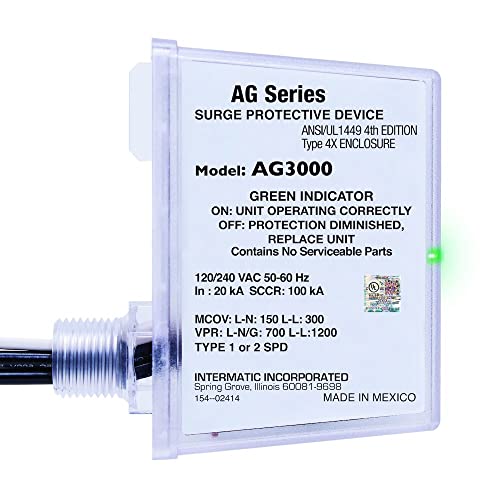
The AG3000 provides comprehensive three-mode protection (L-G, L-L, L-N) suitable for outdoor HVAC units and related pool equipment. It uses TPMOV technology to reduce failure risks associated with traditional MOV devices and features a Type 4X watertight, UV-resistant enclosure for outdoor reliability. Best for systems that require robust surge defense and long-term durability; best to verify that the enclosure and wiring configurations align with local electrical codes.
Wells 25kA Type 1 Surge Protector

The Wells surge protector suits outdoor HVAC systems and pumps requiring high surge tolerance. It features a NEMA 4X/IP66-rated enclosure designed for outdoor use and TPMOV technology for improved spike suppression. Best for protectors that must endure heavy weather and substantial surge events. Limitation: high surge rating may come with a larger enclosure footprint and more complex installation.
BXST Heavy Duty Wiring Surge Protector

BXST offers 140J surge protection with adjustable voltage and delay protection, making it suitable for refrigerators, air conditioners, and pumps. The adjustable delay helps protect sensitive appliances from frequent restarts after a surge and stabilizes voltage before re-energizing devices. Choose this if you need customizable protection settings for mixed load scenarios; a limitation is that it is more feature-rich, which may complicate simple pool pump protection needs.
Jandy 6908 Surge Protection Kit

Jandy’s 6908 surge protection kit targets AquaLink control systems and related components. Best for users with integrated pool control networks requiring surge protection for control modules. It’s more specialized for Jandy systems; consider its applicability if you operate a connected pool automation setup. Limitation: not a general-purpose surge protector for all outdoor equipment.
Buying Guide: Key Considerations For Pool Pump Surge Protection
- Environment and enclosure: Look for Type 4X watertight and UV-resistant housings for outdoor pool equipment to withstand rain, sun, and humidity.
- Surge tolerance: Higher surge ratings (kA) offer greater protection for motors and compressors; match to the critical equipment’s electrical load.
- Protection modes: Devices that support L-G, L-L, and L-N protection provide comprehensive defense for 120/240V systems commonly used with pool pumps.
- Voltage compatibility: Ensure the protector supports your system’s voltage (e.g., 120V or 240V, single or three-phase) and short-circuit withstand rating if applicable.
- Ease of installation: Prefer models with clearly labeled wiring terminals and simple mounting options for outdoor installation near pumps or control panels.
- Diagnostics and status: A visible indicator or LED status helps confirm protection is active after installation and during storms.
- Maintenance and replacement: Consider units with modular or easily replaceable components in case of a surge event.
Frequently Asked Questions
- What size surge protector do I need for a pool pump?
Choose a protector rated to handle the pump’s startup surge and running current. Look for a unit with an adequate current rating and a robust surge capacity (kA) suitable for outdoor motors.
- Should I use a dedicated surge protector or a power strip for pool equipment?
Use purpose-built outdoor surge protectors designed for damp or wet environments. Power strips are not appropriate for pool pumps or HVAC equipment due to rating and enclosure requirements.
- Is a higher protection rating always better for pool equipment?
Higher ratings improve protection against spikes, but ensure compatibility with your system’s voltage and electrical code requirements. Overkill can add cost and size without additional benefit.
- Do these protectors require professional installation?
Installation should follow local electrical codes. Some units are straightforward for DIY with basic electrical knowledge, while others may require professional wiring, especially for 240V or three-phase setups.
- Can surge protectors be used indoors as well as outdoors?
Yes, but ensure the enclosure and rating match the environment. Outdoor-rated, weatherproof units are best for pool and HVAC equipment located outdoors.
- How often should I replace a surge protector?
surge protectors are designed to take the hit and dissipate energy. If a protector shows damage, wear, or reduced protection indicators, replace it promptly.