For homes seeking efficient, on-demand hot water powered in part by solar energy, choosing the right tankless system is crucial. This guide highlights five electric and hybrid-ready options that pair well with solar setups, offering compact design, energy efficiency, and reliable performance. Each model listed supports high-efficiency operation and space-saving installation, making them suitable for sunny homes, cabins, or off-grid setups where solar power can offset electricity use. The selections below include compact wall-mount units and higher-capacity options to meet varied household demand.
Summary of the chosen products:
| Product | Brand | Key Benefit | Approx. Power |
|---|---|---|---|
| EcoSmart ECO 11 Electric Tankless Water Heater, 13KW | EcoSmart | Space-saving, self-modulating with precise temperature control | 13 kW |
| Rheem RTEX-24 24kW Electric Tankless Water Heater | Rheem | Strong performance for whole-home use with adjustable temperature | 24 kW |
| Orbek 18kW Tankless Electric Water Heater | Orbek | High efficiency with 3/4 in NPT connections and 2-3 fixture support | 18 kW |
| Titan Electric Tankless Water Heater | Titan | Simple 220 V unit with solid amperage and compact form | 54 A max |
| NEW WINTEMP 27kW 240V Tankless Water Heater | WINTEMP | High output with energy-saving, self-regulating technology | 27 kW |
EcoSmart ECO 11 Electric Tankless Water Heater

Endless on-demand hot water is a core feature of the EcoSmart ECO 11. This 13 kW device uses patented self-modulating technology to adjust energy use to current demand, helping conserve electricity when solar generation is high and water usage is low. It is designed to be 90% smaller than traditional tank heaters, enabling wall-mounting or point-of-use installation. The unit operates with a compact footprint (approximately 11.5 x 8 x 3.75 inches) and claims 99% thermal efficiency by heating water only when called. For solar-powered homes, this unit can pair well with a solar array and storage to minimize grid draw during peak sun. It provides consistent water temperature within about a degree of the set point, though the actual temperature rise will depend on incoming water temperature and flow. Amperage draw is 54 A. This model is widely installed in households seeking space efficiency and energy-conscious operation.
Rheem RTEX-24 24kW Electric Tankless Water Heater
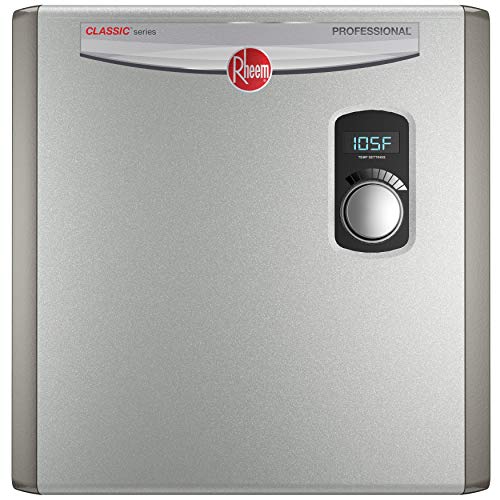
Rheem’s RTEX-24 is a 24 kW electric tankless model designed for whole-home use with steady pressure and temperature control. It features an external digital thermostatic control with an LED display and 1-degree accuracy, supporting a precise temperature adjustment within a typical range. The unit employs self-modulation to match hot-water demand, reducing energy use when demand is lower. Two durable copper immersion elements provide reliable heating performance, and field serviceability makes maintenance simpler. The recommended flow rate is up to about 4.4 GPM, which suits moderate households or point-of-use configurations in solar-powered homes. For solar integration, it pairs with a solar storage system to limit daytime grid draw while delivering consistent hot water during peak sun hours.
Orbek 18kW Tankless Electric Water Heater
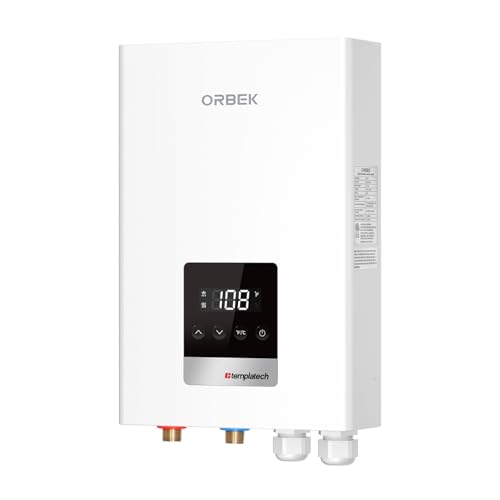
Orbek’s 18 kW on-demand heater is designed for 240V operation, with a note that installation may require two 240V/40A breakers and a 3/4″ NPT water connection. The model promises up to 4.17 GPM at 3 seconds of hot water for 2-3 fixtures, and claims high energy efficiency by separating water and electricity to reduce scale and corrosion. It emphasizes rapid heat delivery and potential electricity savings, which can complement solar-powered homes by decreasing daytime energy use and enabling more solar energy to substitute for grid electricity during peak sun hours.
Titan Electric Tankless Water Heater

Titan’s electric tankless model provides a compact option with 220 V operation and a maximum amperage of 54 A. It is a straightforward, space-saving unit designed for homes seeking a simple, reliable on-demand hot water solution. While not the highest output on this list, Titan’s unit is suitable for smaller homes, apartments, or partial-house systems when solar generation aligns with moderate hot-water need. Proper electrical planning is essential to ensure the circuit capacity and panel space meet the unit’s requirements, particularly when paired with solar storage or inverters.
NEW WINTEMP 27kW 240V Tankless Water Heater

The WINTEMP 27 kW model is designed for whole-house hot water with a high output. It requires three 40-amp double-pole breakers and three runs of 8 AWG wiring, with a recommended 250-amp service. The unit uses self-regulating technology to adjust power based on flow and incoming water temperature, delivering up to 6.5 GPM while aiming for stable temperatures and energy savings up to 99% versus tank heaters. It is positioned for residential use with multiple simultaneous outlets, making it a strong candidate for solar-powered homes that have sufficient solar generation and storage to support higher load during peak sun hours.
Buying Guide: Solar-Powered Tankless Water Heater Considerations
- Power compatibility: Solar-powered homes typically use inverters and batteries. Electric tankless heaters demand high continuous power. Check whether your solar setup can support the unit’s wattage during peak water-use times and plan for buffer capacity with battery storage.
- Flow rate needs: GPM requirements depend on whether you are heating water for a single point of use or multiple fixtures. Larger homes may require units with higher kW ratings or staging configurations to maintain comfortable temperatures when demand increases.
- Temperature stability: Look for models with precise digital control and minimal temperature fluctuation. In solar-integrated systems, temperature feedback helps the heater modulate output to offset changes in incoming water temperature due to solar cycling.
- Installation and space: Wall-mounted, compact units save space and reduce heat loss. Ensure proper clearances and venting (for gas-powered or condensing models) and check local code requirements for solar-electric integration.
- Reliability and service: Opt for units with durable heating elements and accessible service options. If you anticipate remote installation or off-grid use, consider units with straightforward maintenance and availability of replacement parts.
- Efficiency and conservation: Self-modulating or demand-controlled heaters can minimize energy consumption, maximizing the benefits of solar power by using grid electricity less frequently and more efficiently when solar is available.
- Electrical safety and permit needs: Working with high-power electric appliances requires professional electrical work. Plan for permits and inspections as needed for your region and solar configuration.
- Gas vs. electric: If you want off-grid operation, electric tankless heaters pair more directly with solar. Gas models may offer other benefits but require gas supply and venting, complicating solar integration.
In sum, the five models featured above offer a range of capacities and configurations suitable for solar-powered homes seeking on-demand hot water. When pairing with solar, consider total system load, peak sun hours, storage capacity, and local electrical codes to select a unit that provides reliable comfort while aligning with your solar strategy.