Efficient solar powered exhaust fans can cut energy costs while improving ventilation in greenhouses, chicken coops, attics, sheds, and garages. This guide highlights five top options, comparing airflow, battery backups, noise levels, and installation flexibility. Each product is linked to its Amazon listing for quick reference and purchase.
Summary of Selected Products
| Product | Brand | Key Benefit | Airflow (CFM) | Power |
|---|---|---|---|---|
| GROWNEER Solar Powered Exhaust Fan | GROWNEER | Smart solar priority, battery backup, durable | 1200 | 30W solar + battery |
| SHENVITASO Solar Exhaust Fan 8″ | SHENVITASO | High airflow with night/day flexibility | 430 | 25W solar + adapter |
| Prozilon Solar Exhaust Fan 8″ | Prozilon | Ultra-quiet, strong 430CFM | 430 | 25W solar + adapter |
| DC HOUSE Solar Attic Fan 32W | DC HOUSE | High airflow, weatherproof, off-grid | 1600 | 32W solar |
| ecoCalm 12″ Solar Exhaust Fan | ecoCalm | Battery backup with bifacial panels | depends on setup | 30W panels + battery |
GROWNEER Solar Powered Exhaust Fan
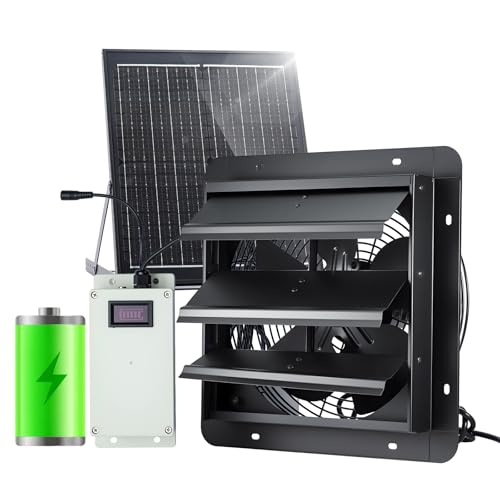
The GROWNEER unit combines a 30W solar panel with a high-speed 12″ fan. It offers a built-in 3200mAh battery that powers the fan during cloudy periods and at night. Users can switch between low, medium, and high speeds with a single button, delivering up to 1200 CFM for spaces up to about 1400 square feet. The metal housing provides rust resistance, and noise levels stay within 40–60 dBA. An automatic louver helps prevent dust ingress when the fan stops.
Key features include solar priority operation, a robust battery, and a quiet yet powerful performance suitable for greenhouses, attics, sheds, and chicken coops. The durable construction and long life make it a strong all-around option for off-grid ventilation.
SHENVITASO Solar Exhaust Fan 8″

SHENVITASO pairs a 25W solar panel with an 8″ high-speed exhaust fan and an anti-backflow valve. The unit can reach up to 2300 RPM and 430 CFM, delivering strong airflow with relatively low noise at 36 decibels. It includes a 16.4-foot panel cable and a power adapter for both solar and grid-powered operation, plus a built-in iron block to keep the valve closed when not running to prevent intruders or pests from entering.
Designed for sheds, chicken coops, greenhouses, and small spaces, this kit emphasizes day-and-night operation and flexible mounting. The long cable length allows rooftop placement with a convenient power adapter option when needed.
Prozilon 8″ Solar Exhaust Fan

Prozilon offers an 8″ solar exhaust fan with a brushless motor to reduce noise and vibration, maintaining quiet operation at ≤36 dB. The kit includes a 25W solar panel, 16.4-foot panel cable, and a 4.9-foot AC adapter cord for flexible installation. It delivers around 430 CFM at 2600 RPM, making it a solid option for medium-sized chicken coops, sheds, and greenhouses. The anti-backflow valve helps maintain interior air quality when the fan is not running.
This solution emphasizes durability and quiet performance, suitable for both daytime solar use and supplemental nighttime operation when connected to AC power.
DC HOUSE Solar Attic Fan 32W
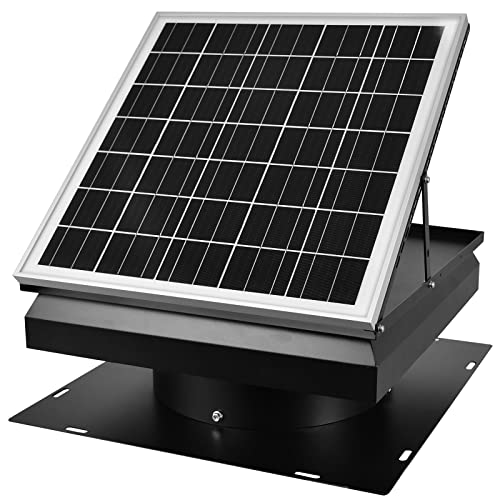
DC HOUSE’s 32W solar attic fan is designed for off-grid operation with a weatherproof aluminum housing and a maximum 1600 CFM airflow. It’s engineered to reduce attic temperatures and ease the load on air conditioning. The system activates automatically at sunrise and deactivates at dusk, with the option to pair with existing vents for enhanced whole-house ventilation. The unit is built to withstand extreme temperatures and high wind conditions, making it suitable for rooftops, garages, and greenhouses.
With strong airflow and durable construction, this model targets larger spaces and provides reliable solar-powered cooling during sunny days while remaining shielded against the elements.
ecoCalm 12″ Solar Exhaust Fan

ecoCalm’s 12″ solar exhaust fan pairs a 5000mAh battery with two 30W bifacial solar panels for enhanced daytime charging. The intelligent temperature control allows automatic on/off based on ambient temperature, and the included battery supports operation during night hours. This setup is designed to improve airflow in greenhouses, attics, garages, or sheds while leveraging dual-sided solar panels to maximize energy capture. The kit emphasizes energy efficiency and extended runtime in varying weather conditions.
The dual-panel approach helps maintain steady performance, particularly in sunny climates, and offers flexibility for mid- to large-sized spaces needing reliable ventilation.
Buying Guide: Key Purchase Considerations
What to evaluate when choosing a solar powered exhaust fan includes airflow needs, space size, noise tolerance, and installation flexibility. Consider the following factors to compare options objectively:
- Airflow capacity (CFM): Match the fan’s CFM to the size and heat load of the space. Larger spaces or hot climates benefit from higher CFM ratings.
- Power source and storage: Look for built-in batteries or battery backup, plus whether the unit can operate with or without sunlight via a power adapter.
- Noise level: For living areas or busy spaces, prioritize models with lower decibel ratings (ideally <50 dBA).
- Durability and weather resistance: Outdoors and roof installations demand rugged housings, rust resistance, and IP ratings to withstand wind and temperature extremes.
- Installation flexibility: Assess panel orientation (mono vs bifacial), cable lengths, mounting brackets, and whether the kit supports multiple fans or airflow directions (intake/exhaust).
- Safety features: Anti-backflow valves, automatic louver closures, and secure wiring reduce dust ingress and wildlife intrusion when the fan is off.
- Maintenance: Brushless motors typically offer longer life and lower maintenance than brushed designs; check for serviceable components and warranty terms.
- Cost of ownership: Evaluate total cost including panels, battery capacity, adapters, and potential weatherproofing needs for year-round operation.
Choosing between a pure solar system and a hybrid model (solar plus AC adapter) depends on how consistently you need airflow. For hot sunny climates, a solar-forward unit with a battery backup provides most reliable daytime cooling and continued operation at night or on cloudy days. For spaces requiring constant ventilation, a kit with an efficient motor, robust housing, and flexible installation will offer the best long-term value.