Looking for a solar powered exhaust fan with a built-in thermostat? This guide surfaces five top picks designed for poultry houses, greenhouses, sheds, and small workshops. Each option uses solar power to run a fan and includes a thermostat or temperature control to automate operation. This helps maintain comfortable temperatures while saving energy. The selections emphasize clear, practical benefits: best for chickens, best for greenhouses, best for sheds, and best for small outdoor spaces. A quick buyer’s table follows to compare core specs at a glance.
| Product | Best For | Key Benefit | Approx. Power |
|---|---|---|---|
| ecoCalm Solar Exhaust Fan for Greenhouse with Battery and Adjustable Thermostat (2x25W Panels) | Greenhouse growers | High airflow with dual 25W panels and thermostat control | 2x25W panels |
| ecoCalm Solar Fan with Battery and Adjustable Thermostat (8″) | Sheds and outdoor spaces | 8″ diameter with bifacial panel and smart temp control | 16W bifacial panel |
| ecoCalm 12″ Solar Exhaust Fan for Greenhouse with Battery (2x30W Panels) | Large greenhouses | Larger 12″ fan with two 30W bifacial panels | 2x30W panels |
| ecoCalm Solar Powered Fan with Battery and Adjustable Thermostat (6″) | Chicken coops | Compact 6″ fan with reliable battery and backflow valve | 8W panel |
| Lewisa 10W Solar Powered Fan with Timer & Temp Control | Small barns and pet areas | Dual fan system with digital temp sensor and timer | 10W panel |
ecoCalm Solar Exhaust Fan for Greenhouse with Battery and Adjustable Thermostat

Best for greenhouse environments requiring robust airflow and automated operation. This model uses a bifacial 25W solar setup in a dual-panel configuration, providing power to a high-capacity exhaust system and charging the internal battery. The integrated thermostat lets you set the ambient temperature at which the fan activates or deactivates, delivering hands-off climate control. The product is most advantageous in sunny climates with daytime operation and occasional night-time ventilation via stored battery power. A potential limitation is reduced efficiency on cloudy days, when solar input drops.
- Solar Air Conditioner with Battery: 4400mAh battery supports up to 10 hours of operation in sunlight and can run through the night or on cloudy days with smart mode switching.
- Adjustable Temperature Control: Built-in battery box temperature control auto-switches based on set preferences.
- Bifacial Solar Panel: 2x25W panels augment energy capture, though performance depends on sun exposure.
ecoCalm Solar Fan with Battery and Adjustable Thermostat (8″)
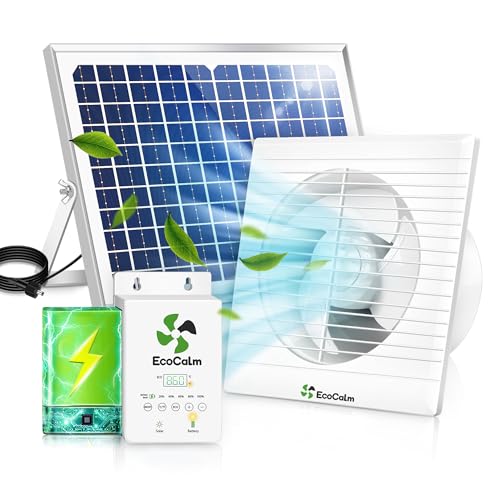
Designed for sheds, greenhouses, and outdoor spaces, this 8″ solar fan emphasizes a bifacial panel with a powered battery for nighttime use. The thermostat system allows auto on/off according to ambient temperature, reducing energy waste. Best for: moderate-to-large spaces that require steady airflow during daylight and supplemental nighttime ventilation. Caution: performance may vary with cloud cover, and the 16W panel capacity may limit peak airflow in very hot, sunny days.
- Solar Air Conditioner with Battery: 4400mAh battery supports up to 8 hours after full charge in sunlight.
- Adjustable Temperature Control: Auto on/off based on user-set temperature.
- Bifacial Panel: 16W front/rear panel increases power capture; cloudy conditions reduce efficiency.
ecoCalm 12″ Solar Exhaust Fan for Greenhouse with Battery

Best for larger greenhouses and garage spaces requiring higher airflow. The 12″ exhaust fan combines a 5000mAh battery with two 30W bifacial panels to deliver sustained ventilation during daylight and after sunset. The thermostat feature enables automatic operation to maintain target temperatures. A potential limitation is the heavier setup that may require sturdier mounting hardware for secure installation.
- Solar Air Conditioner with Battery: 5000mAh battery; about 6 hours of operation after full sun.
- Adjustable Temperature Control: Auto switch based on ambient conditions.
- 2x30W Bifacial Panels: Higher energy capture, but cloudiness reduces overall performance.
ecoCalm Solar Powered Fan with Battery and Adjustable Thermostat (6″)
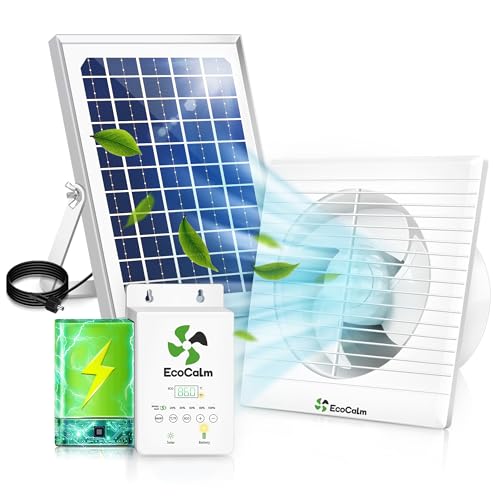
Best for chicken coops and compact spaces where a smaller solar fan is sufficient. The 6″ model uses a bifacial 8W panel and a 4400mAh battery, delivering up to 8 hours of operation in sun and automatic control via a temperature sensor. This option is ideal when space is limited but airflow needs are steady. Limitation: lower panel wattage may limit peak performance on hot, sunny days compared to larger units.
- Solar Air Conditioner with Battery: 4400mAh battery, up to 8 hours in sunlight.
- Adjustable Temperature Control: Auto on/off by temperature setpoint.
- Bifacial Panel: 8W rear panel captures additional light; performance depends on sun exposure.
Lewisa 10W Solar Powered Fan with Timer & Temperature Control

Ideal for small barns, clinics, pet houses, and other compact spaces. Lewisa adds a dual-fan system with a temperature sensor and timer, delivering two modes: time-based or temperature-triggered operation. The 10W solar panel powers the system, and a 4400mAh battery provides nighttime or low-light performance. Best for: spaces where precise, programmable ventilation is needed. Caution: the dual-fan setup may require careful installation to optimize intake vs. exhaust balance.
- Dual Fan System: Exhaust and intake for balanced airflow.
- Smart Controls: Temperature sensor and timer manage operation precisely.
- 10W Solar Panel: Sufficient for small to mid-sized spaces; battery aids night operation.
Buying Guide: Key Considerations For Solar Exhaust Fans With Thermostats
What space will you ventilate? For greenhouses, larger 12″ or dual-panel systems deliver stronger airflow. For chicken coops and sheds, compact 6″ to 8″ models balance space and power. Consider panel size and battery capacity to ensure daytime operation translates into reliable nighttime ventilation.
- Thermostat vs. timer: Thermostats auto-start based on temperature; timers run on a fixed schedule. Choose based on how actively you want temperature-based control to shape airflow.
- Panel type: Bifacial panels capture light from both sides, increasing energy yield but performance depends on sun exposure and orientation.
- Battery capacity: Higher mAh extends night-time operation, crucial for cloudy or shorter daylight periods.
- Installation space: Larger fans demand sturdy mounting and appropriate ducting or exhaust routes; ensure mounting location supports airflow direction (exhaust vs intake).
- Weather considerations: Outdoor exposure, humidity, and heat can influence battery life and electronics—look for IP ratings and weatherproofing.
FAQs
- Do solar powered exhaust fans require direct sunlight to run?
- Is a bifacial solar panel always better?
- Can these fans be used indoors without sunlight?
- What space benefits most from a thermostat-controlled fan?
- Are these fans easy to install for a DIY homeowner?
- How do I choose between multiple models?
Yes, but most models store energy in a built-in battery to run during night or cloudy periods.
Generally, bifacial panels harvest light from both sides, which can improve energy capture in bright conditions, but effectiveness depends on installation and sun exposure.
They can, if the battery has charge; otherwise, they rely on solar power and may not operate reliably without daylight.
Spaces with variable temperatures, like greenhouses or chicken coops, benefit from automatic adjustments to maintain steady conditions.
Most kits are designed for simple mounting, but heavier models or larger panels may require additional hardware and basic electrical precautions.
Match airflow (CFM), panel wattage, and battery capacity to your space size, typical climate, and desired day/night operation.