Answering the question “which solar kit fits a home grid system,” this guide highlights five top off-grid and grid-compatible kits. These selections suit homeowners seeking scalable power, easier maintenance, and reliable backup. The best picks include high-capacity home systems for whole-house support, as well as compact kits ideal for cabins, sheds, or RV use. The buyer types most served include: homeowners planning a full off-grid install, property owners seeking a robust backup, and enthusiasts needing scalable options for future expansion.
| Product | Best For | Key Benefit |
|---|---|---|
| ECO-WORTHY 10KW Output Complete Off-Grid Solar System Kit | Homeowners with high power demand | High continuous output and parallel scalability |
| ECO-WORTHY 10KW 120V/240V System with 16.1kWh Storage | Complete whole-house support | Large storage and dual-phase output |
| ECO-WORTHY 5KW Off Grid Solar System Kit | Smaller homes or cabins | Compact, easy-to-install, scalable |
| Renogy 400W Premium 12V Kit | DIY enthusiasts and versatile setups | Efficient MPPT controller and easy setup |
| ECO-WORTHY 200W RV Complete Solar Kit | RV, small off-grid needs | Compact, user-friendly for off-grid travel |
ECO-WORTHY 10KW Output Off-Grid Kit

The system delivers a nominal 9.36 KWh daily output under four hours of full sun, using 12 panels totaling 2340W. Best for home, shed, cabin, or farm energy backup, it powers typical 240V AC appliances such as AC units, refrigerators, and microwaves. This kit supports parallel expansion up to six units for higher total capacity, making it ideal for expanding home energy resilience. The inverter operates at 120V/240V AC output and includes a WiFi module for monitoring. Caution: parallel expansion requires proper electrical planning and adherence to local codes.
Best for: homes needing substantial daytime generation with potential for future scaling. Better for: users planning to run multiple high-draw devices simultaneously. Choose this if: you want a high-capacity, scalable off-grid solution with remote monitoring and safety certifications.
Product-specific features include:
- Real-time battery monitoring via mobile app with Bluetooth/WiFi
- UL 1741 certified inverter and UL 1973/UL 9540A battery standards
- CAN/RS485 communication for battery status
ECO-WORTHY 10KW Home-Scale Grid-Ready Kit

This kit provides up to 10 kW of power with a 2950W PV array and a 16.1 kWh LiFePO4 battery. It includes a 48V, 314Ah battery system offering substantial energy storage and supports up to 15 units in parallel for larger scale needs. The 7-inch display with Bluetooth and Wi-Fi connectivity enables convenient monitoring, and the system is designed for straightforward setup alongside conventional inverters. Best for: households seeking significant on-site generation with scalable storage. Caution: the higher capacity requires careful installation and professional guidance in some jurisdictions.
Best for: larger homes or multi-zone properties needing robust daily generation and storage. Better for: users who want scalable battery capacity and a comprehensive monitoring interface. Choose this if: you anticipate expanding beyond 10 kW and require user-friendly remote management.
Notable features include:
- 15-way parallel capability for high total output
- Integrated 7-inch display and remote monitoring
- Compatibility with mainstream inverters and multiple battery chemistries
ECO-WORTHY 5KW Off Grid Complete Kit

This 5 kW all-in-one kit includes 12 × 195W N-Type bifacial panels (total 2340W), a 48V 100Ah LiFePO4 battery, and a 5KW split-phase inverter. It uses series-connected panels for straightforward wiring and a series-connected battery bank for high capacity. It aims to simplify installation while delivering reliable off-grid power for homes or small cabins. Caution: the 100Ah battery delivers a finite storage, so longer outages demand larger capacity or additional modules.
Best for: small-to-medium off-grid homes or cabins needing a compact, simpler system. Better for: DIY installers who want fewer wiring complexities. Choose this if: you prefer an easy, all-in-one setup with straightforward parallel options for expansion.
Key details include:
- Single 120V/240V output with parallel expansion potential
- UL-listed components for safety and compliance
- Integrated wiring and electrical robustness for simple deployment
Renogy 400W Premium 12V Grid Kit

This kit bundles 4 × 100W panels and a 40A MPPT controller, offering a daily output of 2–2.5 kWh depending on sunlight. It emphasizes efficiency with MPPT tracking and a higher conversion rate compared to PWM systems. The panels feature a sturdy low-iron glass and robust framing for wind and snow loads, with pre-drilled holes and included mounting hardware for straightforward installation. Caution: performance depends on panel orientation and shading; avoid long shadows on panels.
Best for: DIY installers seeking a reliable, scalable grid-capable kit with strong warranty coverage. Better for: homes where space allows for a multi-panel array with efficient MPPT control. Choose this if: you want a reliable, expandable 12V system with advanced monitoring potential.
Highlights include:
- 10-year panel warranty and 3-year MPPT controller warranty
- 99% MPPT tracking efficiency and 98% peak conversion efficiency
- Temperature sensor for battery protection and efficiency
ECO-WORTHY 200W RV Complete Solar Kit
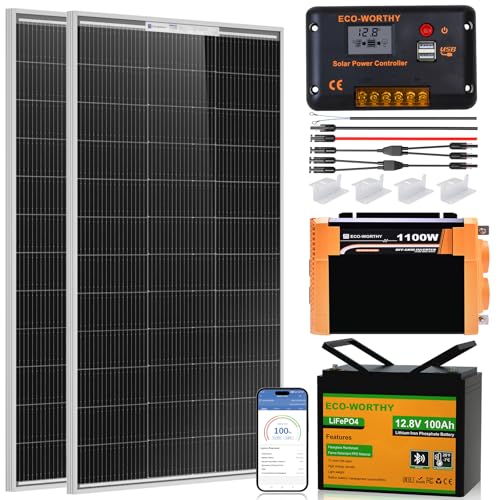
This compact kit includes 2 × 100W panels, a 1100W inverter, a 100Ah Li battery, and a 30A PWM controller. It is designed for RV use and off-grid travel, offering a simple four-step installation process and compatibility with mains charging. It powers typical RV appliances, including fridges, microwaves, and air conditioners, during trips away from the grid. Caution: its smaller capacity may require battery management during longer outages or higher-load scenarios.
Best for: RV owners needing portable, easy-to-setup solar power. Better for: short trips or smaller load profiles where space is limited. Choose this if: you want a user-friendly starter kit with essential components for on-the-road energy independence.
Buying Guide: Key Purchase Considerations
- System size and intended use: For whole-home backup, prioritize higher kW capacity and substantial battery storage. For RV or cabin use, smaller systems with portable components can suffice.
- Battery chemistry and capacity: Lithium-based storage (LiFePO4) tends to offer longer life and safer operation than lead-acid. Consider daily energy needs and desired autonomy.
- Inverter type and output: Split-phase 120V/240V inverters support more household appliances; ensure the system supports your local electrical codes and needs.
- Expandability: If future growth is likely, choose systems with parallel capacity and modular batteries to scale without replacing core components.
- Monitoring and connectivity: WiFi/Bluetooth monitoring helps track performance and battery health, aiding maintenance and optimization.
- Certifications and safety: Look for UL certifications and compliance with regional energy standards to ensure reliability and legal operation.
- Installation considerations: Some kits are all-in-one and beginner-friendly; others require professional wiring or local permitting for larger installations.
Frequently Asked Questions
- What is the difference between off-grid and grid-tied solar systems?
Off-grid systems operate independently from the utility grid and require battery storage, while grid-tied systems connect to the grid and often use net metering for power credits. - Can these kits be expanded later?
Yes, many kits support parallel connections or modular battery additions, but expansion depends on inverter and battery compatibility and local regulations. - Which kit is best for a full-home backup?
High-capacity systems with significant storage (such as the 10 kW class kits) are better suited for whole-house reliability and longer outages. - Is lithium storage safer than lead-acid?
Lithium LiFePO4 offers longer life, lighter weight, and better thermal stability, benefiting long-term performance and safety when paired with proper protection circuitry. - Do I need professional installation for these systems?
For larger, grid-connected or code-compliant installations, professional installation is advised to ensure safety and compliance with local codes. - Can these systems operate during a power outage?
Some off-grid kits provide continuous power during outages; grid-tied systems typically disconnect during outages for safety unless they include specific islanding capabilities.