Answering buyers’ needs: these solar fence chargers provide reliable remote livestock containment and predator deterrence, with varying ranges and energy outputs. They’re best for ranchers managing larger pastures, smallholders protecting poultry, and property owners seeking off-grid fencing solutions. The following selections balance power, duration, and ease of installation to help you compare quickly.
| Product | Coverage | Best For |
|---|---|---|
| 24 Hour Solar Electric Fence Charger (Epoify) | Up to 10 miles | Medium pastures with livestock and predator protection |
| FarmNix 30 Miles Solar Electric Fence Charger | Up to 30 miles | Large farms and multi-zone fencing |
| Solar Electric Fence Charger 1.2J Stored Energy (Epoify LD12) | Up to 45 miles | Large pastures and long fence lines with durable power |
| ANDMON MINI400 30 Miles Solar Charger | Up to 30 miles | Day/night mode, versatile installation |
| Zareba Solar Electric Fence Charger | Up to 5 miles | Remote locations with quick setup |
24 Hour Solar Electric Fence Charger (Epoify)
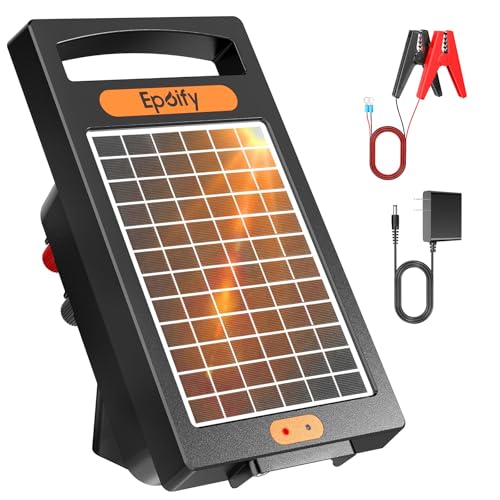
The 24 Hour Solar Electric Fence Charger delivers a consistent 0.18 Joule pulse suitable for cattle, goats, and poultry, with deterrence for raccoons and other predators. It covers up to 10 miles of pasture fencing and operates continuously by charging a built-in battery during the day for overnight performance. This model is best for medium-sized properties where dependable day-night operation is critical. Caution: ensure proper grounding and vegetation management to maximize pulse effectiveness.
10 Miles Solar Electric Fence Charger (ANDMON)
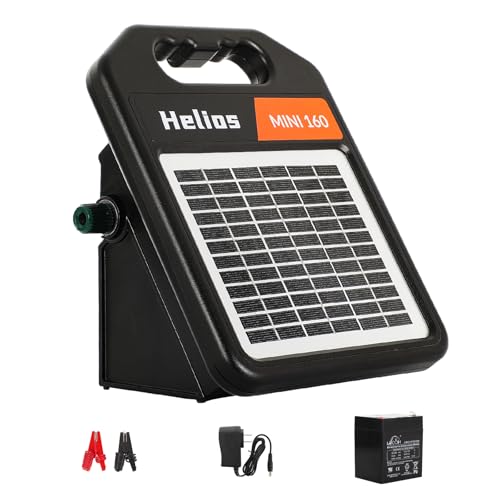
This portable charger powers up to 10 miles and emphasizes reliability in strip-grazing scenarios. It features built-in solar panels and a GEL battery, designed to remain operational in low-light conditions. Best for mobile fencing setups or temporary installations where quick deployment matters. Choose this if you need a lightweight, transportable unit for rotating paddocks; avoid if you require very long-term power for multi-zone fencing without frequent repositioning.
FarmNix 30 Miles Solar Electric Fence Charger
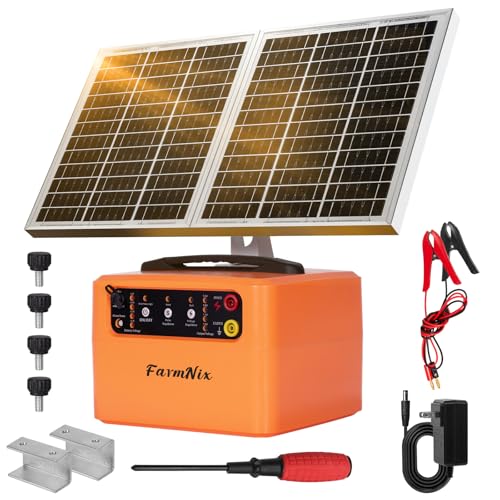
FarmNix offers adjustable output power (6KV/8KV/10KV/12KV) with 0.3/0.8/1.1/1.5 joule energy outputs, designed to protect fences up to 30 miles. It supports day and night mode for 24-hour protection and relies on a 15W solar panel with a 12V sealed lead-acid battery. This unit is best for large pastures or multi-zone fencing where high energy pulses are needed to deter predators and prevent breaches. Limitation: performance depends on sun exposure and ground conditions.
Solar Electric Fence Charger 1.2J Stored Energy (Epoify LD12)

This ranch-grade unit delivers 1.2 joules of stored energy with a 7–11kV pulse, suitable for large fences and substantial livestock. It includes an upgraded 8W solar panel and a large battery to sustain pulses during cloudy periods and at night, supporting up to 45 miles of fencing under optimal conditions. Best for large ranches or farms with long boundary lines; better for those who require robust, long-lasting power even in challenging weather. Caution: installation quality and grounding are critical for maximum effectiveness.
ANDMON MINI400 30 Miles Solar Charger
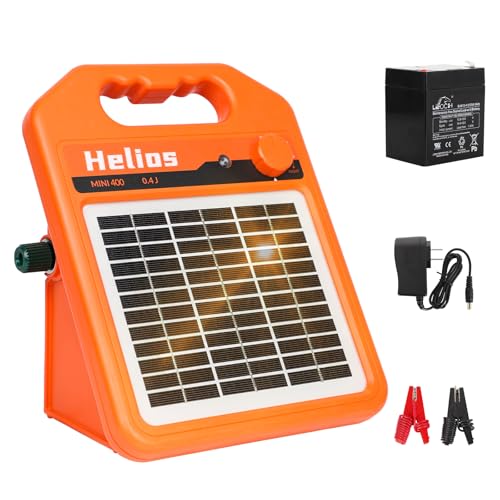
The ANDMON MINI400 delivers up to 0.4 joule output to power on 30 miles of fence, featuring Day/Night mode for energy efficiency. It can operate with solar power and a DC charger, offering installation flexibility in various environments. Best for medium-to-large properties where energy efficiency and dual-power options are advantageous. Limitation: slightly lower pulse energy compared to higher-joule units may be less effective against very determined predators.
Epoify LD03 Solar Fence Charger 1.0J

The LD03 provides a stable 1.0 joule output with 8–12kV pulses and an upgraded 8W solar panel for extended runtime, claiming coverage up to 45 miles. It is well-suited for rotational grazing, long fences, and multi-wire setups. Best for farms needing reliable performance across large perimeters; caution: efficiency depends on sun exposure and correct installation to prevent voltage leaks.
Zareba Solar Electric Fence Charger

The Zareba model energizes up to 5 miles with a built-in mounting bracket that supports T-posts, Y-posts, and round-wood posts, and offers 360-degree rotation to maximize sun exposure. It stores energy for roughly two weeks without sunlight, making it suitable for remote locations with intermittent sun. Best for small to mid-sized operations needing straightforward installation; limitation: shorter range compared to larger units.
Buying Guide
- What fence length and livestock type will you protect? Choose higher joule outputs for larger animals or longer fences.
- How often are you in sun? Prioritize models with larger solar panels and battery capacity for cloudy climates.
- Do you need portability? Consider compact, lightweight units for strip-grazing or temporary setups.
- What installation conditions exist? Look for weatherproof housings and versatile mounting options for posts and varied terrains.
- Grounding and vegetation control impact performance. Plan routine maintenance to preserve pulse strength.
FAQ
- Q: Do solar fence chargers work in cloudy weather?
A: Yes, but performance depends on battery capacity and solar panel size; larger panels help maintain pulses longer. - Q: How many miles of fence can one charger handle?
A: Ranges vary from about 5 to 45 miles depending on joule output, terrain, and wire configuration. - Q: What maintenance is required?
A: Inspect grounding, clean panels, and check connections regularly; replace batteries as needed. - Q: Is higher joule always better?
A: Not always; choose joule output appropriate to livestock type, fence length, and predator risk. - Q: Can these units charge multiple fence lines?
A: Yes, many models are designed for multi-wire or multi-zone fencing when configured properly.