If you need a solar charge controller that can work with generator input, these MPPT models support high input voltages and versatile battery chemistries, making them ideal for off-grid setups, RVs, and mobile power stations. This guide highlights five strong options, outlining who each is best for and why. The top picks emphasize wide voltage ranges, high efficiency, and robust protection to pair with generator-assisted solar systems.
| Product | Best For | Key Benefit |
|---|---|---|
| POWLAND 120A MPPT Solar Charge Controller | Large off-grid systems, multi-battery setups | Ultra-wide auto-sensing (12V–96V) and 120A capacity |
| EcoSolLi 120A MPPT Solar Charge Controller | High-capacity solar arrays | High MPPT efficiency up to 98% |
| Renogy Rover Lite 60A MPPT | Home, RV, small workshop | 150V input, reliable temperature performance |
| Renogy Rover 40A MPPT | Budget off-grid systems | Auto 12V/24V detection with lithium compatibility |
| Victron SmartSolar MPPT | Integrated, synchronized systems | Bluetooth-enabled, synchronized charging |
POWLAND 120A MPPT Solar Charge Controller

This 120A MPPT controller adapts to 12V–96V systems with automatic voltage sensing and a high 230V PV input threshold. It includes a 3-stage charging profile suitable for LiFePO4, AGM, GEL, and flooded lead-acid batteries. Best for large off-grid installations where multiple battery types are used and precise MPPT control is desired.
- Best for large RVs, off-grid homes, and mobile power stations.
- Better for systems needing automatic voltage detection across a wide range.
- Avoid if you require a very compact 12V-only solution.
EcoSolLi 120A MPPT Solar Charge Controller
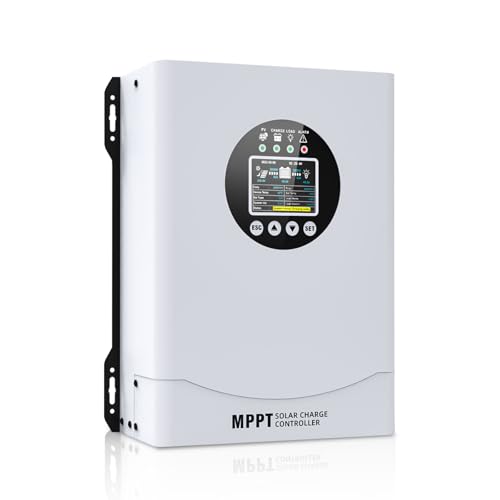
This 120A controller supports up to 96V inputs with excellent MPPT efficiency—no less than 99% tracking and up to 98% peak conversion. It features multiple protections (PV overcurrent, battery protection, load protection, temperature, and lithium activation). Best for high-capacity panels feeding diverse battery banks in offline settings.
- Best for maximizing energy harvest in large arrays.
- Better for lithium and hybrid battery configurations.
- Limitations: data emphasizes protection features; ensure compatibility with your exact battery chemistries.
Renogy Rover Lite 60A MPPT

Rover Lite 60A provides a robust 150V maximum solar input, enabling multiple panels in series for simplified wiring. It offers full 12V–48V support, good low-temperature protection, and self-cooling design. Best for larger home or RV installations where fewer strings simplify setup and expansion is anticipated.
- Best for setups needing higher input capacity and fewer cables.
- Better for cold environments due to built-in low-temperature protection.
- Limitations: may be more than needed for small cabins or single-panel systems.
Renogy Rover 40A MPPT

The 40A Rover controller handles 12V/24V systems with 4-stage charging and compatibility with gel, sealed, flooded, and lithium batteries. It includes protection against reverse polarity and overload. Best for budget-conscious buyers who still need reliable MPPT control for RVs or small off-grid cabins.
- Best for budget-friendly off-grid setups.
- Better for standard 12V/24V systems with mixed battery types.
- Limitation: lower amperage limits expansion of very large arrays.
Victron Energy SmartSolar MPPT

Victron SmartSolar MPPT controllers feature Bluetooth-enabled monitoring and synchronization across multiple controllers, optimizing system-wide charging. They prioritize battery health with advanced algorithms and are designed for professional-grade off-grid systems. Best for users who value integration, remote monitoring, and scalable architectures.
- Best for synchronized, multi-controller systems.
- Better for users who want Bluetooth monitoring and app access.
- Limitation: may involve a higher upfront cost and more setup complexity.
Buying Guide
What should you consider when choosing a solar charge controller with generator input?
- Voltage range and compatibility: Ensure the controller supports your system voltage (12V, 24V, 48V, up to 96V) and battery chemistry (LiFePO4, AGM, GEL, flooded). Wide auto-sensing helps with mixed setups.
- Current rating and system size: Match the controller’s amp rating to your solar array and battery bank size. Higher-end models handle larger arrays with robust protection.
- MPPT efficiency: Look for peak conversion efficiency around 98% and real-world tracking efficiency near 99%. This impacts charging speed and energy harvested, especially in generator-assisted scenarios.
- Protection features: Prioritize reverse polarity, overcurrent, over-temperature, short-circuit, and low-temperature protections to safeguard batteries and equipment.
- Generator integration: Check for wide PV input ranges and compatibility with generator-powered systems. Some controllers are designed for high input voltage or have smart synchronization features when linked with other controllers or in hybrid setups.
- Monitoring and connectivity: Bluetooth, LCD display, app integration, and data logging help with maintenance and optimization for longer battery life.
Frequently Asked Questions
- What is an MPPT solar charge controller?
A: An MPPT controller optimizes solar energy conversion by tracking the maximum power point of the solar array and adjusting charging accordingly. - Can I use a solar charge controller with a generator?
A: Yes. Look for models with wide input voltage ranges and protections that accommodate generator-powered charging scenarios. - Do I need to match battery chemistry exactly?
A: It’s best to choose a controller compatible with your battery type (Lithium, AGM, GEL, flooded). Some controllers offer flexible charging profiles for multiple chemistries. - Is Bluetooth monitoring necessary?
A: Not mandatory, but it helps for remote monitoring, system diagnostics, and optimization in larger setups. - What does “auto-detection” voltage mean?
A: The controller automatically identifies whether the system is 12V, 24V, 48V, or higher, simplifying installation for mixed or expandable systems. - Why choose a high-input-capacity controller?
A: It reduces wiring complexity and enables more panels in series, which can lower installation costs in larger off-grid projects.