Yes—these solar cell charge controllers optimize how your panels charge batteries, protecting battery life while maximizing energy capture. This guide highlights five top options, explaining who each is best for and why it was selected. Ideal buyers include RV/boat owners needing compact PWM control, off-grid enthusiasts seeking MPPT efficiency, and anyone balancing lithium, AGM, Gel, or Flooded batteries. The summary table below compares key strengths to help you decide quickly.
| Product | Best For | Key Benefit |
|---|---|---|
| Renogy Wanderer 10A | Smaller RVs and marine setups | Advanced four-stage PWM with LCD |
| Rolokit 30A PWM | Home and light industrial systems | Auto-adapts to 12V/24V with USB charging |
| ELUSH 100A MPPT | Larger off-grid systems | High-efficiency MPPT with versatile voltage support |
| AeternaSol 20A PWM | Starter 12V systems and USB charging | Balanced features with PD/QC USB-PD output |
| Victron SmartSolar MPPT | Professional-grade, scalable setups | Bluetooth-enabled, synchronized charging |
Renogy Wanderer 10A PWM Charge Controller
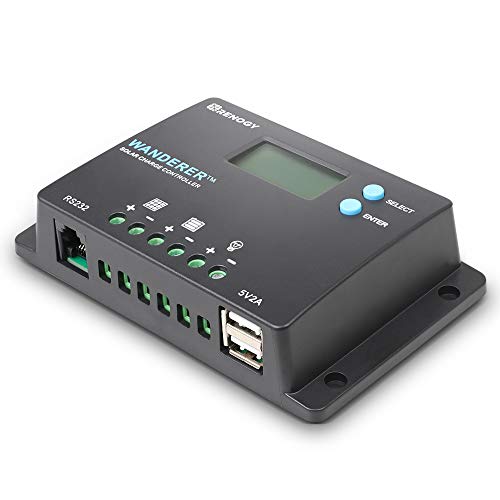
The Renogy Wanderer 10A PWM Charge Controller uses a 4-stage charging cycle (Bulk/Boost/Float/Equalization) to optimize AGM, Gel, Flooded, and Lithium batteries. It features a compact, negative-ground design and an LCD display for real-time monitoring. This model is best for small RVs, boats, or off-grid setups with limited space and modest power needs. It emphasizes battery life extension and safety through overcharge and reverse-protection.
Best for: RV and marine applications with tight installation spaces where low idle drain matters. Why chosen: its balance of protective features, LCD visibility, and versatile battery compatibility makes it a solid, entry-to-mid-level PWM option. Limitation: not suitable for certain high-capacity or lithium-only systems where MPPT could offer more efficiency.
Key specs and notes:
- 4-stage charging with LCD error codes
- Negative ground design for certain vehicle systems
- Compact dimensions (fits in standard control panels)
Rolokit 30A PWM Solar Charge Controller

This 30A PWM controller supports 12V/24V systems automatically and includes dual USB outputs for charging devices. It’s suitable for lead-acid batteries (OPEN, AGM, GEL) and provides easy LCD monitoring with adjustable settings for float and low-voltage disconnect. A caution: not compatible with lithium batteries, so match battery chemistry to the controller’s intended use.
Best for: Home, industrial, or commercial installations that require straightforward PWM control and USB device charging. Why chosen: its automatic voltage adaptation and USB ports add convenience for mixed-use environments. Limitation: exclusion of lithium battery compatibility may require a separate controller for Li-type packs.
What to consider when choosing:
- Battery type compatibility
- Voltage (12V vs 24V) and system size
- Need for device charging via USB
ELUSH 100A MPPT Solar Charge Controller

This 100A MPPT controller supports 12V/24V/36V/48V systems with dual USB ports and a backlit LCD. It uses MPPT tracking to maximize efficiency, reporting a tracking efficiency of at least 99.5%. Seven operating modes include timing and universal control, making it suited for larger off-grid setups and systems requiring precise control and monitoring. A caution: ensure compatibility with your battery chemistry, especially with Lithium options.
Best for: Larger off-grid or vehicle-based power systems needing high efficiency and advanced control. Why chosen: MPPT capability provides higher energy harvest in varied conditions, and the LCD with multiple modes supports flexible operation. Limitation: higher upfront cost and more complex configuration compared to PWM controllers.
Key considerations:
- Voltage and current rating for system scale
- MPPT tracking efficiency claims and real-world performance
- Battery chemistry support and safety protections
AeternaSol PWM Solar Charge Controller 20A
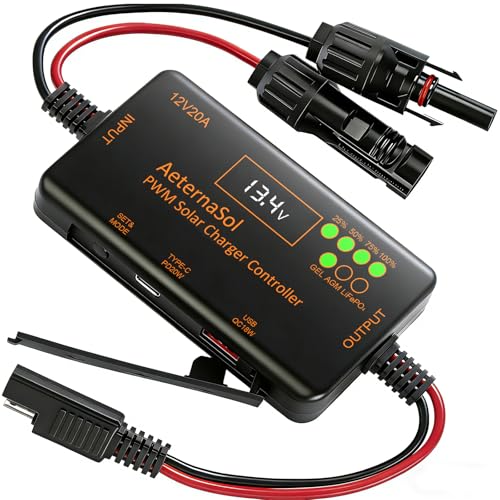
This PWM controller is designed for 12V systems and supports lead-acid chemistries (open, sealed, colloid). It features an LCD display, adjustable charging modes, and a USB-C/USB-A output for charging devices. The description notes no lithium compatibility, so this is best for standard lead-acid setups where simple, reliable control is sufficient. It’s a practical pick for entry-level off-grid or backup power projects. A caution: verify your battery type to ensure safe operation.
Best for: Beginners or budget setups with 12V lead-acid batteries and a need for USB device charging. Why chosen: straightforward operation, clear LCD readouts, and controllable charging parameters. Limitation: not suitable for lithium or high-volt multi-battery configurations.
Key features to weigh:
- Automatic 12V/24V adaptation with simple press-and-go setup
- Dual USB outputs for charging while stored power is available
- Single-battery-type limitation may restrict future upgrades
Victron Energy SmartSolar MPPT Charge Controller

The Victron SmartSolar MPPT controller uses advanced MPPT algorithms to maximize power output and extend battery life. It supports synchronized charging across multiple SmartSolar units, enabling system-wide energy optimization. Bluetooth connectivity provides convenient monitoring and configuration tweaks via mobile devices. This option is well-suited for professional setups requiring scalable, efficient solar management and remote oversight.
Best for: Professional, scalable solar installations with multiple controllers and remote monitoring. Why chosen: Bluetooth-enabled monitoring and synchronization across devices improve energy management in complex systems. Limitation: premium price and setup complexity compared to entry-level PWM units.
Buying Guide
How to choose the right solar charge controller?
- Battery chemistry compatibility: Ensure the controller supports your battery type (lead-acid, AGM, Gel, Flooded, Lithium).
- System voltage and current: Match 12V/24V and the amperage to your solar array and battery bank size.
- PWM vs MPPT: MPPT offers higher efficiency, especially in lower light or larger systems, but PWM is simpler and cheaper for smaller setups.
- Monitoring and connectivity: LCD displays are helpful; Bluetooth or mobile apps improve system oversight for larger installations.
- Protection features: Overcharge, over-discharge, reverse polarity, and short-circuit protections reduce battery wear and risk.
FAQ
- What is the difference between PWM and MPPT controllers? PWM controllers are simpler and cheaper, ideal for small systems. MPPT controllers optimize energy transfer, increasing efficiency, especially with larger arrays or when panel voltage is higher than battery voltage.
- Can I mix battery types in one system? Most controllers support specific chemistries. Verify compatibility for each battery type in your bank before mixing.
- Do I need a remote monitor? Remote monitoring is beneficial for larger systems to track voltage, current, and charging states across multiple controllers.
- Are USB ports on controllers safe for charging devices? USB outputs are intended for charging accessories and small devices; ensure they do not draw more current than the controller can safely supply.
- Is lithium compatibility essential? For lithium batteries, use a controller explicitly rated for LiFePO4 or other lithium chemistries with appropriate protections and settings.
- Which controller should I choose for a boat? For compact, low-maintenance setups, PWM may suffice; for larger or harsher environments, MPPT offers better efficiency and system flexiblity.