When choosing a small, quiet propane generator, you want dependable power that won’t wake the neighbors. This guide highlights five compact, low-noise options ideal for home backup, camping, and RV use. The list balances dual-fuel flexibility, clean power, and portability, so you can pick the right generator for your needs. The following table summarizes key details to help you compare at a glance.
| Product | Fuel | Peak Watts | Run Time (Gas/Propane) | Best For |
|---|---|---|---|---|
| PowerSmart 3800 Watt Dual Fuel | Gas/Propane | 3800 | up to 10h (Gas) / up to 25h (Propane) | Home backup and quiet camping |
| WEN 2800-Watt Dual Fuel | Gas/Propane | 2800 | — | Lightweight, budget-friendly backup |
| POXURIO 2450-Watt Portable | Gas | 2450 | 8.3h | Super quiet, compact camping |
| WEN Quiet 4800-Watt Dual Fuel | Gas/Propane | 4800 | — | RV-ready, higher power |
| Westinghouse 2800 Peak Inverter | Gas/Propane | 2800 | Up to 12h | Home use and portability |
PowerSmart 3800 Watt Dual Fuel Inverter Generator
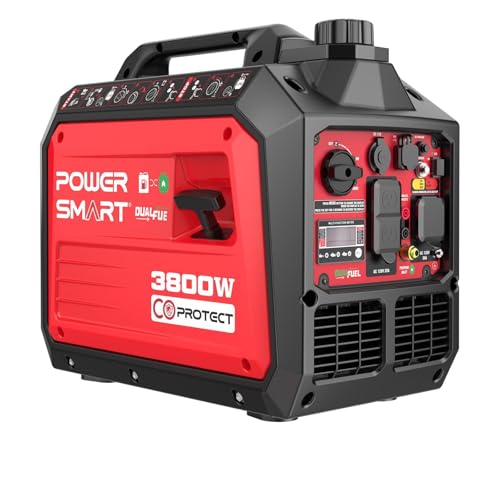
The PowerSmart generator offers dual-fuel versatility with 3800 starting watts and 3300 running watts on gasoline, and 3500 starting watts with 3100 running watts on propane. It delivers up to 10 hours on gas and up to 25 hours on propane, making it a flexible choice for longer outages or extended camping trips. Its inverter design provides cleaner power (less than 3% THD), making it safer for sensitive electronics like phones and CPAP machines. Noise is kept to a respectful level at 65 dBA at 23 feet, suitable for quiet campgrounds and residential settings. Best for homeowners who want a robust dual-fuel option without sacrificing electronics safety.
Who it’s best for: households needing reliable backup power and campers who want long propane runtimes. Why selected: strong dual-fuel performance, quiet operation for its class, and stable power for sensitive devices. Caution: as a 149cc engine, it’s heavier than ultra-light models, so consider operator effort and storage space.
WEN 2800-Watt Dual Fuel Inverter Generator

The WEN model delivers dual-fuel capability with 2800 surge watts and 2250 rated watts on gas, and 2800 surge watts with 2000 rated watts on propane. It focuses on clean power to protect electronics and includes the CO watchdog feature, which automatically shuts down the unit if carbon monoxide is detected. This makes it a practical option for small apartments, cabins, or camping where safety is a priority. Best for: budget-conscious buyers who still want dual-fuel flexibility and built-in CO safety. Caution: lower wattage means limited power for higher-draw appliances or tools.
POXURIO 2450-Watt Portable Inverter Generator

POXURIO emphasizes quiet operation with a claimed 59 decibels during operation, making it ideal for late-night camping and RV use. It runs on gasoline, offering 2450W of strong starting power and stable sine-wave output to protect electronics. This model suits casual campers and outdoor enthusiasts who prioritize quiet operation and portability. Best for: solo travelers or small groups needing reliable power without loud noise. Caution: propane capability is not listed, so gas-only use may limit fuel flexibility in some situations.
WEN Quiet and Lightweight 4800-Watt Dual Fuel

This WEN model offers a higher power output with 4800 surge watts and 4000 rated watts on both gasoline and propane. It is described as extremely quiet for its class, which is reinforced by its low-THD output for protecting electronics. It is RV-ready and includes both electric and recoil start options, plus CO watchdog safety. Best for: campers or small crews needing more power while still prioritizing quiet operation. Caution: higher wattage may result in heavier weight and larger footprint than super-compact options.
Westinghouse 2800 Peak Watt Dual Fuel Inverter

This Westinghouse unit weighs about 42.4 pounds and provides dual-fuel operation with 2800 peak watts and 2200 running watts on gas, plus up to 12 hours of runtime at 25% load. It features a 120V TT-30R outlet and additional 120V outlets, making it versatile for home or campsite use. It includes an economical mode to reduce fuel consumption and noise. Best for: users who want a portable, fuel-efficient backup with multiple outlets. Caution: lower continuous output means you should plan for smaller appliances or charge-sensitive devices accordingly.
Westinghouse 5000 Peak Watt Dual Fuel Inverter

The Westinghouse 5000 Peak model adds substantial power with 5000 peak watts and 3900 rated watts, dual-fuel capability, and RV-ready 30A outlet. It provides remote electric start and parallel capability for expanded power when needed, along with a CO sensor and low-oil monitoring for safety. Best for: larger RV setups, tailgating with higher power demands, or home backup where extended runtime is required. Caution: increased size and weight may reduce portability compared with lighter models.
Westinghouse 4000 Peak Watt Dual Fuel Inverter

The Westinghouse 4000 Peak Watt unit balances power and portability with 4000 peak watts on propane or gasoline and a 30A RV-ready outlet. It includes a remote start option and digital display for fuel level and run time. This generator suits campers who need solid power without compromising on quiet operation or compact design. Best for: weekend campers who want RV compatibility and easy starting. Caution: despite its quiet claim, higher loads will still generate noticeable noise compared with ultra-compact units.
Buying Guide
What size generator should I choose for home backup?
Determine the essential circuits you want to power (refrigerator, sump pump, lights, APPLIANCES) and sum their wattage. Dual-fuel options add flexibility if one fuel source becomes scarce or expensive. For average home backup with essential loads, 2800-4800 watts is a practical range.
Is a dual-fuel inverter generator worth it?
Yes, if you value fuel flexibility, better fuel economy, and cleaner power for electronics. Inverter technology reduces noise and THD, which helps protect devices like laptops and phones.
How important is noise level?
Important for neighborhood compatibility and campsite etiquette. Generators in the 50-65 dBA range at 23 feet are generally considered quiet. If you will use it near bedrooms or quiet campsites, prioritize lower dBA ratings and inverter designs.
What safety features matter?
Look for a CO safety shutoff, low-oil shutdown, and an automatic or remote start option. CO watchdog sensors add a layer of protection when used indoors or in enclosed spaces.
What maintenance considerations should I expect?
Check for easy access to oil changes, air filters, and spark plug replacements. Some models offer fuel shut-off features to purify the carburetor between uses, extending equipment life.
How do I compare runtimes fairly?
Runtimes vary by load. Compare at a standard load (e.g., 25% rated load) to get consistent estimates. Dual-fuel units typically run longer on propane due to higher energy density per unit, but load and tank size are decisive.
Who should consider these models?
Homeowners seeking reliable backup power, campers who want quiet operation, and RV owners needing a portable power source that can run essential appliances are good fits. Consider weight, size, and output in relation to your typical use case.
FAQ
- Q: Do these generators run on propane only?
- A: Several models support dual fuel (gas and propane). Check the product page for exact fuel compatibility and recommended use scenarios.
- Q: Are these generators safe to use indoors?
- A: They should never be used indoors or in enclosed spaces due to carbon monoxide risk. Look for outdoor use guidelines and CO sensors for outdoor setups.
- Q: Can I parallel two units for more power?
- A: Some models offer parallel capability, allowing you to pair units for higher output. Verify this feature for each model before purchase.
- Q: What does “inverter” mean for power quality?
- A: Inverter generators produce cleaner sine waves with low THD, protecting sensitive electronics from voltage fluctuations.