For users seeking clean, stable power from 12V systems to run household appliances, vehicles, RVs, boats, or backup systems, a sine wave inverter with built-in battery charging provides a compact, reliable solution. This article highlights five top inverter-charger combos that deliver true sine wave output, UPS-style transfers, and flexible charging, helping you compare options for deep-cycle batteries, LiFePO4 packs, and various battery chemistries. Each product section links directly to Amazon for quick access and includes practical details derived from their listed features.
| Product | Brand | Key Features |
|---|---|---|
| ECO-WORTHY 1000W Inverter Charger | ECO-WORTHY | 1000W inverter, 55A charger, 20ms UPS transfer, LiFePO4 charging |
| Renogy PUH 3000W Inverter | Renogy | 3000W pure sine, UPS transfer, Bluetooth app monitoring |
| Ampinvt 1200W Inverter | AMPINVT | Pure sine, charger + AC transfer, adjustable charging |
| LANDERPOW 3000W Inverter | LANDERPOW | 3000W, 6000W surge, multiple outlets, USB PD, remote |
| Redodo 3000W Inverter-Charger | Redodo | 3000W, 45A charger, seamless grid/battery transfer |
Below are five selected products, each with a concise overview and practical considerations to help you decide which inverter-charger best fits your setup, whether you are camping, RVing, boating, or maintaining a home backup system.
ECO-WORTHY 1000W Inverter Charger

The ECO-WORTHY 1000W Inverter Charger combines a 1000W pure sine wave inverter with a 55A LiFePO4 battery charger in a single unit. It provides 20ms UPS-style transfer from grid to battery power, ensuring continuous operation for critical loads such as refrigeration or communications equipment. The device supports LiFePO4 charging, improving cycle life for suitable battery packs, and includes full system protection: high/low voltage, overload, overcurrent, overtemperature, and short-circuit protection. This makes it a versatile option for RVs, boats, and home backup where reliable, clean power is essential.
Key considerations: Suitable for 12V LiFePO4 systems, peak 2000W compatibility, rapid transfer during outages, and robust protection features. Ensure your battery chemistry matches LiFePO4 and confirm your load profile stays within the 1000W continuous rating with surges managed by the unit.
Renogy Inverter PUH, 3000W Pure Sine Wave

Renogy’s PUH series offers a 3000W continuous pure sine wave inverter with an enhanced 6000W surge capability, designed for off-grid and backup power. It features an on-grid transfer switch for seamless switching between grid and off-grid power, reducing downtime during outages. Built-in Bluetooth and a wired remote switch enable monitoring via the Renogy App, while an efficient design targets inverter efficiency above 92% with low idle power consumption. This model is suitable for RVs, trucks, and homes that require strong performance and remote management.
Key considerations: High continuous power supports large appliances; Bluetooth/app access supports real-time monitoring; verify battery type compatibility and installation requirements, especially for remote control setups and transfer behavior during power transitions.
AMPINVT 1200W Pure Sine Wave Inverter

The AMPINVT model combines a 1200W pure sine wave inverter, battery charging, and AC auto-transfer switching. It emphasizes high transfer efficiency (over 90%), isolation of input/output interference, and broad battery compatibility, including SLA, AGM, GEL, Li-ion, and LiFePO4. The charger current is adjustable (0-15A), allowing tailored charging profiles and the ability to turn charging off if desired. This makes it a flexible choice for varied battery chemistries and load profiles, including off-grid setups and backup power for sensitive electronics.
Key considerations: Check compatibility with your battery type and whether you need adjustable charging current. Consider the overall system efficiency and whether the 1200W continuous output meets your anticipated loads, especially during startup surges.
LANDERPOW 3000W Inverter

The LANDERPOW 3000W Pure Sine Wave Inverter provides continuous 3000W output with a 6000W surge, designed for RVs, trucks, solar systems, and off-grid homes. It features 3 AC outlets plus a hardwired terminal, and 5V/3.1A USB plus USB-C 30W PD ports for fast charging. A remote control adds convenience for location-based management, and the unit’s robust specification aims to handle heavy-start appliances and multiple devices without flicker or hum. This model is suited for users needing multiple outlets and flexible connection options in mobile or remote environments.
Key considerations: Ensure your load distribution aligns with the 3000W continuous rating and use the USB PD port for modern devices. Consider the remote control setup and how you will mount or connect the hardwired terminal in your vehicle or off-grid shelter.
Redodo 3000W Inverter-Charger
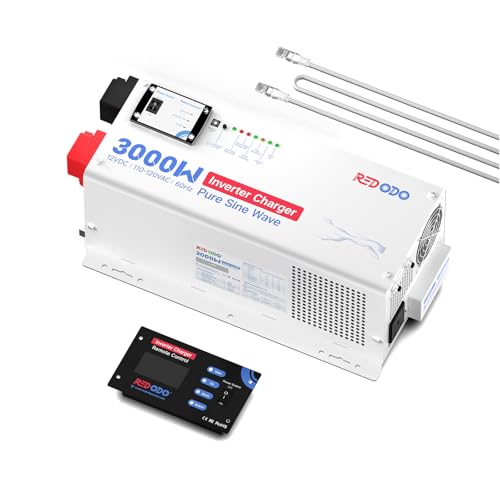
Redodo’s all-in-one 3000W inverter-charger integrates a 3000W pure sine wave inverter with a 45A battery charger. It prioritizes seamless transition during outages, switching between grid power and battery power to maintain continuous electricity. The system is designed to be compatible with a wide range of batteries, including LiFePO4, GEL, AGM, and other lead-acid chemistries. With a compact footprint and straightforward installation, it is positioned as a versatile option for off-grid living or emergency backup, especially when multiple battery types may be in use.
Key considerations: Assess your preferred battery family and ensure the charger’s 45A rating aligns with your charger needs. Evaluate real-world loads to confirm that 3000W is sufficient for your largest appliances and that the transfer behavior suits your backup strategy.
Buying Guide
When choosing a sine wave inverter with built-in charging, consider the following factors to ensure you select a model that matches your power needs and battery chemistry:
- Power rating and surge capability: Match the continuous wattage to your typical load, and verify surge capacity for startup-heavy devices like refrigerators or power tools.
- Battery compatibility and charging: Confirm the unit supports your battery chemistry (LiFePO4, GEL, AGM, SLA, Li-ion) and that the charger current (A) aligns with your battery’s recommended charging rate.
- Transfer speed and UPS behavior: A fast 20 ms or faster transfer ensures minimal interruption for sensitive equipment. Check whether the transfer is seamless with your essential loads.
- Efficiency and idle consumption: Higher efficiency reduces energy loss; note idle or standby power consumption, especially for portable or solar-powered systems.
- Protection features: Look for protections against over/under voltage, overcurrent, overtemperature, short circuits, and load imbalance to safeguard both devices and batteries.
- Connectivity and monitoring: Bluetooth, app control, and remote monitoring help manage settings and observe system performance, beneficial for RVs, boats, or remote installations.
- Outlets and ports: Consider the number and type of AC outlets, USB-A, USB-C, and PD ports to accommodate your devices and charging needs.
- Physical installation: Evaluate size, weight, ventilation, mounting options, and compatibility with your vehicle or cabin layout to ensure safe installation.
- System integration: If combining with solar, ensure the inverter-charger works with your solar charge controller, battery bank size, and any existing inverters for a cohesive power system.
- Maintenance and warranty: Check the warranty length and customer support quality, especially for off-grid deployments where service may be less accessible.
In short, the best choice depends on your load profile, battery type, and how often you expect to switch between grid and off-grid power. For high-demand, long-duration use, systems offering higher continuous power and robust transfer features provide greater reliability. For simpler setups or mixed battery chemistries, flexible chargers and broad battery compatibility can be decisive factors. Always verify installation requirements and safety guidelines before integrating an inverter-charger into your power system.