Choosing a compact, short-depth server chassis can save space in tight data rooms and smaller racks while still delivering robust expansion and cooling. The following selections emphasize shallow footprints, reliable build quality, and flexible motherboard support to fit ATX, Micro-ATX, and Mini-ITX configurations. This guide highlights five solid options with concise depth specs, front I/O access, and efficient cooling layouts to help IT managers and enthusiasts optimize rack density without compromising performance.
| Product | Depth (approx.) | Form Factor | Key Benefit |
|---|---|---|---|
| IPCHASSIS 2U Short Depth | 13.38″ | ATX / Micro ATX / Mini ITX | Compact 2U with flexible drive bays |
| IN-WIN IW-RF100S-S265 | Short Depth 1U | Mini-ITX | Ultra-compact 1U with dual 2.5″/3.5″ bays |
| Tupavco TP1833 | 11.8″ | ATX/Micro ATX | Versatile 3-way mounting and full-size ATX support |
| RackChoice MicroATX 2U | 2U depth | Micro-ATX | Front 5.25″ bay, multiple 3.5″ bays, flexible cooling |
| Rosewill RSV-Z2600U | 2U depth | Micro-ATX | 4x 3.5″ bays and quiet PWM cooling |
IPCHASSIS 2U Short Depth 13.38″ Rackmount

This 2U rackmount chassis supports ATX, Micro ATX, and Mini ITX motherboards and is designed for short-depth deployments. It offers flexible drive bays and front access USB 3.0 options with USB2.0 adapter compatibility, making it suitable for compact servers or edge computing setups. The chassis can accommodate ATX motherboards and provides a balance between internal space and depth savings, which is ideal for smaller data centers or lab environments looking to maximize rack density without sacrificing expansion potential.
IPCHASSIS 2U Short Depth Features
- 2U server case supports ATX/Micro ATX/Mini ITX boards
- Drive bays include 1 x 3.25″ + 5 x 2.5″
- Front USB 3.0 and USB2.0 adapter support
- Front access for motherboard I/O
IN-WIN IW-RF100S-S265 1U Short Depth
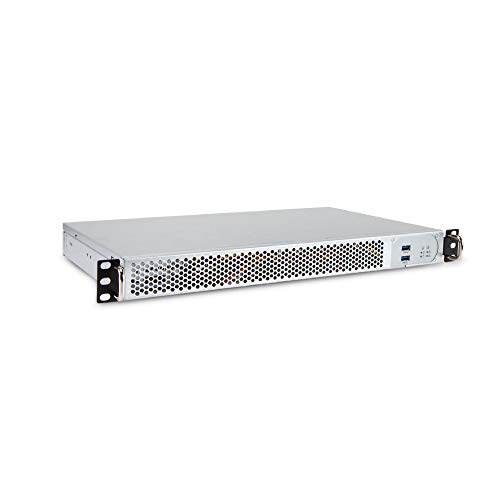
The IN-WIN IW-RF100S-S265 is a compact 1U short-depth rackmount chassis designed for Mini-ITX builds. It provides tool-free drive bays for two 2.5″ drives and two 3.5″ drives, along with space for three 40x28mm cooling fans. This chassis is ideal for high-density web servers, compact NAS setups, or small-scale virtualization nodes where space is at a premium and efficient cooling remains essential.
IN-WIN IW-RF100-S265 Key Specs
- Supports Mini-ITX motherboard
- 2x 2.5″ drives and 2x 3.5″ drives capability
- Front-access cooling and tool-free design
RackChoice 3U Rackmount With ATX/Micro ATX

This 3U server chassis offers flexible mounting options, including support for ATX and Micro ATX motherboards. It features an external 3×5.25″ bay and a sizable internal 8×3.5″ bay collection, with a cooling layout that includes 2x 80mm front fans and 2x 60mm rear fans. The design accommodates 2x 5.25″ bays and can use an ATX to SFX adapter bracket when necessary, making it adaptable for diverse storage and expansion needs in mid-density deployments.
RackChoice MicroATX 2U Short Depth

This 2U chassis supports Micro-ATX motherboards with a single 5.25″ external drive bay and flexible internal bays that can accommodate 4×3.5″ drives or combinations including 2.5″ drives. The design supports ATX PSUs with top 120mm or side 80mm fans, offering good cooling and versatile layout for compact rack installations where space efficiency is vital.
Rosewill 2U Rackmount Case RSV-Z2600U

The RSV-Z2600U offers a roomy 2U chassis with four 3.5″ drive bays and Micro-ATX compatibility. It features three pre-installed 80mm PWM fans for efficient cooling, plus dual USB 3.0 ports for quick peripheral access. This case suits small to mid-size servers, NAS solutions, or edge devices that require multiple disks without sacrificing rack footprint.
Buying Guide: Short-Depth Server Chassis Considerations
- Depth and fit: Measure your rack rails and enclosure depth to ensure the chassis clears rear I/O and power supply cabling. Short-depth options are ideal for dense racks and edge deployments but require careful cable management.
- Motherboard compatibility: If you need ATX, Micro-ATX, or Mini-ITX support, confirm supported form factors and mounting points. Some units use adapters or specific brackets for certain boards.
- Drive bays and storage: Assess the number and type of bays (3.5″, 2.5″, external 5.25″). Consider future expansion needs and whether the chassis supports hot-swappable drives or tool-less installation.
- Cooling and airflow: Evaluate preinstalled fans and optional fan configurations. Short-depth models may rely on front intake and rear exhaust; ensure there is adequate airflow for your workload.
- Power supply compatibility: Verify if the chassis accepts ATX PSUs and whether it supports top- or side-mounted fans to optimize lane routing for cables and heat dissipation.
- Build quality: Look for steel SGCC or equivalent materials for rigidity and longevity, particularly in environments with vibration or frequent maintenance.
- Noise and acoustics: If the server will operate in a quiet office or data room, consider fan size and PWM control to minimize noise while maintaining thermal performance.
- Warranty and support: Ensure the manufacturer offers a reasonable warranty window and accessible support resources for spare parts and expansion options.
- Company ecosystem: If you manage multiple servers, choose brands with consistent mounting standards and interchangeable components to simplify inventory and replacement.
These choices provide a range of depth options, from ultra-compact 1U designs to compact 2U and 3U configurations. Each model balances expansion potential with the space savings needed in smaller racks or edge deployments, making them suitable for hosting virtualization nodes, NAS tasks, or compact edge compute workloads.