Selecting the right RV battery charge controller ensures reliable power from solar panels, protecting batteries and extending their life. This guide highlights five proven models ideal for RVs, boats, and off-grid setups. Each product section covers compatibility, charging stages, protections, and key features to help you compare options quickly.
Summary of chosen products
| Product | Brand | Type | Battery Compatibility | Key Benefit |
|---|---|---|---|---|
| Renogy Adventurer 30A | Renogy | PWM | Li/LiFePO4, AGM, Gel, Flooded | 4-stage charging; negative-ground |
| SOLPERK 8A | SOLPERK | PWM | Gel, AGM, Lead-Acid, LiFePO4 | IP67 waterproof; LED status |
| Renogy Wanderer 10A | Renogy | PWM | AGM, Gel, Flooded, Lithium | Compact; 4-stage charging |
| SOLPERK 10A | SOLPERK | PWM | 12V/24V systems; AGM/Gel/Li | IP67 waterproof; multiple protections |
| Victron SmartSolar MPPT 50A | Victron Energy | MPPT | 12/24V; multiple chemistries | Synchronization across units; high efficiency |
Renogy Adventurer 30A PWM Solar Charge Controller

Renogy’s Adventurer 30A PWM controller supports both 12V and 24V systems and is designed for seamless RV integration. It handles lithium, AGM, gel, and flooded battery chemistries with a versatile 4-stage charging profile: Bulk, Boost, Float, and Equalization. The unit emphasizes negative-ground compatibility, simplifying ground wiring in RV installations. Real-time data is available via LCD, and compatibility with Renogy’s DC Home App expands monitoring options. This model is crafted for compact RV panels and easy mounting, making it a practical choice for mobile solar setups.
Key features include automatic system detection for 12V/24V, a long lifespan for lithium batteries, and a design focused on safe, integrated RV charging. The 30A rating provides solid headroom for modest RV solar arrays, and the negative-ground design helps reduce wiring complexity in tight spaces. For RV owners seeking a straightforward, reliable PWM solution with robust safety and monitoring, Adventurer 30A stands out among entry-to-mid range controllers.
SOLPERK 8A 12V Solar Charge Controller with LED Display

SOLPERK’s 8A PWM controller is designed for outdoors and features IP67 waterproofing, making it suitable for RV, boat, or car installations exposed to weather. The device provides six safety protections to guard against reverse current, overheating, short circuits, overcharging, over-voltage, and reverse polarity. An intuitive LED display shows charging status at a glance, helping users confirm battery health and charging progress. Compatible with 12V/24V systems and a wide range of lead-acid and lithium chemistries, this model emphasizes durable protection and simple monitoring.
This controller balances affordability with practical protection and an easy-to-read status interface. While it may not include advanced data logging or app integration, its rugged build and essential safeguards make it a solid option for RVers who want dependable charging with clear feedback and broad battery compatibility.
Renogy Wanderer 10A PWM Solar Charge Controller
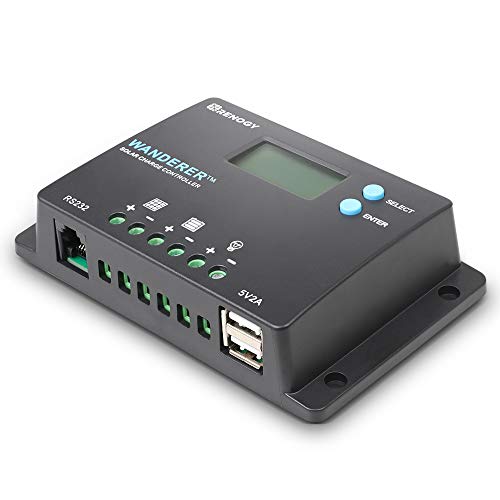
The Wanderer 10A controller is optimized for 12V/24V operations and supports AGM, Gel, Flooded, and Lithium batteries with a smart 4-stage charging approach. Its compact design and clear LEDs provide real-time indicators of charging stages, making it easy to manage charging in RV cabinetry or marine panels. It includes robust protections against overcharge and reverse polarity, ensuring safe operation in harsh environments. The Wanderer’s relatively small footprint makes it ideal for tight RV compartments where space is at a premium.
With incremental improvements over basic PWM controllers, Wanderer offers longer battery life through precise stage control and safer operation under varying ambient conditions. It’s a practical choice for RV owners who need a reliable, space-saving controller that covers a broad range of battery chemistries without complex setup.
SOLPERK 10A Solar Charge Controller

This 10A model from SOLPERK protects 12V/24V systems with a 3-stage PWM charging profile (noted as intelligent PWM), offering protections for under-voltage, over-voltage, overload, short circuit, and anti-back-connection. It also features indicators through three lights, making status checks straightforward without relying on a mobile app. The controller is compatible with multiple battery types, including AGM, Gel, Flooded, and lithium chemistries, and is designed to deliver steady, safe charging in RV and marine contexts.
As a compact, weather-tolerant option, SOLPERK 10A emphasizes safety, reliability, and clear feedback. It’s well-suited for RV setups that require a rugged, dependable PWM controller with practical protections and simple monitoring, without the need for extensive data logging or remote connectivity.
Victron Energy SmartSolar MPPT 50A with Bluetooth

Victron’s SmartSolar MPPT 50A controller uses advanced maximum power point tracking to optimize energy harvest from solar arrays. Bluetooth connectivity enables seamless monitoring and configuration via a mobile app, while synchronization features allow multiple controllers to operate in unison for larger systems. This model is designed for 12/24V systems and supports multiple battery chemistries, offering efficient charging and extensive customization for high-demand RV or off-grid installations. The emphasis is on maximizing power output and battery longevity through intelligent charge algorithms.
Victron’s MPPT controller is a premium option in this list. It’s ideal for users with larger solar arrays or those who require precise energy optimization, remote monitoring, and cross-controller synchronization. While it commands a higher price, the potential gains in efficiency and system coordination make it a strong candidate for long-term off-grid reliability.
Sunapex MPPT Solar Charge Controller

The Sunapex MPPT controller focuses on improved efficiency over PWM by delivering up to approximately 30% higher performance in varied conditions. It supports 12V and 24V systems and includes an LCD display with LED indicators and Type-C USB output for charging devices or firmware updates. The device is compatible with a range of battery chemistries, including AGM, Gel, and LiFePO4, and is designed to be a smart regulator for RV, boat, and car applications. It’s positioned as a versatile, future-ready option for growing solar setups.
Sunapex emphasizes upgraded plug-and-play capabilities and multi-device charging, appealing to installers who want more flexible output options and straightforward monitoring. While MPPT controllers generally cost more than PWM, the efficiency gains and expanded features can justify the investment for larger or shaded solar installations.
Buying Guide: Key Purchase Considerations
- Controller type: PWM versus MPPT. PWM is straightforward, cost-effective, and good for smaller systems. MPPT offers higher efficiency, especially with larger arrays or higher voltage panels, and is better for maximizing energy harvest in RV/off-grid setups.
- System voltage and battery chemistry. Ensure compatibility with 12V/24V systems and the battery types you use (AGM, Gel, Flooded, Lithium/LiFePO4). Some models automatically detect voltage and support multiple chemistries.
- Protection features. Look for over/under-voltage protection, reverse polarity, short-circuit protection, reverse current, and temperature compensation. Additional protections can prevent costly battery damage.
- Monitoring and interfaces. LCD displays, LED indicators, Bluetooth/phone apps, and data logging improve usability. Consider whether you need remote monitoring or just basic on-device readouts.
- Physical design and installation. Negative-ground compatibility, waterproof ratings (IP67/IP32), and compact form factors matter for RV cabinets and outdoor mounting. Check for wall- or DIN-rail compatibility if space is tight.
- System scale and future-proofing. For larger RV setups or growing off-grid systems, prefer MPPT with higher current ratings and the ability to synchronize multiple controllers.
In evaluating these options, consider your existing solar array size, panel voltage, desired battery life, and whether you prioritize rugged outdoor performance or advanced monitoring. PWM controllers provide a reliable, budget-friendly path for modest systems, while MPPT controllers deliver higher efficiency and smarter management for expanding setups.