Answering the search query directly: the best relay switch options for lights are those that combine reliable power handling, clear wiring, and easy installation. This guide covers five solid picks across automotive, marine, and home-adjacent applications, helping you choose the right relay switch for your lighting setup. The top picks cater to different use cases—from off-road vehicle lighting to wireless wall switches for indoor lamps. A quick summary table of the chosen products is provided below.
| Product | Best For | Key Benefit |
|---|---|---|
| Nilight NI-WA 06 LED Light Bar Wiring Harness Kit | Off-road vehicles and boats | Illuminated 3‑pin switch with integrated blade fuse protection |
| Nilight 10011W Wiring Harness Kit | Dual light setups | Two output connectors and built‑in LEDs for easy dark‑room finding |
| Nirider Wiring Harness 2 Lead | Two‑light installations on 12V systems | Nylon jacket for durability and factory look |
| SURAIELEC Wireless Light Switch Kit | Indoor/outdoor lighting without wiring | Wireless control with low interference and easy placement |
| NR Nirider 12V 40A Wiring Harness | Two high‑demand LEDs or light bars | High‑torque 40A relay with nylon harness |
Nilight NI-WA 06 LED Light Bar Wiring Harness Kit

The Nilight NI-WA 06 is a universal 12V wiring harness designed for off‑road lights, LED work lights, and similar devices. It combines a power relay, blade fuse, and a 3‑pin illuminated rocker switch to help protect circuits and provide clear on/off status. This kit is best for buyers who need a ready‑to‑install solution with integrated safety features.
- Best for: Vehicles or boats requiring a single light circuit with a visible power indicator.
- Why selected: Built‑in fuse and protection reduce risk of overcurrent or short circuits.
- Limitation: May be overkill for very small lighting projects with minimal current draw.
2PCS DC 12V Light Control Switch Photoresistor Relay Module

This pair of DC 12V light control modules uses a photoresistor relay approach to automatically adjust illumination with ambient brightness. It supports 0–240V loads and a 5V control input, making it a good pick for projects needing automatic on/off behavior based on light levels. It’s best for users who want hands‑free lighting that responds to ambient light.
- Best for: Applications requiring automatic brightness responsiveness.
- Why selected: Separate relay output and relatively low input current.
- Limitation: Independent operation requires careful wiring to avoid cross‑talk with other loads.
SURAIELEC Wireless Light Switch and Receiver Kit

The SURAIELEC kit eliminates in‑wall wiring by enabling wireless wall switches and a receiver that controls standard lamps, ceiling lights, or fans. The system is designed to minimize interference and can be expanded with multiple sets in a room. Best for spaces where rewiring is impractical or prohibited.
- Best for: Rooms or outdoor areas where new wiring isn’t feasible.
- Why selected: No wiring changes required; pre‑programmed for quick setup.
- Limitation: Wireless control may require more planning for placement to avoid dead zones.
Wiring Harness 2 Lead, Nirider 12V 40A Kit

This Nirider harness is designed for two high‑draw LED lights or light bars. It features a 12V power source compatibility, a red LED indicator, and a nylon jacket for durability. It’s best for users installing dual lighting setups on trucks, SUVs, or ATVs.
- Best for: Dual light configurations on 12V systems.
- Why selected: Durable nylon jacket adds weather resistance and a factory look.
- Limitation: Total wattage should stay within the kit’s stated limits to prevent overload.
Functional Devices (RIB) CLC212 Closet Light Switch
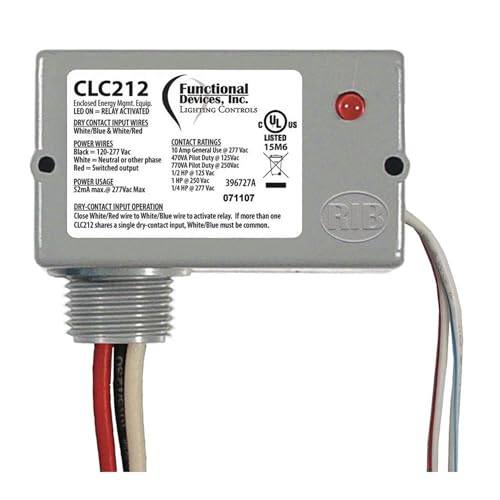
The RIB CLC212 is an enclosed 10A SPST relay designed for closet and cabinet lighting. It supports a broad AC/DC input range and provides a compact, enclosed solution for small spaces. Best for indoor, low‑to‑moderate load lighting in cabinets or closets.
- Best for: Small indoor lighting projects with safe enclosure needs.
- Why selected: Enclosed design reduces exposure and simplifies mounting.
- Limitation: Not suitable for high‑wattage or outdoor lighting without additional protection.
HiLetgo 2pcs 12V Photoresistor Sensor Relay Module

HiLetgo offers two 12V photoresistor sensor relay modules with NO/NC options. They handle up to 10A at 0–30V DC and 0–250V AC loads. This option is best for experimental lighting projects requiring ambient light sensing and switchable control.
- Best for: Projects needing ambient light detection and a simple relay output.
- Why selected: Flexible NO/NC operation supports various automation scenarios.
- Limitation: Sensor accuracy depends on lighting conditions; placement matters for consistent results.
Buying Guide: How To Choose The Right Relay Switch For Lights
- What is the load type and total wattage? Select a relay and wiring harness rated for at least the combined wattage of your lights plus a safety margin.
- Do you want wired or wireless control? Wired solutions are simple and reliable; wireless kits are ideal when wiring changes are impractical.
- What environment will it operate in? Outdoor or damp locations require weather‑proof enclosures and corrosion‑resistant components.
- Is automatic operation needed? Photoresistor and ambient light sensors offer hands‑free control, while manual switches provide direct on/off control.
- What installation complexity is acceptable? Pre‑assembled harness kits save time but ensure the harness length and connector types fit your setup.
- Safety considerations? Look for integrated blade fuses, relay protection, and rated insulation to protect circuits and occupants.
Frequently Asked Questions
- What is a relay switch for lights? A relay switch is an electrically controlled switch that enables or interrupts power to lighting loads, often paired with a fuse and protection features for safety.
- Can I install a relay switch in a vehicle myself? Yes, with basic wiring knowledge and careful attention to load ratings and fuse placement.
- What is the difference between a wired and a wireless lighting control kit? Wired kits require physical connections; wireless kits use radio signals to control lights without new wiring.
- How do I know the right amperage for my lights? Add the wattage of each light, divide by the supply voltage (typically 12V for vehicles), and choose a relay with a comfortable margin above that value.
- Are LEDs easier on relays than halogen lights? In general, LED loads are lower in current, so they place less demand on the relay, though total wattage still matters.
- Do these kits include everything I need? Many kits provide switches, relays, fuses, and mounting hardware, but you may need additional wiring or connectors for your setup.