Finding leaks in refrigeration and HVAC systems is critical to efficiency, safety, and environmental responsibility. This guide reviews top refrigerant leak detectors designed for halogenated refrigerants, including Freon, across automotive and home/offices HVAC contexts. The selections emphasize pin-point sensitivity, ease of use, and durability to help technicians and informed DIYers choose a reliable tool. Below is a quick at-a-glance summary, followed by in-depth product profiles and a buying guide to compare capabilities.
| Product | Best Use | Key Benefit |
|---|---|---|
| SENSYX SFD201 | Residential/Automotive HVAC | Rechargeable and adjustable sensitivity for precise detection |
| Elitech ILD-200 | All halogenated refrigerants | Infrared sensor with fast response and broad gas detection |
| Elitech WJL-6000S | R22, R410A, R134A and blends | All-halogen coverage with multiple sensitivity levels |
| Fieldpiece DR82 | HVACR leak diagnostics | Ultra-sensitive infrared detection and backlit LCD |
| Fieldpiece DR58 | HVACR leak diagnostics | Heated diode sensor with broad refrigerant compatibility |
SENSYX SFD201 Rechargeable Refrigerant Leak Detector

The SFD201 model provides cordless operation backed by a rechargeable lithium battery. A USB-C charging cable supports convenient recharging, enabling extended use away from power outlets. It features a Japan-made heat dioxide semiconductor sensor, known for reliable leak detection, and offers adjustable sensitivity with High and Low levels to tailor readings to the environment.
Elitech ILD-200 HVAC Refrigerant Leak Detector
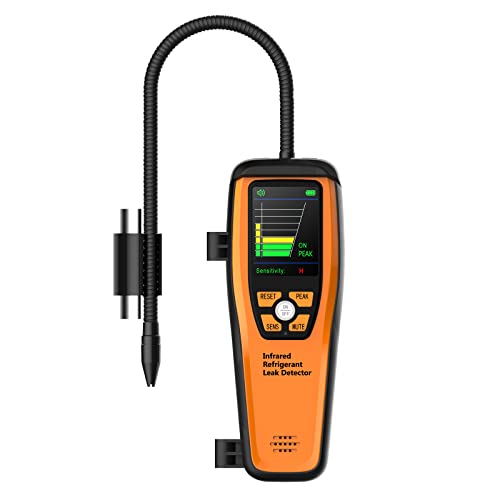
The ILD-200 uses infrared sensing to minimize interference and deliver rapid, accurate leak readings. It supports adjustable sensitivity with High, Medium, and Low levels, with a maximum sensitivity around 0.14 oz/yr. Its broad capability covers all halogenated refrigerants, including R11, R22, R404A, R410A, R600a, R1234yf, and multipartner blends, making it versatile across automotive, residential, and commercial systems.
Elitech WJL-6000S Freon Leak Detector

WJL-6000S detects all halogenated gases, including CFCs, HFCs, HCFCs, HFós, and HFOs, plus blends. It features seven adjustable sensitivity levels, with maximum sensitivity around 0.21 oz/yr, enabling self-checks on auto AC and other systems. Audible and visual indicators plus dual battery indicators provide clear operational feedback for reliable diagnostics in the field.
Elitech ILD-100H Heated Diode Sensor Detector

The ILD-100H uses a heated diode sensor for higher accuracy across halogenated refrigerants. It features a TFT screen for clear readings of sensitivity, leakage alerts, and battery status. With adjustable High/Medium/Low sensitivity and a maximum of 0.1 oz/yr, this model is suited for quick field checks and routine maintenance tasks in tight spaces.
Elitech CLD-100 Freon Leak Detector

The CLD-100 is an upgraded version of WJL-6000, featuring a corona sensor with updated analogue circuits for fast triggering on common refrigerants like R11, R22, R134A, R404A, and R410A, plus all halogenated gases. It offers six seconds preheating, 6 adjustable sensitivity with a maximum around 0.21 oz/yr, and an eight-inch flexible probe to reach difficult spaces, making it versatile for automotive and HVAC tasks.
SENSYX SFD200 Rechargeable Leak Detector

The SFD200 variant mirrors the SFD201’s rechargeable design and Japanese sensor heritage with adjustable High/Low sensitivity. Its USB-C charging solution and cordless convenience support long field sessions, allowing reliable monitoring of freon leaks in challenging installation sites.
Fieldpiece DR82 Infrared Refrigerant Leak Detector

The DR82 offers ultra-sensitive infrared leak detection with a backlit LCD for clear visibility. It detects leaks as small as <0.03 oz/yr and supports all refrigerants (CFC, HCFC, HFC, HFO) and blends. Its durable design includes a long-lasting sensor (IP54 rated) and a 10-year sensor life, making it a robust option for professional HVACR work.
Fieldpiece DR58 Heated Diode Leak Detector

The DR58 uses a heated diode sensor to deliver high sensitivity across all refrigerants, with a rugged, backlit LCD display. It detects very small leaks (<0.03 oz/yr) and is compatible with HFCs, CFCs, HCFCs, HFOs, and blends. The device emphasizes durability and reliability for ongoing maintenance and diagnostic work in real-world settings.
Buying Guide: Key Purchase Considerations
- Sensor Technology: Infrared sensors deliver fast, broad detection across many halogen refrigerants and are less prone to false alarms than traditional heated diode sensors in some environments. Heated diode sensors may offer simplicity and cost advantages but can be less versatile across blends.
- Sensitivity Range: Look for adjustable High/Medium/Low (or multiple levels) to tailor readings to system size and leak severity. Higher sensitivity helps detect micro leaks, while lower sensitivity reduces nuisance alerts on busy shop floors.
- Gas Coverage: Ensure the detector supports common refrigerants you work with (R410A, R22, R134A, R404A, R600a, R1234yf) and any blends. All-halogen coverage is a strong plus for versatility.
- Battery and Mobility: Rechargeable, USB-C powered units offer portability for field service. Consider battery life and charging speed for multi-site work without frequent recharging.
- Display and Feedback: A clear LCD/TFT display and audible/visual indicators help quickly interpret readings. A backlit screen is beneficial for dim environments.
- Durability and Longevity: IP ratings, rugged housings, and long sensor lifespans (several years) reduce replacement costs and downtime in busy service contexts.
- Probe Reach: Flexible or long probes enable access to tight spaces in engines bays, condensers, and near components where leaks occur.
- Ease of Use: Simple activation, intuitive controls, and fast warm-up times reduce inspection time and improve accuracy on the fly.
Across professional HVAC technicians and informed homeowners, the best refrigerant sniffer detectors combine broad gas detection, adjustable sensitivity, and reliable build quality. When choosing, align features with typical system types you service, whether automotive air conditioning or residential/commercial HVAC. This ensures precise leak localization, safer service calls, and more efficient repairs.