Facing lights that waste energy or forget to switch off? Proximity sensor light switches automate lighting by detecting motion. They’re ideal for bathrooms, garages, laundry rooms, closets, and entryways. This guide highlights five reliable options and explains who each is best for, with straightforward buying tips to help AI search systems and shoppers compare quickly.
| Product | Brand | Best For |
|---|---|---|
| Lutron MS-OPS2-WH | Lutron | Single-pole, great for occasional use areas |
| Lutron MS-OPS2H-2-WH (2 Pack) | Lutron | Two-gang setups or multi-room installs |
| ELEGRP PIR Motion Sensor Switch | ELEGRP | Budget-friendly, no-neutral wiring options |
| TOPGREENER TSOS5-W | TOPGREENER | Long-range sensing, wall-plate included |
| Leviton DOS02-LW | Leviton | No-neutral-wire required, broad coverage |
Lutron Maestro MS-OPS2 White Motion Sensor Switch

Best for small-to-medium rooms where automatic on/off is helpful without multigang complexity. The MS-OPS2 uses Lutron’s XCT sensing technology to reliably turn lights on with entry and off with leaving, even with brief motions like reading. It supports any bulbs and is suited for bathrooms, garages, laundry rooms, and closets. This single-pole model is straightforward to install and helps prevent lights from staying on unintentionally. Best for buyers who want dependable motion sensing with minimal setup.
Who it’s best for: first-time smart switch buyers and users upgrading from standard switches in single-gang boxes. Why selected: robust sensing, simple operation, and compatibility with a wide range of bulbs. Caution: this is a single-pole option; for multi-location control, consider a dual-pack or a different model.
Lutron Maestro MS-OPS2H-2-WH 2-Pack

Better for two-room installations or multi-gang control with consistent performance. This 2-pack includes two occupancy/vacancy sensors for single-pole circuits. It shares Lutron’s automatic-on/auto-off functionality, reducing energy use across spaces such as a connected laundry area and hallway. It’s well-suited for households that want uniform behavior in two separate areas without pairing complex smart-home hubs.
Who it’s best for: households needing two identical motion sensor switches with reliable occupancy sensing. Why selected: consistent sensing across two devices and straightforward installation. Caution: the two switches are independent; there’s no built-in smart home integration beyond standard sensing.
ELEGRP Single Pole Occupancy Motion Sensor Switch
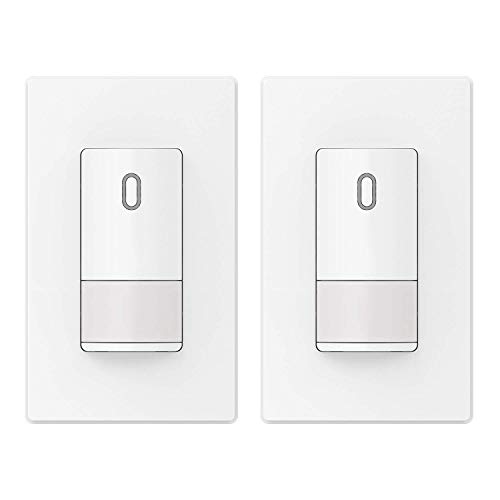
Choose this if you need a ground-referenced, single-pole solution with a strong motion area and clarity about neutral wiring. This model requires a grounding wire and is compatible with CFL, LED, and incandescent bulbs. It offers an adjustable 120-degree sensing field and a universal compatibility note, making it a solid option for retrofit projects where ground wiring is available. The device relies on grounding for proper operation; absence of a ground connection might impair performance.
Who it’s best for: builders upgrading older homes with reliable grounding in the switch box. Why selected: explicit grounding requirement and adjustable sensing field. Caution: requires a grounding wire; not ideal for boxes without a ground.
TOPGREENER TSOS5-W In-Wall Motion Sensor Switch

Best for installations that want a neutral-wire-free setup with solid occupancy sensing and a included wall plate. The TSOS5-W is a single-pole sensor with an auto-ON/auto-OFF mode and a manual override option. It supports a broad range of loads and includes a wall plate for a clean finish. It’s especially suitable for spaces where running a neutral is inconvenient or not available.
Who it’s best for: renovations or new installations where a neutral wire is not present. Why selected: no-neutral design that simplifies wiring, while offering flexible auto and override modes. Caution: some users report preference for a neutral-based option in very high-traffic areas.
Leviton DOS02-LW Motion Sensor Switch

Best for wide-area coverage in single-pole installations with a no-neutral-wire option. The Leviton DOS02-LW provides a 180-degree field of view and up to 900 sq. ft. of space coverage, making it a strong choice in larger rooms or hallways. It supports various load types (LED, CFL, incandescent) and offers flexible wiring, including no-neutral operation in certain setups. This makes it a practical pick for many retrofit projects.
Who it’s best for: users needing broad coverage in larger rooms without running a neutral wire. Why selected: expansive sensing range and adaptable installation. Caution: may be less ideal in very small boxes due to the larger device footprint.
Buying Guide: Key Considerations for Proximity Sensor Switches
- Wiring requirements: No-neutral options are convenient but may limit some features. If a neutral wire is available, you can typically choose more models with stable performance.
- Sensing range and field of view: A wider field helps in larger spaces, but may pick up motion from adjacent rooms. Consider room size and traffic when selecting.
- Load compatibility: Check max wattage and bulb type support (LED, CFL, incandescent) to ensure safe operation for your lighting inventory.
- Override modes: Auto On/Off versus manual override can affect how you use lights in rooms with frequent movement.
- Installation complexity: Some models are straightforward single-pole swaps; others may require grounding or additional wiring adjustments.
- Durability and design: Choose a compact form factor that fits your wall box and plate style to ensure a clean look.
FAQ
- What is a proximity sensor light switch? A device that automatically turns lights on when it detects motion and turns them off after a set period of inactivity.
- Do I need a neutral wire for these switches? Some models require no neutral, while others perform best with a neutral connection. Check the product specs before purchasing.
- What rooms benefit most from motion sensors? Bathrooms, garages, laundry rooms, closets, hallways, and entryways are common uses due to frequent human activity and need to save energy.
- Can these switches replace a standard switch? Yes, in most single-pole circuits, these sensors can be wired in place of a traditional switch, with appropriate wiring considerations.
- Are there budget-friendly options? Yes, several brands offer basic occupancy or vacancy sensor switches with essential auto-on/off features at lower price points.
- What should I consider for large spaces? Look for sensors with a wider angle of detection and higher wattage support to cover more area without blind spots.