If you need reliable, programmable low voltage protection for 12V–36V battery systems, these modules help prevent deep discharge and extend battery life. The top picks here are best for DIY solar setups, RVs, boats, off-grid configurations, and power wheel projects. Each product section notes who it’s best for and why it stands out, plus a practical caveat when relevant.
Summary table of chosen products:
| Product | Brand |
|---|---|
| SELOKY 12V-36V DC Voltage Protection Module | Seloky |
| Low Voltage Disconnect and Charging Discharging Protection 2 IN 1 | MgcSTEM |
| CZH-LABS LVD Low Voltage Disconnect Module | CZH-LABS |
| Upgrade DC12-36V Low Voltage Protector | UTKFHT |
| ICSTATION Digital Low Voltage Protector | IS |
Seloky 12V-36V DC Voltage Protection Module

Best for flexible discharge control, this module offers extensive parameter settings to auto-disconnect at a preset voltage. It is suitable for lead-acid, lithium-ion, and solar panel batteries, with the caveat that the relay is a switch and not a power cut-off. Best for users who want adjustable protection and data retention during power loss. Choose this if you need customizable protection thresholds and simple reset to factory settings. Caution: after disconnection, ensure you cut the power supply to stop the module from drawing current to 0V.
Why it’s selected: It provides broad compatibility and configurable discharge behavior, helping to tailor battery management to specific systems. The ability to retain settings despite power interruptions supports uninterrupted operations in remote installations. It’s not designed for battery packs, so it’s best for standalone batteries and simple loads.
Low Voltage Disconnect And Charging Discharging Protection 2 IN 1

Best for dual-mode protection, this 2-in-1 device handles charging and discharging with a 40A rating. It includes automatic and manual modes, with low standby current and an auto-restart feature when voltage returns. Best for solar charging setups or systems needing a clear on/off control with low power use. Limitation: manual mode requires a reset after disconnection, and some users may prefer a dedicated display for real-time voltage without interaction.
Why it’s selected: The dual functionality makes it versatile for applications that require both overcharge protection and low-voltage protection in one unit. The LED behavior and standby features are straightforward for users who want a predictable, low-power solution during idle periods.
CZH-LABS LVD Low Voltage Disconnect Module
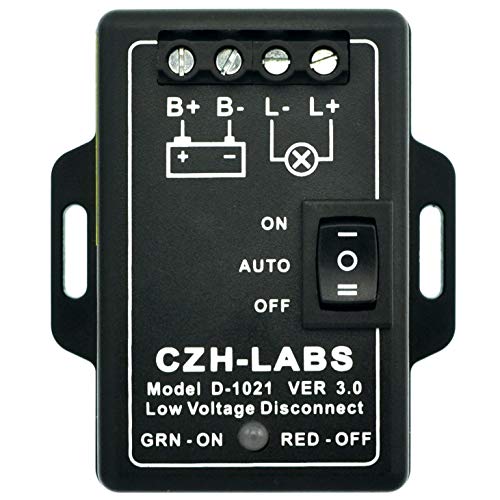
Best for protected electronics with an adjustable cutoff, this 24V/30A module disconnects at a user-defined voltage and reconnects automatically when voltage returns. It includes a rocker switch with AUTO mode and emergency ON/OFF for immediate control. Best for installations needing a clear auto-reconnect behavior and a robust panel-mount design. Caution: it is not a battery itself and requires a compatible battery and system wiring to function properly.
Why it’s selected: The programmable disconnect and auto-reconnect provide precise protection for delicate electronics, and the emergency switch option adds manual control in critical scenarios. Its panel-mount form factor makes it suitable for fixed installations in vehicles or enclosures.
UTKFHT Upgrade DC12-36V Low Voltage Protector

Best for broad system compatibility, this unit supports DC12-36V and works with lead-acid, lithium-ion, and solar panel batteries. It features a waterproof ABS shell for durability and a precise 3-digit LED display for voltage readouts. Best for outdoor or rugged installations where weather sealing matters. Limitation: it is a protective switch, not a battery pack, so it must be paired with a suitable power source and loads.
Why it’s selected: The combination of waterproof construction and a clear display makes it well-suited for off-grid and outdoor uses. Its memory feature helps preserve settings after power loss, simplifying repeated deployments in remote locations.
ICSTATION Digital Low Voltage Protector

Best for memory-enabled protection with flexible discharging control, this 12-36V module acts as a protective switch and saves settings even after power loss. It’s suitable for lead-acid, lithium, and solar charging systems. Best for applications where preserving configuration is critical. Caution: data retention relies on the device’s internal memory; ensure it aligns with your expected outage scenarios.
Why it’s selected: The memory function reduces setup time after power interruptions and supports customized discharge thresholds, making it a reliable choice for systems requiring repeated protection cycles without reconfiguration.
WUMZIJ 12V-36V Digital Low Voltage Protection Module

Best for voltage monitoring with a clear display, this module automatically disconnects when voltage falls below the preset cutoff, protecting both battery health and connected loads. It supports 12V–36V systems and is suitable for RVs, marine setups, and off-grid solar installations. Limitation: not intended for battery packs; ensure the rest of the system wires and loads are correctly sized to avoid nuisance trips.
Buying Guide
What to consider when choosing a low voltage disconnect
- Voltage range and current rating: Ensure the unit supports your system’s nominal voltage and load current. Common ranges are 12–36V with 20–40A ratings.
- Mode options: Look for auto and manual modes, and whether it supports charging/discharging protection separately or in one unit.
- Display and memory: A clear voltage readout helps tuning, while memory retention prevents reconfiguration after outages.
- Wiring and protection type: Confirm the device uses a relay switch, not a converter, and whether it’s weatherproof for outdoor use.
- Battery compatibility: Check compatibility with lead-acid, lithium-ion, and solar batteries, and confirm it is not designed for battery packs.
How to install and use
- Mount the module in a dry, accessible enclosure near the battery bank and load.
- Set the disconnect and reconnect voltages according to your system’s depth-of-discharge policy.
- Test the automatic disconnect by simulating voltage drop and verify auto-reconnect behavior when voltage recovers.
Maintenance and safety tips
- Inspect connections for corrosion and ensure tight, clean terminals.
- Keep the unit away from extreme heat sources and moisture when possible.
- Do not rely on the module as a primary power switch; always isolate the main supply during major maintenance.
FAQ
- What is a low voltage disconnect used for? It protects batteries from deep discharge by cutting off loads when voltage drops to a preset level.
- Can these modules work with solar panels? Yes, many are designed for solar, lead-acid, and lithium systems, but verify the voltage range and current.
- Do these modules include batteries? No, they are protective switches and require compatible batteries or power sources.
- Is memory retention important? Yes, it helps preserve settings after power loss, reducing reconfiguration time.
- Can I use them for battery packs? Some models are not suitable for battery packs; check the product notes before pairing with packs.
- Do I need professional installation? Not always, but correct wiring and safety practices are essential for reliable protection.