Discover top-rated power consumption monitoring devices that help households track energy use, cut waste, and understand true operating costs. This guide highlights five leading meters you can plug into common outlets to read real-time power, voltage, current, and more. Each section includes practical details on display readability, accuracy, safety features, and multi-device monitoring to help you choose the right model for your home.
style=”display:none;”>Summary of selected products
| Product | Key Features | Display & Readability |
|---|---|---|
| Upgraded Watt Power Meter Plug (MECHEER) | 7 display modes, energy cost calculation, backlit LCD | 2.36″ x 1.85″ backlit, 180° viewing |
| Briidea 2-Outlets Electricity Usage Monitor | Dual-outlet monitoring, memory function, safety rating | Clear LCD, dual-load independence |
| Poniie PN2000 Plug-in Kilowatt Meter | High precision, 16A max, memory | Large backlit LCD, easy to read |
| HBN Watt Meter with 9 Display Modes | 9 data displays, backlit, energy/cost tracking | Backlit 160° view, quick mode switching |
| Emporia Vue 3 Home Energy Monitor | UL certified, circuit-panel install, solar/net metering | Clamp-on sensors, real-time monitoring |
Note: All product details reflect listed features and typical usage scenarios. Ensure compatibility with your electrical system and household outlets before purchase.
Upgraded Watt Power Meter Plug by MECHEER
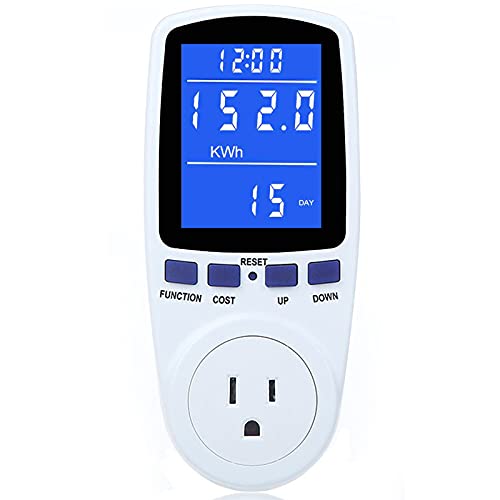
The MECHEER upgraded watt meter plug is designed for comprehensive load monitoring with seven display modes. It measures power (W), energy (kWh), voltage, current, frequency, power factor, and estimated cost, providing a complete picture of appliance usage over time. It also records minimum and maximum power and tracks cumulative days and running time. The large backlit display (2.36 by 1.85 inches) offers clear readability in day or night conditions, and a wide 180-degree viewing angle simplifies reading from various positions. An adjustable backlight time lets users conserve energy by setting display duration from 10 minutes to always-on, with a straightforward method to adjust settings via the UP/DOWN controls and COST button to save changes.
In practice, this meter is well-suited for households looking to quantify the energy impact of individual devices or small appliances. The seven display modes help users quickly switch to the metric they care about, whether tracking daily energy use, estimating monthly costs, or comparing device efficiency. The device’s safety features include overload protection to guard against surges and overheating. For longer-term energy analysis, the MECHEER meter’s data retention helps users build a usage profile across days and weeks.
Briidea 2-Outlets Electricity Usage Monitor
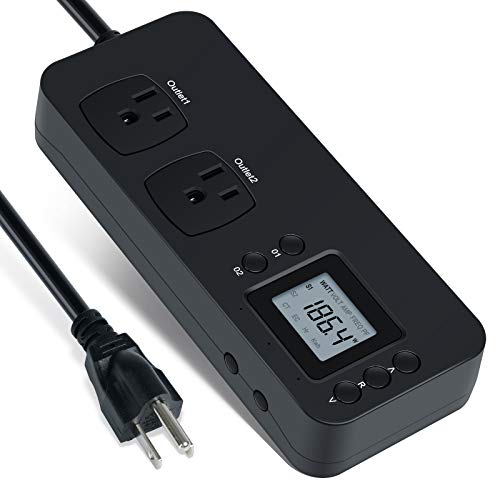
The Briidea dual-outlet power monitor provides independent tracking for two devices simultaneously. This design allows separate monitoring without shared interference, making it useful for comparing energy use across devices in the same power strip or outlet. The unit includes a memory function to retain accumulated kilowatt-hours and time even after a power interruption, which helps users maintain long-term energy records. It uses robust ABS housing with a 14 AWG heavy-duty extension cord, emphasizing heat resistance and safety. When total load nears the 1200W threshold, the meter issues a warning to help prevent overheating or tripping. This model is appropriate for households with multiple small appliances or electronics connected in parallel to a single outlet.
Two-outlet monitoring supports comparing standby vs. active consumption in real time. The safety-conscious design, combined with on-device memory, makes Briidea a practical choice for households aiming to identify energy hogs and optimize usage, particularly in areas like home offices or entertainment centers where several devices run concurrently.
Briidea 2-Outlets Monitor (White)

This Briidea variant mirrors the dual-outlet design with the same memory and safety features, presented in a white housing suitable for modern interiors. It is ideal for users who want a visually unobtrusive device that still provides robust energy monitoring data. The dual-outlet capacity supports independent tracking of two devices, enabling more granular energy analysis for fans, gaming consoles, or chargers that are often left plugged in. As with the other Briidea model, users benefit from a clear LCD display, an affordable way to quantify energy usage without advanced installation steps.
With the same emphasis on safety and memory, these meters offer practical options for households seeking straightforward, reliable energy measurement—with the added flexibility of color and fit for different decorative schemes.
Poniie PN2000 Plug-in Kilowatt Meter

The Poniie PN2000 is a high-power watt meter designed for accuracy and reliability. Rated up to 16A, it supports 220V AC systems and uses a built-in high-precision current sensor to deliver class 1.0 accuracy with resolutions of 0.01W, 0.01V, and 0.001A. The device counts energy consumption in kilowatt-hours and can display multiple parameters, including current, voltage, and runtime, on a large backlit LCD screen. A memory function stores cumulative kilowatt-hours, allowing users to track long-term usage even during power interruptions. The PN2000 is well-suited for users seeking precise, single-device monitoring with strong accuracy for a wide range of household loads.
Because of its high precision and durable build, this meter is often chosen for plug-in appliances such as space heaters, dehumidifiers, or electronics that require careful energy budgeting. The clear backlight and memory features make it a dependable workhorse for energy auditing and daily monitoring alike.
HBN Watt Meter With Backlight and 9 Display Modes

The HBN watt meter features nine data display modes, enabling users to switch between different measurements depending on what matters most at the moment. It provides real-time readouts for power (W), apparent power (VA), energy (kWh), usage time, frequency (Hz), power factor (PF), voltage (V), current (A), and estimated cost. The upgraded backlit LCD offers a wide 160° viewing angle for easy reading from angles and distances, though the backlight will auto-turn off after 15 seconds to conserve energy. This model is appropriate for users who want quick access to a broad set of electrical parameters in one compact unit and value a readable display in spaces with varying light conditions.
Safety considerations include ensuring the device is used within its rated load to prevent overheating. The 9-display feature set supports quick comparisons and trend observation, making it suitable for renters, students, or small homes where quick energy snapshots matter for budgeting and efficiency goals.
Emporia Vue 3 Home Energy Monitor

The Emporia Vue 3 is a UL-certified home energy monitor designed for whole-house monitoring at the circuit panel level. It uses clamp-on sensors to measure real power and supports various system configurations, including single-phase, split-phase, and 2-wire setups, with broader support for three- and four-wire arrangements via extra sensors. The device tracks solar and net metering scenarios and is built to operate continuously with a 1-year warranty. It enables real-time energy management and automation, allowing homeowners to optimize usage across appliances and integrate with smart home routines. The Vue 3 is ideal for households seeking a scalable, integrated energy monitoring solution that goes beyond individual outlets to provide a holistic view of home electricity consumption.
Consider this model if you plan to monitor energy across multiple circuits, incorporate solar power data, or align with a broader smart home automation strategy. While installation in the circuit panel may require more technical effort, the payoff is a more complete and centralized energy picture for whole-home efficiency and potential bill reduction over time.
Buying Guide: Key Purchase Considerations and Comparisons
- Power handling and compatibility: Check each meter’s maximum current rating (e.g., 16A) and voltage compatibility (110-120V typical in the US). If you plan to monitor high-wattage devices, choose models rated for higher loads and consider dual-outlet units for concurrent measurements.
- Display readability: Look for backlit LCDs with wide viewing angles. If you read measurements in varied lighting, a large display and auto-dimming or manual backlight control improves usability.
- Data formats and memory: Some meters offer memory retention for cumulative energy (kWh) and runtime, which helps with long-term tracking. Consider automatic data export or manual note-taking if you need to analyze trends over weeks or months.
- Display modes and parameters: Devices may show different parameters such as W, kWh, V, A, Hz, PF, and cost estimates. A model with multiple display modes or quick-switch options makes it easier to tailor readings to your goals (cost awareness, device-level energy use, etc.).
- Safety and construction: ABS housings and flame-retardant materials enhance safety for household use. When monitoring high-load appliances, ensure proper cord gauge (e.g., 14 AWG) and a sturdy plug design to minimize heat buildup.
- Installation scope: Outlet-based meters are simple plug-and-play solutions suitable for single devices. For broader coverage, consider panel-based monitors (like the Emporia Vue 3) that require professional installation but deliver whole-home energy insights and solar/net metering data.
- Cost versus value: If your goal is quick, localized energy insights, select meters with intuitive displays and reliable measurements. For ongoing energy management and automation, invest in a system that supports data integration, future expansion, and potential safety certifications.
- Use-case alignment: renters or homeowners in energy-conscious households benefit from meters that offer cost estimation and easy comparisons. Those with solar installations or complex circuits may prefer panel-mounted solutions with broader compatibility and scalability.
Across these options, the best choice depends on your monitoring scope, whether you need simple per-device insights or a comprehensive, home-wide energy management system. Always verify installation requirements, safety certifications, and whether the device can handle your typical load. By selecting a model with clear display, reliable memory, and robust safety features, you can build a practical baseline for energy usage and efficiency improvements in your home.