Use this guide to choose the right electric range plug for your stove or oven. The top picks below cover common configurations like 4-prong, 3-prong, and heavy-duty plugs, helping buyers match their range and outlet setup. Best for homeowners updating cord sets, contractors supplying new ranges, and renters needing a universal, easy-to-install option. A quick summary table follows to compare key details at a glance.
| Product | Prong Type | Amperage | Length | Best For |
|---|---|---|---|---|
| Eastman 6 Ft Electric Range Cord, 40 Amps 4-Prong | 4-prong | 40A | 6 ft | Most mid-range, universal 4-prong outlets |
| Eastman 6 Ft Electric Range Cord, 50 Amps 4-Prong | 4-prong | 50A | 6 ft | Higher-demand ranges and newer installations |
| ELEGRP NEMA 10-30P & NEMA 10-50P | 3-prong to 4-prong (dual blades) | 30/50A | – | Heavy-duty, interchangeable for older and newer setups |
| Eastman 3-Prong Electric Range Cord, 40 Amps | 3-prong | 40A | 5 ft | Classic 3-wire systems, older homes |
| SUUJI ERR117 Range Burner Receptacle Kit | Receptacle kit, not a cord | – | – | Replacement parts for burner elements and outlets |
Eastman 6 Feet Electric Range Cord, 40 Amps 4-Prong

The Eastman 40-amp, 4-prong range cord connects electric ranges to a four-conductor power source. It is described as universal, with a configuration compatible with most major electric ranges. Included are two 8-gauge wires and two 10-gauge wires; the plug fits a 4-prong outlet. Best for mid-range installs where a robust 40A cord is sufficient. A potential limitation is compatibility notes with certain brands—verify outlet and stove requirements before purchasing.
Eastman 6 Feet Electric Range Cord, 50 Amps 4-Prong

This 50-amp, 4-prong cord provides higher current capacity for power-hungry ranges. It’s labeled universal and includes a configuration suitable for many major brands. The assembly uses two 6-gauge wires and two 8-gauge wires. Choose this if your range requires 50A service or if you’re upgrading from a lower-amperage cord. Limitation: ensure your outlet and panel can support 50A circuits.
ELEGRP NEMA 10-30P & NEMA 10-50P Plug

This heavy-duty plug supports both 30A and 50A configurations with 3-pole 3-wire or 4-prong options. It features a tough thermoplastic shell for high impact resistance and superior contact pressure for conductivity. Best for installers needing a single, versatile outlet adapter. Caution: verify whether your appliance requires a grounded or non-grounded configuration to avoid miswiring.
Eastman 3-Prong Electric Range Cord, 40 Amps
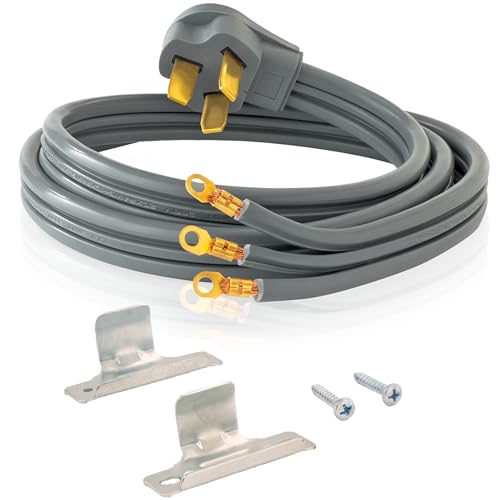
This 3-prong, 40-amp cord is designed for ranges using a three-conductor power source. The middle wire functions as neutral, while the outer wires are hots. It is described as universal for many brands and includes two 8-gauge wires and one 10-gauge wire. Best for older homes or ranges configured with a 3-wire outlet. Limitation: not suitable for modern 4-prong outlets without outlet conversion or reconfiguration.
SUUJI ERR117 Range Burner Receptacle Kit

This 2-pack ERR117 kit includes a replacement receptacle block, high-temperature leads, ceramic wire nuts, and mounting brackets. It is designed for compatibility with multiple Whirlpool, Kenmore, Frigidaire, and other brands’ ranges. Best for DIY repairs or when a range burner’s receptacle shows wear. Limitation: it is a receptacle kit, not a cord, so it must be paired with the correct power cord and wiring when installing.
Buying Guide: Key Purchase Considerations
- Outlets and Amperage: Confirm your range’s required amperage (typically 40A or 50A) and ensure the cord matches the outlet type (3-prong or 4-prong).
- Cord Length and Flexibility: Choose a length that provides adequate reach without excess slack. Longer cords can add convenience but may introduce additional resistance and tangling.
- Compatibility With Brands: While many cords claim universality, verify compatibility with your stove’s model and the outlet configuration before buying.
- Prong Configuration: 4-prong cords isolate ground and neutral, while 3-prong configurations may be necessary for older installations. Do not mix incompatible configurations.
- Durability and Build: Look for heavy-duty shells and solid contact points, especially for high-usage kitchens or professional settings.
- Safety and Compliance: Ensure products meet UL or equivalent safety standards and are appropriate for your locale’s electrical codes.
FAQ
- What amperage should I choose for a standard residential range?
Most residential ranges use 40A or 50A cords; check your appliance plate to confirm. - Is a 3-prong cord safer than a 4-prong cord?
A 4-prong cord provides separate ground and neutral, which is safer for newer homes; use 3-prong only if your outlet is configured for it. - Can I replace a range outlet without an electrician?
Outlets can be hazardous; many jurisdictions require a licensed electrician for outlet replacement or major wiring changes. - Do universal cords fit all stove brands?
Universal claims exist, but verify compatibility with your stove model and outlet. Mismatches can cause poor connections or safety risks. - What maintenance is needed for range cords?
Inspect for cracks, exposed wires, or heat damage. Replace immediately if any damage is found. - Are replacement burners’ receptacles common across brands?
Receptacle kits like ERR117 are designed to fit multiple brands, but verify model compatibility before purchasing.