Plug-and-play wind turbines are designed for straightforward setup, minimal maintenance, and reliable off-grid or supplemental power. This guide highlights five practical options that balance ease of use with performance, helping homeowners, RV owners, and small property owners find the right fit for residential use. Each pick is evaluated for who it’s best for, along with a clear, data-backed rationale and a practical limitation to consider.
| Product | Why It Stands Out | Best For |
|---|---|---|
| Thames & Kosmos Wind Power V5.0 Stem Kit | Updated design with indoor/outdoor versatility and hands-on learning about wind energy. | Young builders and hobbyists who want to explore wind power concepts in a real model. |
| Thames & Kosmos Wind Power V4.0 Stem Kit | Simple, weatherproof construction with a 3-foot turbine for basic electricity generation experiments. | Educational setups and outdoor demos with small-scale wind power projects. |
| VEVOR 12V-500W Wind Turbine Kit | Moderate power output, MPPT controller, and adaptable wind-range suited for homes and RVs. | Homes, cabins, and mobile setups needing a reliable energy boost in variable wind. |
| pofluany 800W Wind Turbine | Low-start wind speed, durable nylon blades, and three-phase output suitable for low-wind areas. | Residential yards and small off-grid applications in low-wind regions. |
| FJYAWEN 3000W Vertical Wind Turbine | High power ceiling with alloy steel construction and low-noise operation for home use. | Higher energy demand sites where compact vertical-turbine footprint matters. |
Notes: The table above compares five practical plug-and-play wind turbine options across typical residential scenarios. It helps buyers identify who each product is best for and why, while highlighting a potential limitation to consider before purchasing.
Thames & Kosmos Wind Power V5.0 STEM Kit

The Thames & Kosmos Wind Power V5.0 is a fifth-generation STEM kit that lets users build a 3-foot-tall turbine and explore wind energy. It emphasizes practical learning about how blades, hubs, gearing, and rotations influence power output. It’s best for ambitious learners who want a hands-on model with clear educational value. Choose this if you want a compact, classroom-friendly demonstration unit with outdoor and indoor versatility. A limitation is that performance depends on external wind or a compatible indoor fan setup, which may affect consistency.
Best for: Students, hobbyists, and families seeking a measurable wind-energy learning experience in both indoor and outdoor environments.
Thames & Kosmos Wind Power V4.0 STEM Kit
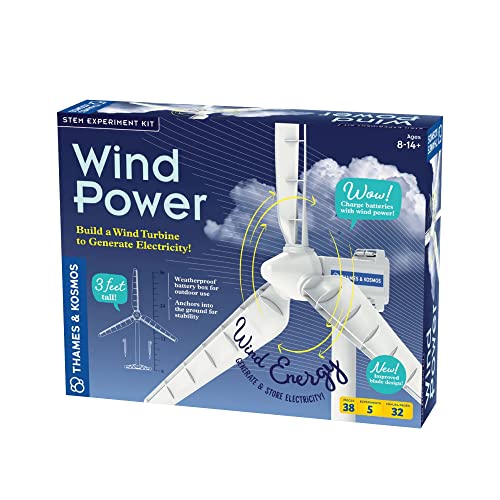
The V4.0 kit builds a 3-foot turbine for electricity generation and emphasizes durability with single-piece blade construction and weatherproofing. It’s well-suited for educators and home experiments that require a robust, easy-to-assemble turbine. Opt for this if you want a straightforward, durable wind-generation project for outdoor use and simple power demonstrations. A potential drawback is that real-world power generation is contingent on wind conditions or a compatible indoor wind source.
Best for: Educational setups and hobby projects focusing on real-world wind electricity generation in a compact model.
VEVOR 12V-500W Wind Turbine Kit

The VEVOR kit offers a 500W output with an MPPT controller and a 12V three-phase generator. It is designed to maximize energy conversion across a broad wind range and is suitable for homes, RVs, boats, and small farms. It’s best for homeowners who want a scalable wind solution with intelligent current- and voltage-management. A limitation is that performance data depends on site wind conditions, and installation may require some technical comfort with electrical systems.
Best for: Off-grid and semi-off-grid properties seeking reliable energy capture with a smart controller for domestic use.
800W Horizontal Wind Turbine Generator

This unit uses a horizontal-axis design with a built-in controller and durable nylon blades, optimized for low-wind areas. It starts generating electricity at about 1.0 m/s and targets residential or small-scale off-grid usage where wind is relatively modest. Best for: homes in areas with modest wind where early power generation matters. Caution: actual output depends heavily on consistent wind access, and installation may require awareness of local regulations around turbine height and structure.
Best for: Moderate-wind residential locations seeking early-stage energy capture with straightforward setup.
Lionel Plug-Expand-Play Wind Turbine Model

The Lionel Plug-Expand-Play Wind Turbine is a model accessory designed for O Gauge toy layouts. While not a real power-generator for homes, it demonstrates turbine motion with realistic blade rotation on a Lionel rail system. Best for: hobbyists integrating wind imagery into model railways and educational displays. Limitation: It is a display or toy accessory, not an actual residential power source.
Buying Guide: Practical Considerations For Residential Wind Power
- Assess wind availability: Small residential turbines perform best when average wind speeds exceed 3–4 m/s. Local wind data helps estimate potential output.
- Choose a suitable turbine type: Horizontal-axis rotors are common and offer efficiency in steady winds. Vertical-axis models can be quieter and less sensitive to wind direction, but may deliver different power profiles.
- Consider installation ease: Plug-and-play models often include mounting hardware and simple wiring. Ensure you have safe access to a suitable mounting location away from obstructions.
- Check compatibility: For grid-tied or off-grid setups, confirm the controller’s compatibility with your battery bank or inverter and ensure proper electrical safety practices.
- Evaluate noise and aesthetics: Residential apps require quiet operation and a turbine size that fits your property’s visual standards and local regulations.
- Maintenance expectations: Look for sealed gearboxes, corrosion-resistant housings, and bearings designed for outdoor use. Regular inspections help sustain performance.
- Safety and regulations: Verify zoning rules, height restrictions, and any permitting requirements before installation.
- Cost vs. benefit: While many plug-and-play options emphasize ease of use, assess long-term energy savings and maintenance costs relative to your local energy needs.
Frequently Asked Questions
- What is a plug-and-play wind turbine for home use? A plug-and-play wind turbine is designed for simple installation with minimal technical setup, often including integrated controllers and clear wiring for rapid deployment.
- Do I need professional installation for a residential turbine? It depends on local regulations, electrical codes, and the complexity of the system. Some models are designed for DIY installation, while others may require professional help for safety and code compliance.
- Can a turbine work indoors? Some small educational or model kits can operate with indoor wind sources like fans, but most residential turbines rely on outdoor wind exposure to generate meaningful power.
- What size turbine is right for a typical home? For most homes, a turbine in the 400–1500W range is common for supplemental power, depending on wind resource and energy goals. Larger systems deliver more power but require more space and investment.
- How much power can I expect from a low-wind area turbine? In low-wind regions, even small turbines may struggle to generate steady power. Look for models with low start-up wind speeds and good efficiency at moderate wind.
- What maintenance is required? Regular inspections of blades, bearings, and electrical connections help prevent performance drops. Weatherproof housings and MPPT controllers support longevity in outdoor conditions.