Answering your search intent directly: these moisture readers help you detect moisture inside walls without damage, making them ideal for home inspection, remodeling, and water-damage prevention. Pinless models are best for quick scans on drywall and masonry, while pin-type meters offer precise moisture readings in wood. The following selections are chosen for reliability, depth capability, and practical guidance for American homeowners and professionals.
| Product | Best For |
|---|---|
| Klein Tools ET140 Pinless Moisture Meter | Non-destructive detection up to 3/4 inch; ideal for drywall and masonry |
| General Tools MMD4E Digital Moisture Meter | Situational alerts for mold-prone areas; versatile for leaks |
| General Tools MMD7NP Digital Moisture Meter | Deep, surface-friendly readings up to 3/4 inch |
| AMERICAN MUTT TOOLS Mutt Tools Pinless Meter | Broad wall and surface checks with quick alerts |
| PREXISO Wood Moisture Meter | Multi-mode with pin-type for accurate wood and walls |
Each product is described below with who it’s best for, why it was selected, and a practical caveat to consider during purchase.
Klein Tools ET140 Pinless Moisture Meter

Best For: Drywall, wood, and masonry surveys without surface damage. Why selected: non-destructive detection up to 3/4 inch deep uses EMF technology to locate moisture quickly. Caution: Pinless meters can give lower accuracy over metal or certain coatings; interpret readings in context with visual signs.
General Tools MMD4E Digital Moisture Meter
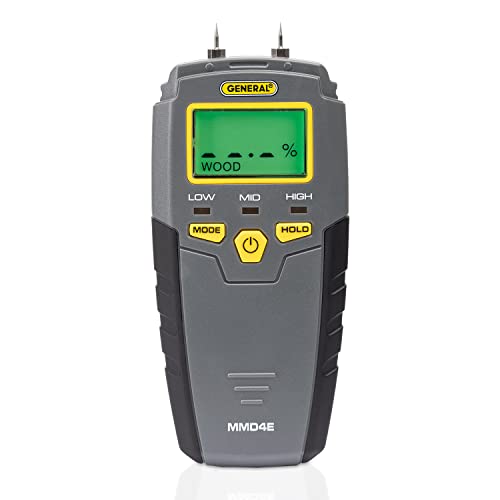
Best For: Detecting moisture in suspected mold areas and leaks. Why selected: features a backlit LCD, audible/visual alerts, and extra pins for flexible testing. Caution: Pin-type meters can damage delicate surfaces if misused; use on treated surfaces or use pinless options for sensitive jobs.
General Tools MMD7NP Digital Moisture Meter

Best For: Deep, non-intrusive readings in walls and surfaces. Why selected: pinless design, auto-calibration, large backlit display, and a broad range suitable for drywall and masonry. Caution: Readings can be influenced by surface coatings or metal elements; verify with complementary checks when anomalies appear.
AMERICAN MUTT TOOLS Mutt Tools Pinless Meter

Best For: Quick wall and surface checks in home inspections. Why selected: measures up to 2 inches deep, non-destructive, with instant alerts and a hold function for quick decisions. Caution: Higher depth readings may require multiple placements to map moisture spread accurately.
PREXISO Wood Moisture Meter

Best For: Wood and walls with multiple measurement modes. Why selected: pin-type measurement for accuracy, plus temperatures and humidity readouts; useful for woodworking projects and damp-prone areas. Caution: Pin-type use can leave small holes; reserve for surfaces where pin holes are acceptable.
Buying Guide: Moisture Readers For Walls
Key considerations help tailor a purchase to your space and goals. Depth capability, pinless versus pin-type, surface compatibility, and data presentation all affect usefulness and accuracy in real-world conditions.
Depth And Surface Type
Pinless meters read beneath the surface without leaving marks, making them preferable for finished walls and delicate surfaces. Pin-type meters can offer higher precision on wood or porous materials but may leave tiny holes. For wall-to-wall screening, opt for pinless tools with at least 3/4 inch detection depth.
Depth Performance By Material
Wood readings typically require a meter with calibrated scales for softwood and hardwood. Masonry and drywall readings can vary with substrate and plaster thickness. Look for models that specify readings up to 3/4 inch or more into drywall, plaster, or masonry for reliable wall inspections.
Alerts, Display, And Calibration
Backlit LCDs and audible alerts help in low-light conditions. Auto-calibration reduces setup time, while a hold function preserves a reading for later documentation. Consider a model with multiple color indicators to quickly categorize moisture levels.
Practical Use Scenarios
Use a pinless meter for initial sweeps in basement walls or exterior masonry. Switch to a pin-type meter for wood framing behind walls or when you need precise moisture content values for remediation planning. Always corroborate readings with visual cues like staining, musty odors, or swelling materials.
Maintenance And Safety
Keep sensors clean and dry between measurements. Replace batteries as needed to maintain accuracy. Avoid metal pipes, wiring, or steel studs near sensors when using high-sensitivity devices, as interference can affect readings.
FAQ
- What is the difference between pinless and pin-type moisture meters?
Answer: Pinless meters scan moisture beneath the surface without creating holes, while pin-type meters insert pins for precise moisture content readings at specific depths. - How deep can these meters read moisture in walls?
Answer: Most models detect up to 3/4 inch (19 mm) or slightly more, suitable for drywall and some masonry. - Can these meters detect hidden mold risk?
Answer: They indicate moisture presence, which is a prerequisite for mold risk but do not diagnose mold itself. Use with environmental assessment. - Which type is best for wood against walls?
Answer: For wood framing behind walls, a pinless meter with wood-mode compatibility offers quick screening and avoids surface damage. - Should I rely on a single reading?
Answer: No. Take multiple readings across different locations to map moisture patterns and confirm with visual evidence. - Are these meters suitable for professional contractors?
Answer: Yes, many models provide reliable, non-destructive moisture detection useful for home inspection and remediation planning.