Finding a reliable four-bank marine battery charger is essential for keeping boat systems powered and batteries healthy. This guide reviews top four-bank models, comparing charging modes, battery compatibility, waterproof ratings, and smart features. Whether you run lead-acid, AGM, LiFePO4, or lithium batteries, these options are built to endure harsh marine environments while delivering precise, safe charging. Explore each product’s strengths and a practical buying guide to help you choose the right four-bank charger for your vessel.
Summary of featured products: NOCO GENPRO10X4 (NOCO), Minn Kota Precision MK-440PCL, Guest 2740A, FORM Fusion 10X4, and VEVOR 4-Bank Charger. Brands vary, but each unit provides four independently controlled charging banks, 12V operation, and support for multiple battery chemistries. The following sections offer a concise look at each model’s standout features and suitability for different boating needs.
NOCO Genius GENPRO10X4: High-Performance 4-Bank Charger
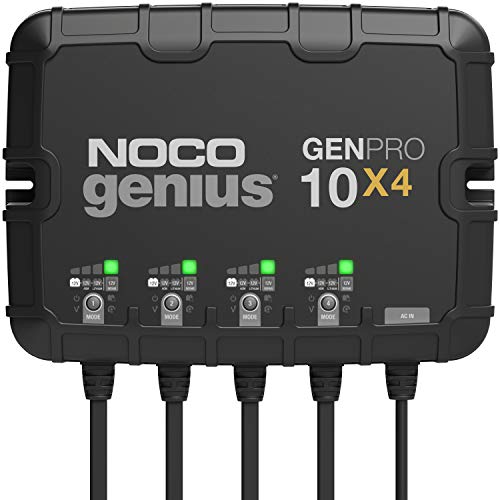
The GENPRO10X4 provides a total of 40 amps across four independent banks, delivering 10 amps per bank. It is described as 10% smaller and 33% more powerful than earlier models, optimized for harsh marine conditions. Each bank supports 12V, 12V AGM, 12V Lithium, and a 12V Repair Mode, enabling precise charging for lead-acid and lithium batteries. This model emphasizes protection features like overcharge safeguards and temperature compensation to maintain battery health.
Minn Kota Precision MK-440PCL On-Board Charger

The MK-440PCL offers four banks with 10 amps each and automatic temperature compensation to adjust charging based on ambient conditions. It supports battery type selection—Lithium (LiFePO4), AGM, or flooded lead acid—to optimize safety and charge speed. Low-line voltage compensation ensures reliable charging even when shore power is weaker than standard. This model targets boaters needing precise, safe multi-battery charging across diverse battery chemistries.
Guest 2740A On-Board 40A Four-Bank Charger

The Guest 2740A delivers 40 amps across four banks with 120V input. It features comprehensive safety protections including reverse polarity, over-current, over-voltage, over-temperature, and ignition protection, plus inline fuses for DC wire protection. The unit is fully waterproof to IP67 and designed for both fresh and saltwater applications, making it suitable for a wide range of marine vessels.
FORM Fusion 10X4 Marine Battery Charger

The FORM Fusion 10X4 provides four banks with a total of 40A (10A per bank) and is designed to handle LiFePO4, AGM, and deep cycle batteries. It features automatic maintenance mode that switches to trickle charging once batteries are full, helping extend battery life. An IP67-level waterproof design and WeatherShield coating protect the unit in salt, rain, or high humidity, while advanced battery sensing optimizes charging across chemistries.
VEVOR 4-Bank Marine Battery Charger
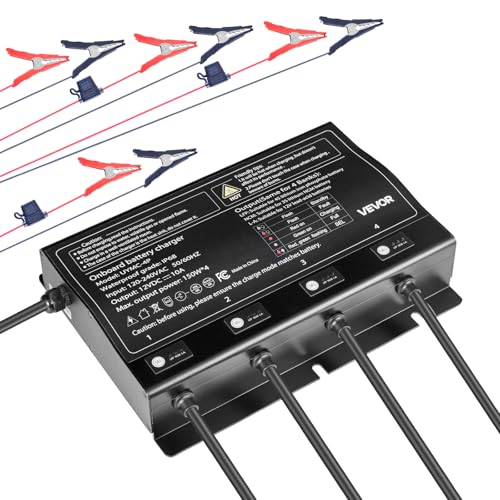
The VEVOR four-bank charger delivers 4 x 10A for 12V operation, supporting LiFePO4, NCM lithium, and lead-acid batteries. It emphasizes IP68 waterproofing and dust resistance, making it robust for harsh marine environments. The charger uses multi-stage charging with intelligent management to adapt power based on battery status, aiming for efficient and safe charging across different chemistries.
Buying Guide: Key Considerations For A Four-Bank Marine Charger
When selecting a four-bank marine battery charger, consider battery type compatibility, charging modes, and environmental durability. Assess the following perspectives to ensure a well-rounded choice for your vessel:
- Battery chemistry support: Choose a charger that supports the battery types you use—lead-acid, AGM, Li-ion, and LiFePO4. Multicode or automatic mode simplifies operation when mixing chemistries.
- Per-bank control: Independent banks allow staggered or simultaneous charging without cross-interference. This is especially useful for boats with varied battery banks serving starting, house, trolling motor, and dry storage systems.
- Temperature compensation: Marine environments experience wide temperatures. Chargers with temperature sensing help prevent undercharging or overcharging in hot sun or cold air.
- Waterproof and durability: Look for IP ratings (IP67 or IP68) and robust housings designed for boat decks, saltwater exposure, and vibration.
- Maintenance and smart features: Automatic maintenance or trickle modes preserve battery life after full charge. Some models offer battery health diagnostics and state-of-charge indicators for ongoing monitoring.
- Power source compatibility: Confirm the charger works with standard shore power and accepts typical US AC inputs (120V). Check whether it requires ventilation or has low-noise operation for cabin spaces.
- Installation considerations: Ensure mounting compatibility, cable sizing, and available space on your vessel. Access to climate and wiring routes can influence model choice.
In practice, boaters often prioritize reliability, robust safety features, and clear monitoring capabilities. For saltwater boats, models with IP67/IP68 protection and weatherproof coatings reduce maintenance concerns. If you operate multiple battery chemistries, a charger with selectable modes per bank or automatic sensing can simplify usage while preserving battery health across the fleet of devices on board.