Yes, these low voltage electrical cables are designed for safe, simple outdoor lighting setups. This guide highlights five top options, ideal for homeowners, hobbyists, and landscapers seeking reliable, flexible wiring for landscape lighting, signs, and outdoor projects. Each pick is evaluated for conductivity, durability, and ease of installation. The buyer best suited for each product is noted, along with practical cautions to consider before purchase.
Summary at a glance:
- GOSDENG 12/2 Low Voltage Landscape Wire — Best for flexible, lightweight installation with copper-clad aluminum for cost efficiency.
- SUNVIE 12/2 Low Voltage Landscape Wire (250FT) — Best for long runs and direct burial with pure copper.
- SUNVIE 12/2 Low Voltage Wire (100FT) — Best for shorter runs with strong conductivity.
- NAOEVO 18 Gauge Wire 2 Conductor — Best for automotive, marine, or compact projects needing thin, durable insulation.
- Wirefy 14/2 Low Voltage Landscape Wire (100 ft) — Best for easy, flexible installation with direct burial suitability.
The following table compares core attributes to help quick decisions:
| Product | Best For | Conductor Type | Direct Burial | Notes |
|---|---|---|---|---|
| GOSDENG 12/2 | Budget-friendly lighting with good flexibility | 12 AWG, Copper Clad Aluminum | Yes | Lightweight, flexible, economical |
| SUNVIE 12/2 (250FT) | Long runs, high brightness | 12/2, Pure Copper | Yes | ETL listed, VW-1, 300V |
| SUNVIE 12/2 (100FT) | Short-to-mid runs, reliable power | 12/2, Pure Copper | Yes | Direct burial-ready |
| NAOEVO 18 GA | Compact wiring, non-LED automotive/marine use | 18 AWG, tinned copper | Yes | IP68 waterproof jacket |
| Wirefy 14/2 (100 FT) | Beginner-friendly, flexible projects | 14 AWG, Pure Copper | Yes | Outdoor direct burial suitable |
GOSDENG 12/2 Low Voltage Landscape Wire
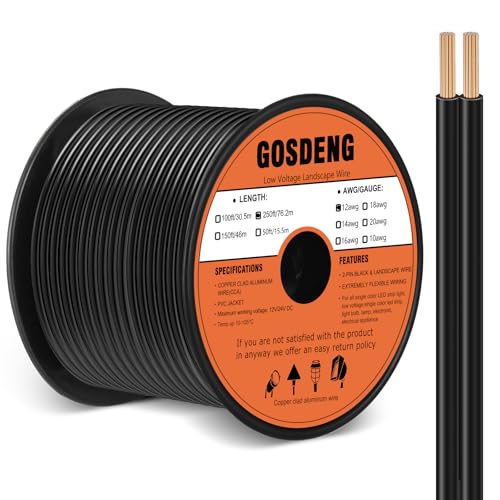
Best for budget-focused projects that still require reliable performance. The 12 AWG, 2-conductor black cable uses a copper-clad aluminum (CCA) design with a PVC jacket. It delivers reasonable conductivity and mechanical strength for typical landscape lighting and low-voltage connections. Direct burial compatibility supports straightforward yard installations.
Who it’s best for: homeowners prioritizing cost savings without sacrificing essential performance, and DIY landscapers needing a flexible wire for longer runs.
Why chosen: CCA offers lighter weight and flexibility with reduced cost, enabling longer runs without heavy installation equipment.
Caution: CCA has different corrosion characteristics from pure copper; verify system voltage and terminations to ensure longevity in moisture-prone areas.
SUNVIE 12/2 Low Voltage Landscape Wire (250FT)
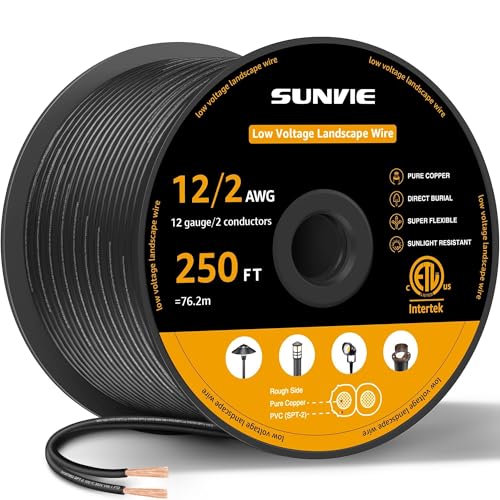
Best for long-distance runs where stable brightness matters. This 250-foot spool uses pure copper conductors with SPT-2 black PVC insulation and VW-1 fire resistance. It supports up to 300V and is designed for direct burial, offering strong conductivity with minimal voltage drop over distance.
Who it’s best for: gardeners and professionals setting up extended landscape lighting circuits that demand dependable power distribution.
Why chosen: Pure copper minimizes voltage drop over long runs and maintains brightness.
Caution: Longer runs may require careful strain relief at terminations to preserve connection integrity.
SUNVIE 100FT 12 Gauge Low Voltage Wire
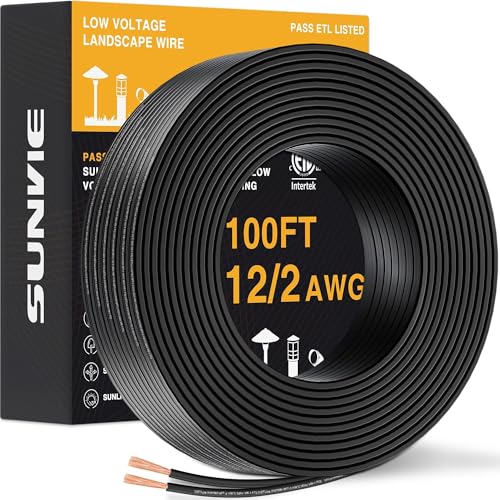
Best for mid-length, high-power lighting setups. The 12 AWG, 2-conductor wire uses pure copper with a durable PVC jacket and direct burial capability. It supports a maximum worked voltage of 300V, offering robust performance for mid-sized landscaping projects.
Who it’s best for: project builders needing consistent power delivery in moderate-length runs.
Why chosen: Pure copper provides reliable conductivity and reduced voltage drop.
Caution: If you’re wiring near moisture, ensure proper sealing at splices to prevent exposure of conductors.
NAOEVO 18 Gauge Wire 2 Conductor

Best for compact installations where flexibility and small size matter. This 18 AWG wire uses tinned copper with an outer PVC jacket rated for up to 600V. It’s designed for DC low-voltage wiring and is suitable for automotive, marine, or lamp wiring in tight spaces.
Who it’s best for: installers needing a thin, flexible conductor for intricate layouts or tight conduit spaces.
Why chosen: Higher strand count and tinned copper offer improved oxidation resistance and flexibility.
Caution: 18 AWG is thinner than typical landscape wire; it may not be ideal for long runs or high-current fixtures where voltage drop could be a concern.
Wirefy 14/2 Low Voltage Landscape Wire (100 FT)

Best for beginner-friendly projects and flexible installations. The 14 AWG, 2-conductor wire is pure copper and rated for outdoor use with direct burial capability. It’s ideal for paths, decks, and garden lighting where ease of use is prioritized.
Who it’s best for: DIY homeowners starting landscape lighting projects who want straightforward stripping and connection.
Why chosen: Larger-gauge copper provides reliable current capacity for typical LED and small fixtures.
Caution: 14 AWG has higher resistance than thicker gauges; for very long runs or high-load fixtures, consider thicker wire to minimize voltage drop.
Buying Guide: Key Considerations For Low Voltage Landscape Wire
What gauge should you choose?
Lower gauge numbers (like 12 or 14) carry more current with less voltage drop over distance. Use thicker wire for longer runs or more powerful fixtures. For shorter, decorative lighting, 16–18 GA can work but may limit length and brightness.
Is copper or copper-clad aluminum better?
Pure copper conducts better and has lower resistance, which reduces voltage drop. Copper-clad aluminum is lighter and cheaper, often suitable for longer runs if cost or weight is a concern, but you may notice higher resistance over distance.
Direct burial suitability matters.
If you plan to bury the wire directly, ensure the jacket is rated for outdoor exposure, moisture resistance, and UV stability. Some wires are specifically designed for direct burial, while others require conduit protection.
Voltage rating and compatibility.
Most landscape lighting runs use low voltage (12–24V). Check the maximum working voltage (often 300V in listed products) to ensure compatibility with your transformers and fixtures.
Durability and weather exposure.
Look for jackets that resist sunlight, moisture, abrasion, and chemicals. Larger, heavier jackets tend to last longer in harsh environments, though they can be stiffer to handle in tight bends.
Installation ease and future-proofing.
Consider wire flexibility, ease of stripping, termination connectors, and whether you may expand the system later. A spool with extra length helps accommodate future lighting zones.
Frequently Asked Questions
- What gauge wire is best for landscape lighting? For most residential projects, 12 or 14 gauge offers a balance of current capacity and manageable voltage drop; use thicker gauges for longer runs.
- Can I bury landscape wire directly in soil? Yes, if the wire is rated for direct burial and UV/moisture resistance. Otherwise, use conduit or protective sleeving.
- Is copper or CCA better for long runs? Copper provides the best conductivity and lowest voltage drop; CCA can be lighter and cheaper but may exhibit higher resistance over long distances.
- What voltage is typical for landscape lighting? Most systems run at 12V or 24V DC, often powered by a transformer. Ensure your cable is rated for the max system voltage.
- How do I avoid voltage drop? Use thicker gauge wire for longer runs, keep runs as short as possible, and group fixtures to reduce overall resistance.
- Can I mix wire gauges in a single project? Yes, but plan the runs to minimize voltage drop and ensure consistent brightness across zones.