Choosing the right low voltage air circuit breaker (LVACB) helps protect electrical installations from overloads, short circuits, and leakage faults. This article reviews five practical options, spanning DC and AC applications, with a focus on compatibility with DIN rails, ease of installation, and protective features. Each product is evaluated on its current rating, pole configuration, and how it fits typical residential or commercial distribution setups. Use this guide to compare core specs and select a breaker that aligns with your system’s voltage, phase, and protection needs.
Summary table of selected products:
| Product | Brand | Voltage / Poles | Current Rating | Mounting | Key Feature |
|---|---|---|---|---|---|
| Chazcool Miniature Circuit Breaker | Chazcool | DC, 2P, 250V | 63 A | DIN Rail | Fast closing, DC protection |
| smseace DZ47-63 1 Pole | smseace | AC, 230V | 40 A | DIN Rail | Single pole protection for AC circuits |
| smseace 2 Pole 20A | smseace | AC, 400V | 20 A | DIN Rail | Double disconnect protection |
| smseace 1 Pole 32A | smseace | AC, 230V | 32 A | DIN Rail | Single pole, compact DIN rail mount |
| DIHOOL Ground Fault Circuit Breaker | DIHOOL | AC 120V/240V, 2P | 63 A | DIN Rail | Five protection functions incl. leakage, surge, overcurrent |
Chazcool Miniature Circuit Breaker, DC 2P 63A

The Chazcool miniature circuit breaker is designed for low voltage DC systems. It features a 2-pole configuration with a 250V rating and a 63A current capacity, suitable for protecting DC loads and solar or battery installations. The device supports fast closing to minimize arcing and provide reliable protection against overloads. Its modular DIN-rail design with a bistable locking clip enables straightforward installation in distribution boxes. The product description emphasizes DC protection, making it a practical choice for renewable energy setups and other low-voltage DC circuits. Safety and longevity are enhanced by rapid trip performance and a compact, rail-friendly form factor.
smseace DZ47-63 1 Pole AC Breaker

Ideal for 220V branch circuits in residential or light commercial spaces, this single-pole SMSEace DZ47-63 breaker provides protection for AC loads. Rated at 40A and 230V, it fits standard DIN rails and is commonly used to guard individual circuits. Its single-pole operation means it interrupts only the live conductor, which simplifies wiring in straightforward AC installations. The compact dimensions make it a convenient option for spaces with limited clearance, though it does not offer neutral-side disconnection. This is a practical choice for standard AC protection needs in homes or small offices.
smseace 2 Pole 20A AC Breaker

This two-pole SMSEace breaker supports 20A at 400V and provides dual-disconnect protection by interrupting both the live and neutral conductors. The dual-pole design enhances safety for AC circuits and is suitable for applications requiring complete circuit isolation. The device’s dimensions list a compact footprint compatible with standard DIN rails. It is especially appropriate for distribution panels where full protective shutdown of a circuit is necessary, and where the neutral needs to be simultaneously isolated during tripping.
smseace 1 Pole 32A AC Breaker
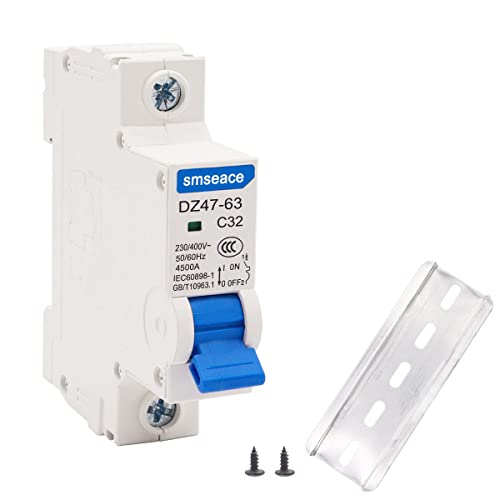
This single-pole AC breaker from SMSEace handles 32A at 230V and is designed for DIN rail mounting in distribution panels. It is a straightforward option for protecting individual 230V circuits in residential or commercial settings. While it provides essential overcurrent protection, it does not offer multipole disconnection or leakage protection on its own. This makes it a solid choice for circuits where only live-wire protection is required and space is constrained.
DIHOOL Ground Fault Circuit Breaker with Leakage Protection

The DIHOOL unit combines overcurrent protection with leakage current protection and surge protection, delivering a multi-function solution for AC circuits. With a 63A rating and a 120/240V operating range, it uses a 2-pole design to provide robust protection for both hot and neutral conductors. This device includes multiple protection features such as leakage protection (30 mA), surge protection, and short-circuit protection, along with a 35MM DIN rail mounting system. It is well-suited for main distribution panels that require comprehensive fault protection and rapid isolation in a single module.
Buying Guide: Key Considerations For Choosing LVACB
- Voltage and current rating: Ensure the breaker’s nominal voltage matches your system (AC 120/230/400V as applicable) and its current rating aligns with the circuit’s load. Do not overspec or underspec the device for the target circuit.
- Pole configuration: Single-pole breakers interrupt one conductor and are common for simple circuits. Double-pole breakers disconnect both live and neutral, offering complete circuit isolation for 2-wire systems. For DC applications, check DC compatibility and the required pole count.
- Din rail compatibility: Most LVACBs are designed for standard 35 mm DIN rails. Confirm rail mounting fit in your panel, space clearance, and any clipping or locking features for secure installation.
- Protection features: Overcurrent protection is standard, but some units include additional protections such as leakage (RCCB/GFCI), surge protection, or combination devices. Assess whether you need multi-function protection in a single module.
- Disconnection behavior: Consider whether you need complete isolation of both conductors (live and neutral) or protection focused on the live wire. This affects wiring layouts and safety considerations.
- Application type: For DC circuits (like solar or battery systems), ensure the device is rated for DC use and capable of handling potential arcing differences. For AC circuits, standard AC ratings apply.
- Physical dimensions and fit: Verify the device size and mounting depth to fit inside the distribution box or panel without obstructing other components.
- Certification and standards: Look for breakers that comply with relevant safety standards and regional codes to ensure reliability and warranty coverage.
- Replacement and compatibility: If upgrading an existing panel, check compatibility with current busbars, labeling, and trigger characteristics to avoid retrofitting issues.
In summary, for low voltage systems, prioritize DC-rated breakers for solar or battery applications and AC-rated breakers for typical residential or commercial circuits. Consider pole count, leakage protection needs, and DIN rail compatibility to optimize safety, ease of installation, and future maintenance. The five reviewed options cover common scenarios including DC protection, single- and multi-pole AC protection, and comprehensive fault protection in a single unit.