Choosing the right lithium marine battery charger can extend battery life, protect lithium packs, and keep systems ready for cruising. This guide highlights five top onboard chargers that balance durability, multi-bank capability, and smart charging modes for LiFePO4 and other battery chemistries. Each product supports 12V systems and offers IP-rated waterproofing for marine environments. Read on to compare bank counts, charging modes, and forced charging options that help maintain batteries even in harsh conditions.
| Product | Bank Count | Total Amp Rating | |
|---|---|---|---|
| NOCO Genius GEN5X2 | 2 | 10 A | Yes |
| NOCO Genius GEN5X3 | 3 | 15 A | Yes |
| FirstPower Pro 2 Bank 5X2 | 2 | 10 A | Yes |
| Upgraded 3 Bank 10X3 | 3 | 30 A | Yes |
| NOCO Genius GENPRO10X2 | 2 | 20 A | Yes |
These selections emphasize onboard reliability, independent bank charging, and modes tailored for LiFePO4 and other chemistries. They are suitable for vessels that require continuous 24/7 maintenance, deep-cycle support, and easy field operation. The following sections break down each option’s strengths, compatibility, and key configuration details to help you pick the right model for your boat’s electrical setup.
NOCO Genius GEN5X2: 2-Bank, 10A Onboard Battery Charger
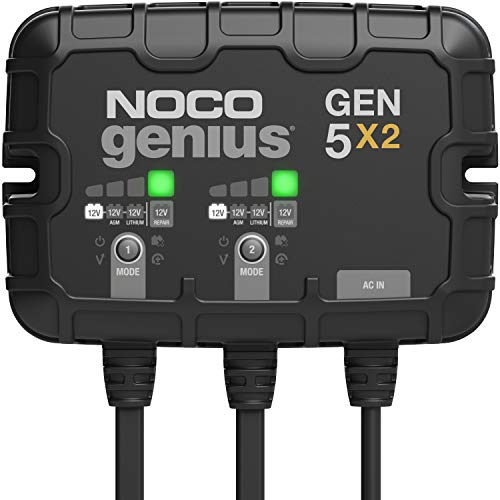
Two independent banks deliver 5 A per bank for simultaneous charging of marine, starter, and deep-cycle batteries. The GEN5X2 offers selectable modes including 12V, 12V AGM, 12V Lithium, and a repair mode. It is designed to withstand harsh marine environments with water-resistant construction and temperature compensation. The unit is compact for spaces under the helm or in a battery compartment, while maintaining robust performance for LiFePO4 and lead-acid systems.
NOCO Genius GEN5X3: 3-Bank, 15A Onboard Charger
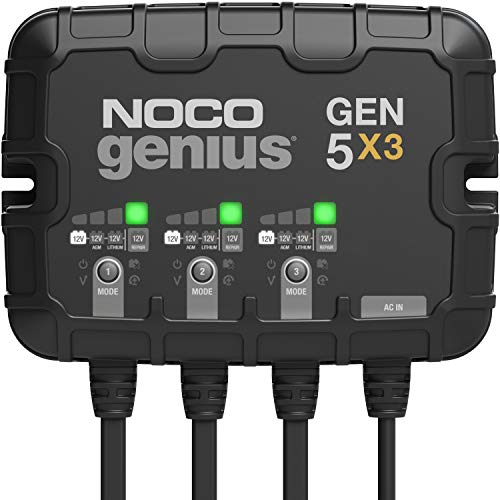
The GEN5X3 adds a third bank for more complex electrical setups without sacrificing compactness. With 5 A per bank, it independently charges 12V batteries across marine, boat, starter, and deep-cycle systems. It includes multiple charging modes per bank and a repair mode, enabling precise optimization for LiFePO4 and other chemistries. This model is well-suited for larger vessels with multiple battery banks and high daily draw from electronics and propulsion.
FirstPower Pro 2 Bank 5X2: 10A Total, 2-Bank Charger

Designed for dual-bank charging with 5 A per bank, this model supports 12V SLA/AGM, 12V Lithium, and 12V Calcium modes, with IP68 waterproofing for 24/7 onboard charging. Each battery can be set to its own mode via the MODE button, and a Force Mode helps revive deeply discharged cells below 1V. It’s suitable for boats with mixed battery chemistries and a demand for independent bank control in rough sea conditions.
FirstPower Pro Upgraded 3 Bank 10X3: 30A Total, 3-Bank

This upgraded three-bank charger delivers 10 A per bank, totaling 30 A. It provides IP68 sealing for all-weather use and supports 12V SLA/AGM, 12V Lithium, and 12V Calcium modes. Each bank can be tuned independently, with a Mode control to optimize charging for alternating battery chemistries. The Force Mode option enables charging of dead batteries, making it practical for boats with long standby periods or batteries that settle to very low voltages.
NOCO Genius GENPRO10X2: 2-Bank, 20A Onboard Charger

The GENPRO10X2 features high-capacity charging for larger boats and fleets, with 10 A per bank across two banks. It supports 12V, 12V AGM, 12V Lithium, and a Repair Mode for battery restoration. Its rugged design and temperature compensation help maintain optimal charging in varied marine climates, making it a solid choice for vessels with substantial power demands and LiFePO4 packs in the system.
Buying Guide
Key considerations when selecting a lithium marine battery charger:
- Bank count and total amperage: Choose a charger with enough banks to match your battery banks and a total current that avoids long charging times or heat buildup.
- Battery chemistry support: Ensure compatibility with LiFePO4 as well as lead-acid options if you have mixed chemistries on board.
- Charging modes per bank: Look for selectable modes (12V, AGM, Lithium) and a repair mode to address sulfation or dead cells.
- Waterproofing and ruggedness: IP68 or better is ideal for exposed locations; consider enclosure ratings and temperature tolerance for marine environments.
- Independent bank control: Independent mode selection per bank offers flexibility when different batteries serve different purposes (starter vs. deep-cycle).
- Force/Recovery features: Force Mode or dead-battery recovery can be valuable when batteries are deeply discharged or sitting idle for long periods.
- Size and installation: Ensure the unit fits your mounting space and electrical panel layout; verify wiring and fuse requirements.
- Maintenance and monitoring: Some chargers offer indicators, fault protection, and smart features to minimize stray currents and extend battery life.
- Warranty and support: A robust warranty and accessible support can reduce downtime on the water.
When comparing models, weigh the importance of bank count against the vessel’s typical daily power use. Smaller boats with limited electrical needs may benefit from a compact two-bank solution, while larger yachts with multiple systems might justify a three- or four-bank charger. For LiFePO4 users, prioritize models with explicit lithium modes and temperature compensation to safeguard high energy-density cells in varying climates.