Choosing a lab bench power supply involves balancing precision, stability, protection, and ease of use. This guide spotlights five well-regarded options that cover a range of needs—from compact, precise CV/CC units to high-current benches with multiple protections and USB charging. Each product section includes key features, practical considerations, and how it fits typical American lab setups. Use the summary table to compare essentials at a glance.
| Product | Brand | Voltage Range | Current Range | Special Notes |
|---|---|---|---|---|
| Jesverty SPS-3010 | Jesverty | 0-32V | 0-10A | 4-digit display; CV/CC auto-switch |
| NICE-POWER B0C7ZZV972 | NICE-POWER | 0-300V | 0-1A | Programmable with software |
| Jesverty SPS-3010V | Jesverty | 0-32V | 0-10A | Coarse/Fine encoder; USB-C/USB-A |
| ITECH IT6721 | ITECH | 0-60V | 0-8A | Memory function; CC/CV auto |
| NICE-POWER 30V/30A | NICE-POWER | 0-60V | 0-30A | Encoder knob; safety outputs |
Jesverty SPS-3010: 0-30V, 0-10A Bench Power Supply

The Jesverty SPS-3010 is a compact, switch-mode bench supply offering 0-30V and up to 10A. It features a bright 4-digit LED display showing voltage, current, and power in real time, with resolutions as precise as 0.01V and 0.001A. The device automatically switches between constant-voltage (CV) and constant-current (CC) modes as the load changes, helping maintain accurate outputs during experiments. A 5V/2A USB port adds convenience for powering control electronics or charging devices during longer sessions. This unit is particularly well-suited for education labs and hobbyists who need precise readouts in a small footprint.
Key considerations include its CV/CC auto-switch stability, readability of the display in bright environments, and the impact of load changes on the crossing point between CV and CC. Users should verify that their test setup’s heat dissipation aligns with the device’s compact case. The dual-mode operation is beneficial for battery charging, electronics testing, and sensor calibration where precise voltage or current control is critical.
NICE-POWER DC Power Supply Variable 300V 1A
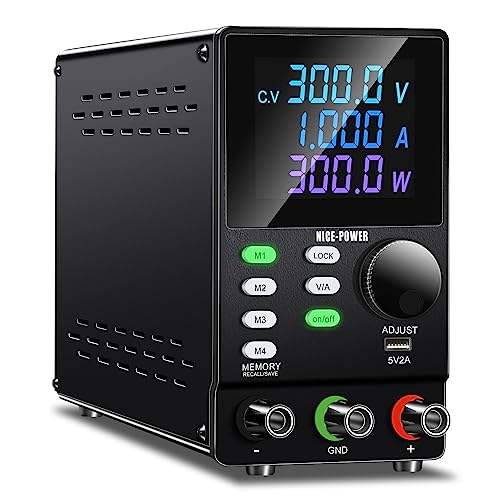
The NICE-POWER 300V 1A programmable DC power supply is designed for precision control via RS232/USB software. It enables computer-based voltage and current regulation, as well as data export for graphs and tables. A dedicated encoder knob allows precise manual adjustment, while an output switch provides quick on/off control to protect the load from accidental output. Memory storage and a lock button add convenience for repeated experiments and safer operation in busy lab environments. This model appeals to electronics labs that perform automated testing or require reproducible, repeatable output profiles.
Considerations include software compatibility (Windows-only, per the manufacturer), the necessity of a dedicated control PC, and how well the unit’s memory storage aligns with your workflow. Users should also assess whether the 300V ceiling matches their typical test voltages, as some applications demand higher voltage or sustained current. The high-precision encoder helps reduce drift when repeating measurements across multiple sessions.
Jesverty SPS-V 0-32V, Encoder-Controlled Output

The Jesverty SPS-V variant upgrades to an encoder-based coarse and fine adjustment system, making voltage and current settings quicker and more precise. With 20W USB-C and USB-A ports, this unit doubles as a compact charging hub for project boards and microcontrollers, alongside core bench testing. The built-in output ON/OFF switch eliminates the need to unplug loads during parameter changes, reducing wear on both the supply and connected devices. The device’s 0.01V/0.001A resolution supports fine tuning for sensitive electronics, including precision sensor circuits or lab experiments that demand tight regulation.
For users, the encoder-based control reduces the likelihood of accidental adjustments and speeds up setup times. However, as with any USB-powered accessory, users should consider cable quality and potential interference in high-noise lab environments. The unit’s compact size makes it a good fit for desktop labs and university teaching spaces where space is at a premium but reliable CV/CC control is essential.
ITECH IT6721: 0-60V, 0-8A, Memory Function

The ITECH IT6721 offers a broad voltage range (0-60V) and current up to 8A, packaged with a memory function to recall frequently used settings. A notable feature is automatic switching between CC and CV modes, allowing uninterrupted operation as load conditions vary. Protection is comprehensive, including OCP, OVP, and OTP, which helps safeguard both the supply and the test subjects. The resolution is 0.01V and 0.001A, delivering precise control for bench testing, calibration tasks, and electronics assembly work.
In practice, the IT6721 suits research labs and university classrooms where multiple CC/CV scenarios are common. Its memory function enables quick reconfiguration for different experiments, while the protection suite provides a safety net for new learners and more complex projects. Users should assess the footprint and heat dissipation at higher current settings, as extended high-current operation can affect longevity and stability in compact benchtop spaces.
NICE-POWER 30V/30A: High-Power Bench Supply

This high-power NICE-POWER model targets demanding lab tasks, offering up to 30V and 30A with encoder and a robust output switch. The front panel integrates a precise encoder knob to set voltage and current, while the back panel provides a high-current output option for safe connection when higher currents are required. The unit supports series/parallel configurations, enabling flexible voltage or current scaling to fit diverse experiments, such as multi-rail testing or larger instrumentation setups. It is best suited for advanced research labs or repair shops that require scalable power delivery with dependable safety features.
Key considerations include safe use of back-panel high-current terminals, proper cooling during heavy use, and the understanding that the front-panel current rating may be limited to 5A for safety. This makes the back panel essential for higher-current applications, ensuring safer operation while maintaining precise control at the front. The encoder knob enhances efficiency in settings changes, which is valuable for iterative testing and device provisioning in professional environments.
NICE-POWER Dual DC Power Supply: 60V 10A Parallel/Series

The NICE-POWER dual supply provides versatile configurations, functioning as two 30V/10A units or as a combined 60V/10A or 60V/20A when paralleled. This 4-in-1 capability supports complex experiments where separate channels or higher current on a single rail are required. The unit carries CE and FCC certifications and includes multiple protections, such as overvoltage, overcurrent, overheating, and short-circuit protections. It suits educational labs, electronics repair, and advanced hobbyist projects that demand flexible power delivery with safety assurances.
Users should consider the practicalities of series and parallel operation, the procedure to engage parallel or series modes, and how to safely route high-current connections. The device’s packaging and cooling need to be compatible with lab benches that operate near other equipment. For teams running long calibration sessions or automated test rigs, this model offers a scalable, protection-first approach to bench power delivery.
Buying Guide: Key Purchase Considerations
- Voltage and current range: Match the supply to your typical test voltages and currents. If you regularly test high-current modules, prioritize higher current capability and robust protection.
- Regulation type: Look for CV/CC auto-switching and clear readouts. Precision is critical for calibration, sensor testing, and microcontroller power.
- Readouts and controls: Four-digit or greater displays with high resolution improve readability. Encoder knobs (coarse/fine) speed setup and reduce drift during experiments.
- Protection features: OCP, OVP, OTP, leakage protection, and short-circuit protection reduce risk to the load and the supply. Ensure safety features align with your lab’s risk management standards.
- Connectivity and software: Optional USB/RS-232 control enables automation and data logging. Windows compatibility may be a consideration for software-driven setups.
- Physical footprint and cooling: Heavier, higher-current units may require more space and better ventilation. Consider the lab bench layout and airflow.
- Safety and certifications: CE/FCC marks and compliance with local electrical standards help ensure reliability in professional environments.
- Expansion options: Series/parallel modes and back-panel high-current terminals enable scaling for higher voltages or currents as project needs grow.
- For hobbyists and teaching labs: Compact units with CV/CC auto-switching and clear displays are ideal for daily learning and small electronics projects.
- For automated research or production testing: Programmable or software-controlled supplies with memory presets support repeatable testing and data logging.
- For high-power applications: Balanced high-current units with robust protection, plus back-panel connections, provide safety and flexibility for demanding tasks.
Overall, the picks above cover a spectrum of bench power supplies suitable for American labs, classrooms, and workshops. When selecting, prioritize repeatability, protection, and ease of use to ensure reliable performance across routine experiments and longer test sessions.