Answering the needs of home electrification and energy backup, these solar panel kits are designed for different lifestyles and budgets. The top picks here suit hobbyists, RV owners, cottages, and full-home back-up systems. Each option is evaluated for ease of setup, scalability, and safety. This guide helps buyers choose kits for permanent installation, portable use, or temporary off-grid needs, with practical notes on what each kit excels at and where to be cautious.
| Product | Best For | Key Benefit |
|---|---|---|
| ECO-WORTHY 10KW Off-Grid System | Home or cabin backup | High parallel capacity and real-time monitoring |
| ECO-WORTHY 200W 12V Starter Kit | RV and beginners | All-in-one, novice-friendly setup |
| ECO-WORTHY 10000W Complete System | Whole-house power | Biggest scalable home system in this list |
| ECO-WORTHY 200W RV Kit | Off-grid RV adventures | Compact, turnkey RV solution |
| Renogy 100W Starter Kit | Starter off-grid projects | Well-known reliability and supports learning |
ECO-WORTHY 10KW Off-Grid System Kit

Best for high-demand homes or remote sites, this kit claims a daily output near 9.36 KWh under ideal sun. It uses 12 pieces of 195W solar panels (2340W total) and a 10KW 120V/240V inverter, with 2 lithium batteries. It supports parallel operation (up to six inverters) for increased capacity and includes a WiFi module for monitoring. This setup targets households with substantial power needs and a preference for a modular, expandable system.
- Best for: homes, cabins, or farms needing substantial off-grid power with future expansion.
- Why selected: strong parallel capability and remote monitoring enable scalable backup power.
- Caution: performance depends on sunlight; parallel configurations add complexity and wiring needs.
ECO-WORTHY 10000W Complete Off-Grid System

This all-in-one setup targets whole-home power with a 48V 314Ah battery and a 10kW inverter. It includes five 590W solar panels (total PV around 2,950W) and integrates a 7-inch color display with Bluetooth/Wi-Fi for monitoring. The manufacturer notes parallel expansion up to six units and system compatibility with multiple battery types. It provides a clear path for homeowners seeking a scalable, robust off-grid solution without sourcing separate components.
- Best for: individuals planning a large, scalable off-grid system for full-time home use.
- Why selected: integrated monitoring and high output capability support ambitious power needs.
- Caution: system size requires adequate space and professional wiring for safety and efficiency.
ECO-WORTHY 200 Watt 12V Starter Kit
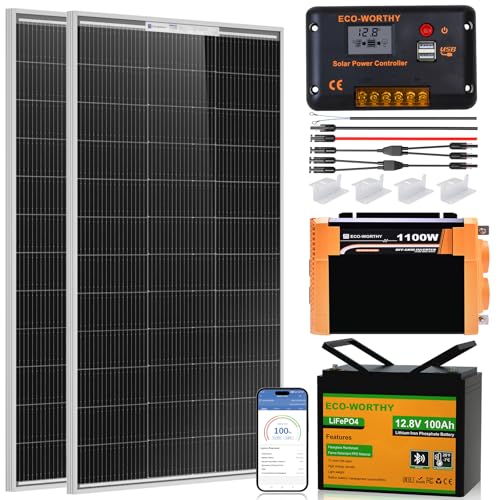
This starter kit is designed for RVs and small off-grid uses. It includes two 100W panels, a 12.8V 100Ah lithium battery, an 1100W inverter, and a 30A PWM controller. The package emphasizes novice-friendly installation and a four-step quick setup. It’s a compact, all-in-one solution for portable power on the go.
- Best for: RV travelers and beginners seeking a compact, easy-to-build system.
- Why selected: complete package reduces the need for separate purchases.
- Caution: total daily output is lower than full-home kits; best for lighter loads.
Renogy 100W Starter Kit

This starter kit provides a reliable entry point into solar with a 100W monocrystalline panel and a PWM charge controller, plus a complete accessory set. It suits off-grid beginners and small projects. The kit emphasizes efficiency and a straightforward assembly path, making it suitable for hobbyists learning solar basics or powering light loads in cabins, vans, or sheds.
- Best for: beginners and small off-grid applications.
- Why selected: well-regarded brand with comprehensive starter components.
- Caution: PWM controllers are less efficient than MPPT in variable sun; anticipate practical daily output around 0.5 kWh to 0.8 kWh per day depending on conditions.
Buying Guide
Key considerations to match your needs and space with the right kit:
- Power needs: Estimate daily energy consumption in kWh to determine PV capacity and storage size. Higher appliances and longer usage require larger systems.
- Location and sun exposure: Kits perform best with full sun. Shading, orientation, and climate affect actual output.
- System type: Off-grid kits work for cabins and remote spots; grid-tied or hybrid setups are better for homes connected to the utility grid.
- Storage: Battery chemistry (LiFePO4 vs lead-acid) influences safety, lifespan, and cost. Higher capacity yields longer backup durations.
- Expandability: If you expect future power needs to grow, choose modular kits that allow adding panels or inverters.
- Maintenance: Look for durable frames, weather-rated enclosures, and monitoring features to simplify upkeep.
- Installation complexity: Some kits are turnkey, while others require electrical knowledge or professional installation.
FAQ
- What is a solar panel kit for homes best used for?
They are designed to provide backup power, reduce grid dependence, or support off-grid living, depending on capacity and storage.
- Do all kits include batteries?
Not all kits include batteries; some are panel-and-inverter only, while others include lithium battery packs for energy storage.
- What is the difference between MPPT and PWM controllers?
MPPT controllers are more efficient in variable light and higher voltage systems; PWM controllers are simpler and cheaper but less efficient.
- How much space do you need for a 10 kW system?
Space depends on panel size and layout, but expect several hundred square feet for large residential kits plus room for wiring and clearance.
- Can I expand later if my energy needs grow?
Many kits are designed for parallel expansion; verify the number of units and compatibility with future components before purchasing.
- Is professional installation required?
For large or grid-connected systems, professional installation is recommended to ensure safety and code compliance.