The best battery kill switch options provide reliable, easy-to-use power isolation for cars, trucks, boats, and RVs. This guide highlights five top picks that balance safety, durability, and installation ease. Suitable buyers include automotive enthusiasts, boaters, and fleet managers seeking to prevent battery drain or add theft protection. Below is a quick summary table of the featured products to help you compare at a glance.
| Product | Best For | Key Benefit | Voltage Range |
|---|---|---|---|
| Nilight 90015A | Vehicles and marine equipment | High current isolation with multiple voltage compatibility | 12-48V |
| Spurtar Battery Disconnect Switch | High-current needs | 200A continuous, 1000A intermittent with clear on/off | 12-48V |
| Joinfworld Top Post Switch | Easy negative-post installs | Negative clamp, tapered post, durable ABS construction | 12-48V |
| DZSSCY Remote Battery Disconnect Switch | Remote operation and anti-theft | Remote control with mechanical backup option | 12V |
| RVBOATPAT Remote Disconnect | Vehicles that sit idle | Ultra-low standby draw, automatic discharge protection | 12V |
Nilight Battery Switch 90015A

Nilight’s 90015A battery switch is designed for DC 12-48V systems. It features an ABS housing, rear terminal insulation, and a two-position On/Off operation with high current ratings. Best for vehicles or boats needing solid isolation without complex wiring. This unit supports simultaneous safety and reliability when you want a straightforward disconnect to stop parasitic drain. A potential limitation is its higher-profile housing, which may require sufficient mounting space.
Spurtar Heavy Duty Battery Disconnect

Spurtar’s disconnect switch is built for heavy-duty use with a 200A continuous rating and 1000A intermittent current. It’s suitable for 12-48V systems and emphasizes reliable transmission with a clearly indicated on/off face plate. It’s best for vehicles or boats that demand robust protection against battery drain and electrical faults. A caveat: installation clarity can vary based on wiring configuration, so users should follow the included mounting guidance carefully.
Joinfworld Top Post Battery Disconnect Switch

Joinfworld’s top-post, negative-on/off switch targets easy installation on the battery’s negative post. It offers 250A DC continuous and 1000A DC cranking, with a 12-48V operating range. The product’s ABS housing and copper clamp contribute to safer, more reliable conductivity. Best for marine and automotive setups where quick, secure disconnection is needed and installation favors negative-post placement. Limitation: top-post designs may not fit all battery configurations; verify compatibility with your battery layout.
DZSSCY Remote Battery Disconnect Switch
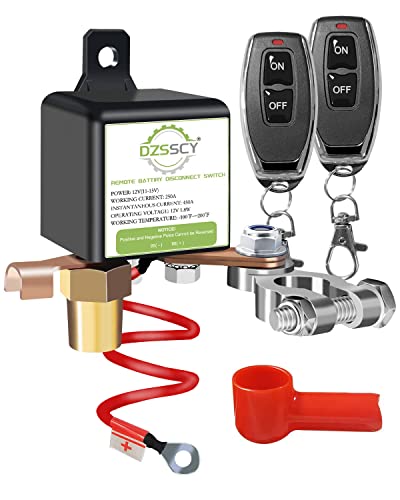
DZSSCY offers a remote kill switch with up to 450A instantaneous current and 250A rated current. It emphasizes a combination of remote operation and manual backup, ideal for users seeking anti-theft features and emergency control. Best for drivers who want the option to disconnect from a distance and in emergencies. A potential limitation is reliance on remote wiring that may require careful routing to avoid interference or accidental disconnection while driving.
RVBOATPAT 12V Remote Disconnect
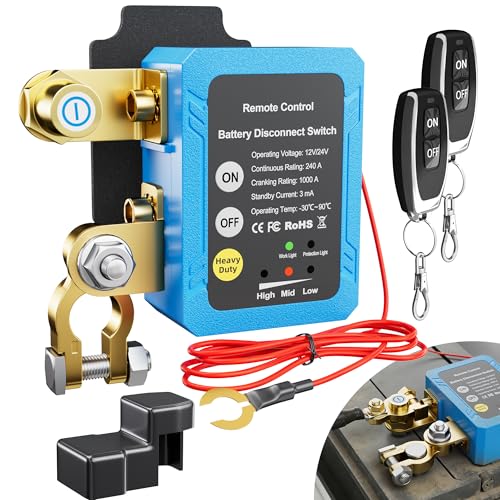
RVBOATPAT’s remote switch is built for continuous 12V operation with 240A continuous and 1000A peak current. It protects batteries during long-term parking by detecting voltage drops below 11.8V and cutting power, all while maintaining low standby drain. This makes it a strong pick for boats and vehicles stored for extended periods. Best for: reducing risk of deep discharge when vehicles sit idle. Limitation: remote control reliability depends on maintenance of the accompanying hardware and proper placement.
Buying Guide
What should you consider when choosing a battery kill switch?
- Voltage range and current rating: Ensure the switch supports your system voltage (commonly 12-48V) and handles peak currents during cranking or fault conditions.
- Installation style: Negative-post, top-post, or remote-control configurations affect compatibility with your battery setup and space constraints.
- Environmental conditions: Marine or outdoor use benefits from rugged housings and insulation against moisture and corrosion.
- Remote vs. manual operation: Remote switches add convenience and anti-theft features but require proper wiring and reliability considerations.
- Durability and materials: Look for corrosion-resistant contacts, strong clamping, and safe, durable housings for long service life.
Frequently Asked Questions
- What is a battery kill switch and why use one? A battery kill switch disconnects the electrical circuit to prevent battery drain, reduce fire risk, and add theft protection in unattended vehicles or vessels.
- Where should I install a kill switch? Common locations include near the battery post for negative-on/off, or remotely in the dash or cockpit for easy access and security.
- Can I install a kill switch myself? Yes, if you follow product instructions, use proper safety procedures, and ensure correct terminal connections to avoid shorts.
- Will a kill switch protect my entire electrical system? A well-rated switch on the main power line can isolate most circuits, but some accessories may have separate power sources or require additional protection.
- What maintenance is needed? Periodically inspect terminals for corrosion, ensure the switch remains securely mounted, and verify operation by testing in a safe environment.
- Are remote kill switches safe for driving? Use caution to ensure the remote switch cannot be accidentally activated or cause unintended power loss while operating the vehicle.