When outages strike, a reliable grid-tie hybrid inverter can keep essential appliances running by blending solar, grid, and battery power. The following five inverters are among the top options for American homes seeking robust performance, high efficiency, and flexible charging. Each model supports grid-tie operation, with features like built-in MPPT, battery compatibility, and the ability to sell surplus power back to the grid. This guide highlights practical differences to help you choose the right system for your needs.
Summary of Selected Products
| Product | Brand | Key Benefit | Notes |
|---|---|---|---|
| POWLAND 12000W Grid-Tied Hybrid Solar Inverter | POWLAND | Battery-free design with high output | Grid backfeed with CT sensor option |
| PowMr 12000W Solar Inverter 48V to 120/240V | Temank | ETL-certified with seamless backup | Supports up to 6kW PV input; scalable |
| 12000W Hybrid Solar Inverter 48V | BUSBYR | Dual MPPT, versatile battery support | Grid-tie/off-grid capable |
| Hybrid Solar Inverter HE200, 6500W | LCRHLCNC | WiFi/GPRS monitoring | Integrated MPPT; grid or off-grid |
| AIMS Power Hybrid Inverter Charger 9.6 kW | AIMS Power | All-in-one with solar charge controller | Grid tie with battery backup |
POWLAND 12000W Grid-Tied Hybrid Solar Inverter

Powerful 12,000W pure sine wave output supports heavy loads, including central air, refrigerators, and power tools. Its battery-free design can feed excess solar energy directly to home circuits or the grid when paired with a CT sensor. This model targets large homes or installations where battery maintenance is a concern, offering substantial grid-savings by diverting surplus energy back to the utility.
- Massive power with a 120V ±5% output suitable for demanding equipment.
- Battery-free operation that prioritizes solar and grid use, with optional backfeed to the grid.
- High-efficiency MPPT harvesting and the ability to handle a broad DC input range (90-500VDC).
PowMr 12000W Solar Inverter 48V to 120V/240V
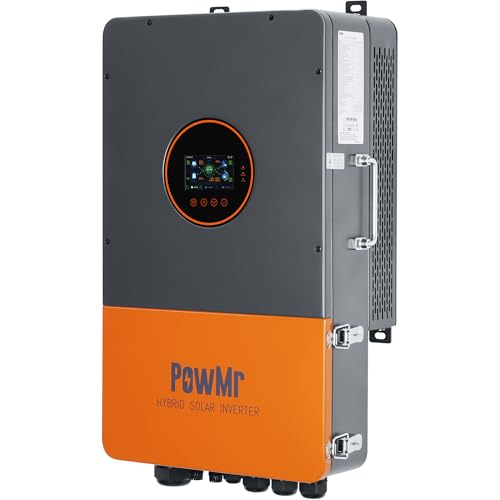
This 12kW grid-tie hybrid delivers robust 120V/240V split-phase power with dual MPPT solar charging. It supports battery-backed operation and grid export, with the flexibility to wake dormant lithium batteries using either grid or solar input. It’s designed for homes, cabins, RVs, and workshops where reliability and adaptability are essential.
- ETL-certified to UL 1741 and IEEE 1547.1-2020, with fast sub-20ms transition to backup.
- Smart control for time-based operation and battery flexibility across battery types.
- Scalable up to six units for larger homes or small commercial applications.
12000W Hybrid Solar Inverter 48V 110/120V 240V Split Phase

This hybrid unit combines high continuous power with dual MPPT solar charging and broad battery compatibility, including lead-acid and Li-ion options. It can operate in grid-tie or off-grid modes and supports battery and solar charging for continuous operation during outages or peak solar generation times. Suitable for homes, RV setups, and workshops seeking reliable power and solar optimization.
- Dual MPPT controllers for improved tracking under varying sunlight.
- Supports high-voltage PV arrays up to 500VDC and a broad PV input range.
- Battery-friendly operation with options for battery-free solar + grid to loads.
Hybrid Solar Inverter HE200, 6500W

The HE200 provides a balanced 6500W pure sine wave output with integrated MPPT and WiFi/GPRS monitoring. It supports grid input or standalone operation, enabling remote management and performance alerts. Its compact design makes it a practical choice for homes requiring remote oversight and reliable grid-tie operation with solar backing.
- Pure sine wave output suitable for sensitive electronics.
- Integrated MPPT maximizes solar harvest and supports grid input.
- Remote monitoring via WiFi or GPRS for proactive maintenance.
AIMS Power Hybrid Inverter Charger 9.6 kW

An all-in-one solution for grid-tie solar with battery backup, the AIMS Power Hybrid Inverter offers integrated solar charge control and battery charging in a single unit. It targets users seeking a streamlined setup for net metering, backup power, and load sharing. The configuration supports various battery chemistries and can simplify system design by reducing external components.
- All-in-one design reduces the need for separate chargers and inverters.
- Supports grid-tie operation, charging from solar, and battery backup.
- Flexible configurations for different system sizes and battery types.
Buying Guide: Key Purchase Considerations
When selecting a grid-tie battery backup inverter, consider these factors to ensure compatibility with your home, climate, and goals.
- System size and load profile: Assess your critical loads and peak demand to choose an inverter with sufficient continuous and surge capacity. Larger homes or RV parks may benefit from 12 kW units or multi-unit configurations.
- Battery strategy: Decide between battery-free operation (relying on grid and solar) and full hybrid backup with batteries. If you want during outages or more resilience, ensure battery compatibility and future expandability.
- MPPT performance: Look for multi-MPPT controllers (dual MPPT preferred) to maximize harvesting under shading or variable conditions. Higher efficiency translates to more usable solar energy.
- Grid compliance and safety: Ensure the unit is ETL/UL certified and meets IEEE 1547.1 standards for safe backfeeding and islanding protection. Backfeed control helps prevent backflow issues with the utility.
- Monitoring and control: WiFi or cellular monitoring simplifies remote management, alerts, and firmware updates. This is valuable for proactive maintenance and performance optimization.
- Expandability: If you anticipate growth or shifting needs, choose models that allow stacking multiple units or expanding PV input capacity without major rewiring.
- Battery compatibility: Verify support for your chosen battery chemistry (LiFePO4, lead-acid, etc.). Some inverters offer flexible charging profiles and alternative wake-up methods for dormant batteries.
- Installation considerations: Check ventilation, grounding, and wiring requirements. A professional assessment ensures safe integration with existing electrical panels.
These options provide a range of power levels, efficiency, and integration features. Users should match the selected model to their energy usage, climate, and the desired balance between solar self-consumption and grid export. Always verify current specifications and regional grid regulations before purchase.