Choosing the right LED lighting for football stadiums, arenas, and outdoor fields involves balancing brightness, durability, energy efficiency, and maintenance needs. The following selected products offer high lumen outputs, robust IP ratings, long lifespans, and flexible beam configurations to cover large areas like stands, sidelines, parking lots, and tunnels. This guide highlights five prominent options and provides practical buying considerations to help facilities managers, contractors, and venue operators optimize visibility and reduce ongoing costs.
Summary of Chosen Products
| Product | Brand | Approx. Lumens/Output (max) | Waterproof Rating | Beam / Coverage |
|---|---|---|---|---|
| LED Stadium Light – 3000W Equivalent | Spolehli | 80,000 LM | IP66 | 120° Wide |
| Kekeou 500W Stadium Lights Outdoor | Kekeou | 70,000 LM | IP67 | Adjustable / Wide Coverage |
| Juyace 240W Stadium Lights Outdoor | Juyace | 36,000 LM | IP65–IP67 range in models | 120° Wide |
| STASUN 900W LED Flood Light (Three Heads) | STASUN | 90,000 LM | IP66 | Tri-head Adjustable |
| SJHUOUP 1000W Stadium Lights Outdoor | SJHUOUP | 130,000 LM | IP67 | Multiple Heads |
LED Stadium Light – 3000W Equivalent High Mast Flood Light

This high-mast flood light offers an immense 80,000 lumens with a 120° beam angle suitable for large venues such as football fields, parking areas, and tunnels. A 50,000+ hour lifespan, low-maintenance construction, and a heat-dispersion design help minimize downtime. The premium driver maintains stable, flicker-free illumination across a wide voltage range (85V–305V) and includes surge protection to guard against spikes. The LED array uses 3030 chips and UV-resistant lenses to deliver consistent brightness with a CRI ≥ 70, reducing dark spots and glare. The rugged aluminum housing and honeycomb cooling vents are designed for harsh outdoor environments, helping to keep surface temperatures in check and extend service life. This option emphasizes reliability and long-term cost savings for large-scale installations like stadiums and transit centers.
Kekeou 500W Stadium Lights Outdoor LED Flood Light

This 500W assembly is built from five independent 100W flood lights, offering modular brightness with easy customization for different venues. Delivering up to 70,000 lumens, its adjustable bracket structure lets operators alter projection angles to cover courts, fields, and parking areas precisely. The housing uses a thick aluminum profile for solid heat management, contributing to durability in wind, rain, and snow. The design supports long-term operation in demanding outdoor conditions, making it a flexible solution for multi-use outdoor spaces like playgrounds and arenas, while providing cost-effective installation and maintenance.
Juyace 240W LED Stadium Lights Outdoor

Juyace offers a 240W configuration with a wide 120-degree beam angle and a high-efficiency PC lens to maximize coverage. The unit uses an upgraded fin-type heat sink and thick aluminum plate to improve heat dissipation, supporting long operation with minimal risk of overheating. Its integrated power adapter handles 100–277V input, enabling stable output and protection against short circuits and lightning surges. The combination of wide coverage, bright output, and robust electrical design makes it suitable for courts, fields, and public facilities seeking reliable, glare-controlled illumination.
STASUN 900W LED Flood Light – Mini Series
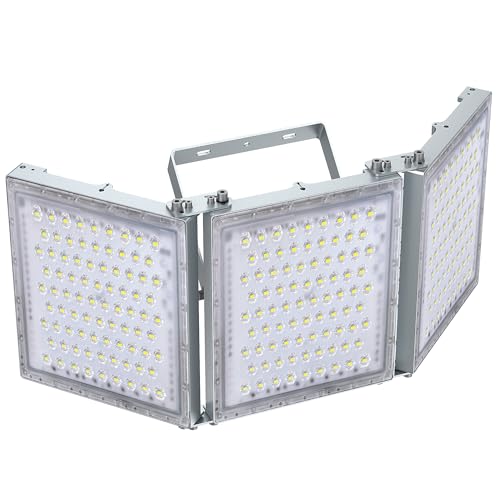
The STASUN Mini Series delivers 90,000 lumens at 6000K with IP66 waterproofing, designed for outdoor stadiums, basketball courts, and tennis facilities. Its three adjustable panels offer flexible beam distribution—outer panels rotate for wide-angle coverage up to 280°, while the inner panel provides focused lighting. This modular approach supports scalable lighting plans and easy maintenance. The fixture claims energy efficiency improvements over traditional 7,500W options and uses high-efficiency LEDs with 150 LM/W and a 100–277V input range, making it suitable for mixed electrical environments and renovation projects where power availability varies.
STASUN 600W 90,000LM LED Stadium Light
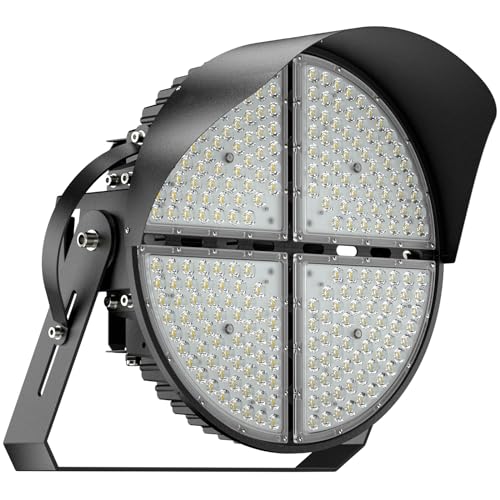
This 600W fixture provides 90,000 lumens at a 45° beam for strong long-range illumination. It emphasizes energy savings, replacing higher-wattage halogen equivalents to achieve significant cost reductions. The unit uses top-tier LEDs with 5000K color temperature and high luminous efficacy (around 150 LM/W), along with a broad input voltage range (100–277V) to suit various electrical systems. It is positioned as a practical choice for stadiums and large outdoor spaces seeking reliable, high-intensity lighting with reduced electricity use.
SJHUOUP 1000W Stadium Lights Outdoor

Offering up to 130,000 lumens, this 1000W package is designed for very large outdoor venues and professional fields. A robust 3030 LED array supports high brightness with a long lifespan exceeding 50,000 hours. The housing features a thick die-cast aluminum body and a finned heat sink for efficient cooling, ensuring stable performance even in harsh weather, including rain, wind, and snow. IP67 protection and 6KV lightning protection add resilience for open-air stadium environments where weather exposure is a concern. The package is suitable for multi-venue setups or large-scale installations that require intense, dependable illumination.
LED Stadium Light – 2000W Equivalent High Mast Flood Light

This 2000W equivalent high-mast flood light delivers 48,000 lumens with a 120° beam, designed for large tunnels, parking lots, and expansive fields. The unit emphasizes long service life with a claimed 50,000+ hours, advanced thermal management, and a 85V–305V operating range for stable performance under fluctuating power conditions. The rugged housing and copper heat pipe technology help minimize surface temperatures and corrosion, promoting reliability in outdoor venues that demand high-intensity, wide-area coverage for security and visibility during events.
Buying Guide: Key Considerations For Football Stadium LED Lighting
- Brightness and coverage: For football fields, aim for high lumens and wide beam angles to minimize dark spots and glare on players and spectators. Consider modular or multi-head designs for flexible coverage over long distances and varying field dimensions.
- Beam control and glare: Opt for fixtures with precise optics, anti-glare lenses, and adjustable beam angles. A mix of wide-area and focused lighting can reduce noise in overhead lighting and improve uniformity on the field.
- Durability and weather resistance: Look for IP ratings of IP66 or IP67 for outdoor stadiums, with rugged housings and corrosion-resistant materials. Equipment should withstand wind, rain, salt spray (coastal venues), and temperature extremes.
- Thermal management: Efficient heat dissipation extends LED lifespan and maintains performance. Fin-type heat sinks, copper heat pipes, and honeycomb cooling vents are common features to prioritize.
- Electrical compatibility: Ensure the driver supports the local power grid, including a wide input voltage range and surge protection. Check compatibility with existing wiring and controls (dimming, zoning, and emergency power).
- Maintenance and lifespan: Long-rated lifespans (50,000+ hours) reduce maintenance cycles and downtime. Consider modular designs that simplify replacement of individual sections or heads.
- Energy efficiency and cost of ownership: Higher initial cost may be offset by substantial energy savings and reduced maintenance over time. Compare lumens per watt and total operating costs across models.
- Installation considerations: Module assemblies with adjustable mounting brackets and straightforward wiring simplify retrofits in older stadiums or multi-use facilities.
In sum, selecting football stadium LED lighting involves balancing brightness with energy efficiency, resilience, and serviceability. The five products highlighted here illustrate a spectrum of approaches—from high-output, all-in-one solutions to modular, multi-head configurations—each suited to different venue sizes, budgets, and maintenance capabilities. When evaluating options, prioritize long-term reliability, uniform field illumination, and the ability to adapt to seasonal or event-based lighting needs.