Fiber to RJ45 media converters enable seamless bridging between fiber optic networks and Ethernet LANs. This guide highlights five capable options designed for reliability, compatibility, and plug‑and‑play setup. Whether upgrading an office backbone or extending a data center link, these devices convert media types without complex configuration. The selections emphasize common fiber standards (MMF and SMF), various speeds (1 Gbps and beyond), and easy installation to help you choose the best fit for your network.
| Product | Fiber Type | Speed | Key Benefit |
|---|---|---|---|
| TP-Link MC220L | MMF/SMF compatible SFP | 1 Gbps | Plug-and-play, metal casing, broad compatibility |
| A Pair of Gigabit Multi-Mode LC Fiber Media Converter (H!Fiber.com) | MMF | 1 Gbps | Two converters included for kit-style deployment |
| A Pair of 1.25G/s Bidi Gigabit Multi-Mode Fiber Ethernet Media Converter (GESD) | MMF | 1.25 Gbps | BiDi SFP modules for flexible MMF links |
| Single Mode LC Gigabit Fiber Media Converter (ADnet) | SMF | 1 Gbps | Longer reach up to 20 km with single-mode fiber |
| A Pair of 1.25G/s Bidi Gigabit Single-Mode Fiber Ethernet Media Converter (GESD) | SMF | 1.25 Gbps | BiDi SFP transceivers included for long-distance SMF links |
TP-Link MC220L Gigabit SFP To RJ45 Fiber Media Converter
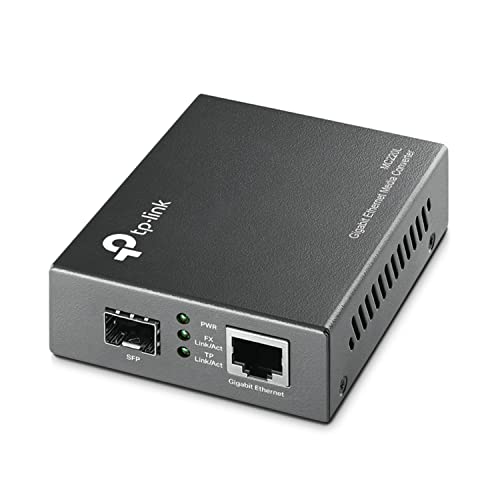
The TP-Link MC220L is a compact, rugged media converter designed to bridge 1000BASE-SX/LX fiber with 1000Base-T copper Ethernet. It supports both single-mode and multi-mode SFP modules and is compatible with 10/100/1000 Base-T networks. The device is plug-and-play, requiring no software installation, making it suitable for quick deployments in offices or data centers. Its metal casing offers durability in rack environments, and the auto-negotiation feature simplifies speed and duplex settings for diverse equipment. This model is ideal when upgrading an existing gigabit backbone or connecting fiber to a copper LAN without extensive setup.
A Pair Of Gigabit Multi-Mode LC Fiber Media Converters Kit

This kit includes two gigabit MMF media converters plus two 1000Base-SX SFPs, offering a complete bundle for two-way fiber-to-Ethernet links. The product supports full/half duplex modes, MDI/MDIX auto-crossover, and jumbo frames, enabling robust performance for office networks or small campuses. The package includes power supplies and a user manual, with a 30‑day return window, a 3‑year warranty, and lifetime tech support. The dual‑converter setup is ideal for connecting two separate fiber links to copper networks or extending a single link to multiple devices.
A Pair Of 1.25G/s Bidi Gigabit Multi-Mode Fiber Ethernet Converters

This set features two 1.25 Gbps gigabit MMF media converters with BiDi LC transceivers. It includes two power adapters, a user manual, and UL certification. The SFP ports support 1000Base-SX on MMF with auto-negotiation on the RJ45 side for smooth operation with existing Ethernet devices. The kit is designed to bridge MMF networks to copper LANs across relatively short to mid-range distances, leveraging BiDi transceivers to simplify fiber routing.
ADnet Single Mode LC Gigabit Fiber Media Converter

The ADnet single-mode converter enables 1000Base-LX to RJ45 copper, with distances up to 20 km over SMF. It supports DOT-compatible operation and dual-speed fiber mode via a dip switch, allowing selection between 1000Base-LX and 100Base-LX. The device emphasizes long-distance coverage, LLF support, and jumbo frames, making it suitable for campus links or enterprise networks needing extended fiber reach while maintaining gigabit copper connectivity on the other end.
A Pair Of 1.25G/s Bidi Gigabit Single-Mode Fiber Converters
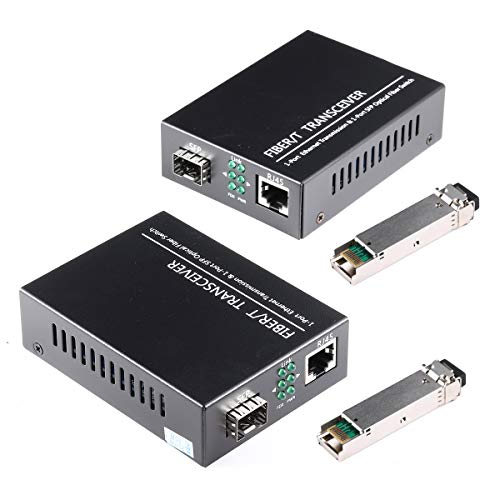
This dual-pack offers two gigabit SMF media converters with BiDi LC transceivers, designed for longer-range fiber links up to 30 km. Included are two BiDi SFP transceivers, two power supplies, and a user manual. UL certification ensures compliance with electrical safety standards. The kit supports full/half duplex, auto-negotiation, MDI/MDIX auto-crossover, and is aligned with IEEE standards, making it a versatile option for inter-building connections or data-center extensions over SMF.
Buying Guide: Key Considerations For Fiber To RJ45 Converters
- Fiber Type and Distance: Determine whether MMF or SMF is needed and the maximum distance to cover. MMF is common for short to mid-range office networks, while SMF suits long-haul links.
- Speed and Duplex: Choose converters that support the required speed (1 Gbps, 1.25 Gbps, or higher) and auto-negotiation for compatibility with varied devices.
- BiDi vs Standard Transceivers: BiDi modules simplify fiber routing by using a single fiber strand for bidirectional traffic, which can reduce fiber count and cabling complexity.
- Power and Reliability: Look for UL certifications, robust metal housings, and included power supplies when selecting a kit, especially for rack deployments or remote sites.
- Warranty and Support: A multi-year warranty and lifetime tech support add value for enterprise deployments and ensure long-term reliability.
- Ease of Use: Plug-and-play operation with minimal configuration is ideal for consumer setups and IT teams seeking straightforward upgrades.
- Deployment Scenario: For campuses or data centers, consider a kit with multiple converters or a device that supports jumbo frames and auto MDI/MDIX to simplify integration.
These considerations help compare choices across the five selected products, balancing distance, speed, and ease of deployment. By evaluating fiber type, SFP compatibility, and kit contents, you can match a converter to your existing network architecture without disrupting core services.