If you need an exhaust fan that helps control moisture and improve air quality, a model with a built-in humidistat or dehumidistat is ideal. This guide highlights five top options, explaining who each product is best for and why it stands out. The listed buyers range from homeowners tackling damp crawl spaces to those needing quiet, energy-efficient bathroom ventilation. Below is a quick summary table to compare key points at a glance.
| Product | Best For | Key Benefit |
|---|---|---|
| CADPXS Crawlspace Ventilation Fan | Crawl spaces and basements | Dehumidistat with wide RH range |
| Pewoaoa Crawlspace Vent Fan | Moist environments with climate control | Smart humidity/temperature auto-activation |
| OREiN 3-in-1 Exhaust Fan | Bathrooms needing light and humidity control | Integrated light plus humidity sensing |
| Abestorm 260CFM Crawlspace Fan | Large crawl spaces and garages | IP-55 rated, robust isolation mesh |
| JOEAONZ Bath Exhaust With Duct | Quiet bathroom ventilation | Compact, low-noise operation |
CADPXS Crawlspace Ventilation Fan With Humidistat
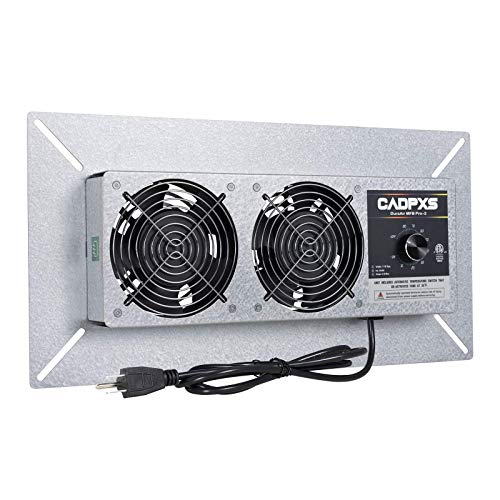
Best for: crawl spaces and basements that require balanced humidity and radon odor control. This model runs air out at 220 CFM and features an integrated humidistat (20%–80% RH) plus a freeze protection thermostat that prevents low-temperature backflow. It helps exchange indoor and outdoor air to improve space quality and reduce moisture-related problems. A potential limitation is that 220 CFM may be overkill for very small enclosures, which could create unnecessary airflow noise.
Pewoaoa 240 CFM Crawlspace Vent Fan

Best for: crawl spaces and basements needing climate-based control. This fan provides 240 CFM with dual humidity and temperature sensors that auto-activate when thresholds are exceeded, helping prevent condensation and mold. A caveat is that the auto-activation depends on set thresholds, so miscalibration could delay ventilation in some rooms.
OREiN 3-in-1 Bathroom Exhaust Fan With Light

Best for: bathrooms needing both ventilation and lighting. It provides 160 CFM with a humidity sensor for auto-venting, plus a 3-CCT LED light option. It is designed for easy room-side installation. A potential limitation is reduced flexibility if you want to mix-and-match different duct sizes without adapters.
Abestorm 260CFM Crawlspace Ventilation Fan

Best for: larger crawl spaces and garages needing robust air exchange. With 260 CFM and an IP-55 rated shell, it balances humidity while resisting dust and water exposure. It includes an isolation mesh to deter wildlife access. A caution is that higher airflow can increase noise, so pairing with a sound-dampening setup may be beneficial.
JOEAONZ Bath Exhaust Fan With Duct

Best for: quiet bathroom ventilation projects. This model delivers 110 CFM with low noise operation and a standard 4-inch duct. It is suitable for spaces up to around 107 square feet. A limitation is that 110 CFM may be insufficient for larger bathrooms or high-moisture areas without boosting airflow through multiple units.
Amico 12″ Smart Shutter Exhaust Fan

Best for: large spaces needing substantial air movement with smart control. It delivers up to 1282 CFM with a long-range, energy-efficient DC motor and eight-speed control, suitable for garages, attics, or greenhouses. The device uses a thermostat to turn on automatically and has a memory function. A limitation is higher upfront cost and installation complexity for very small rooms.
VIVOHOME AutoFlow Humidity-Sensor Exhaust
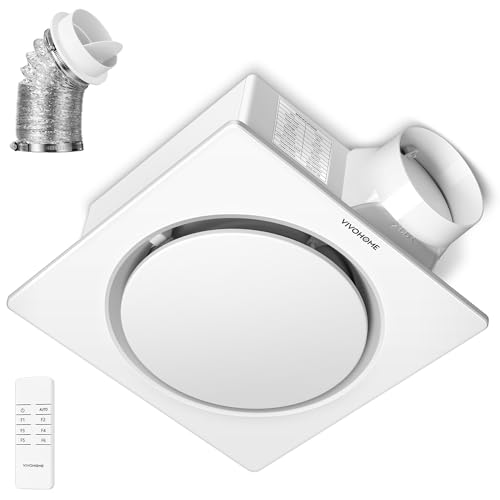
Best for: bathrooms or small spaces needing adaptive airflow. It features a brushless EC motor and a humidity-sensor auto-ventilation system with three speed modes. The included remote extends control convenience. A caveat is that the motor’s constant self-adjusting feature may require initial setup to dial in preferred speeds.
Buying Guide: Key Purchase Considerations
- Humidity control needs: Decide whether you need a humidistat, dehumidistat, or a smart sensor that auto-activates at set thresholds. This affects how reliably moisture is managed in damp spaces.
- Space size and airflow: Match CFM to room or area size. Larger crawl spaces typically require higher CFM; bathrooms can often suffice with 80–160 CFM depending on layout.
- Climate considerations: For areas with cold winters, choose models with freeze protection or low-temperature shutdown to prevent backflow and ice formation.
- Energy use and noise: Look for EC or DC motors for efficiency and quieter operation. Consider noise ratings if the unit will run in living areas or bedrooms.
- Ventilation type and installation: Reach whether it’s air-out, radon mitigation, or air-in. Check duct compatibility and whether attic access is needed for installation.
- Durability and build: IP-rated shells, metal housings, and anti-corrosion features help in humid spaces like crawl spaces and garages.
Frequently Asked Questions
- What is the advantage of a humidistat on an exhaust fan?
It automates ventilation based on moisture levels, reducing mold risk and keeping spaces drier with less manual operation. - Can these fans be used for radon mitigation?
Some models claim to help vent radon gas by circulating air; confirm the product’s intended use and installation requirements before purchase. - Is higher CFM always better for crawl spaces?
Not necessarily. Excessive airflow in small spaces can cause energy waste and noise; choose CFM appropriate to the area size. - Do these fans require attic access for installation?
Several models are designed for room-side installation, while others may need attic access or duct adaptation. Check the installation guide for each product. - What maintenance is needed?
Regular cleaning of the grill and intake, plus checking the humidity sensors, helps ensure consistent performance. - Are these fans energy efficient?
Many models use DC or brushless motors to improve efficiency; verify motor type and wattage when comparing options.