Electric panel lockout devices are essential for protecting maintenance crews and preventing accidental energization during servicing. This guide highlights five top-rated lockout solutions, highlighting how each device secures breakers, fits common panels, and supports OSHA-compliant lockout-tagout (LOTO) protocols. Whether you manage a manufacturing floor or a commercial facility, these options help reduce risk and improve compliance.
Summary of chosen products:
| Product | Brand | Voltage Range / Application | Lockout Type |
|---|---|---|---|
| Electrical Panel Lockout Device – PS1 | Pinnacle Safety Products | Standard electrical panels; general lockout | Panel door lockout device |
| Master Lock Red Electrical Box Circuit Breaker Lockout 493B | Master Lock | 120/240V breakers; standard height with tie-bar toggles | Toggle breaker lockout |
| AuRandoo 12 Pack Circuit Breaker Lockout Kit | AuRandoo | Single-pole breakers (120V-277V) | Clamp-on lockout kit with OSHA-compliant tags |
| AuRandoo Circuit Breaker Lockout Kit – Single Pole Clamp-On | AuRandoo | Single-pole breakers (120V-277V) | Clamp-on lockout with padlock compatibility |
| PILISPARK Circuit Breaker Lockout | PILISPARK | 110-240V standard single/double toggles | Lockout with clamp design |
Electrical Panel Lockout Device – PS1

The PS1 Electrical Panel Lockout Device provides a lockable mechanism for panel doors, preventing unauthorized access and helping protect personnel and equipment from electrical hazards. Its simple design supports rapid installation across a range of standard panels, with compatibility that suits maintenance crews performing servicing tasks. The device supports a straightforward locking workflow, ensuring clear control of access during work on electrical systems. This option is suitable for workplaces seeking a compact, purpose-built lockout solution for panel doors and basic LOTO workflows.
Master Lock Red Electrical Box Circuit Breaker Lockout 493B

The Master Lock 493B is designed for standard-height circuit breakers with tie-bar toggles, commonly found on 120 and 240 volt systems. It emphasizes a secure grip with its Grip Tight design and a simple thumb-turn locking action followed by a clamping handle closure. The durable, powder-coated steel exterior and reinforced polymer provide resilience in harsh environments. It aligns with OSHA-compliant lockout tagout practices and supports reliable multi-user lockout programs in industrial settings where quick, repeatable locking is essential.
AuRandoo 12 Pack Circuit Breaker Lockout Kit

This 12-pack lockout kit from AuRandoo uses a secure clamp-on design to fit single-pole breakers (20-50 amp) and boxes with handles up to 16.5 mm wide. The quick-clip mechanism offers a stable grip that resists accidental removal during maintenance. The set is compatible with Square D panels, smart breakers, and standard panels across 120V-277V. The included safety lock and pre-printed LOTO tags help meet OSHA standards for hazard communication, supporting team-based lockout tagout protocols in facilities that require scalable multi-point isolation.
AuRandoo Circuit Breaker Lockout Kit – Single Pole Clamp-On
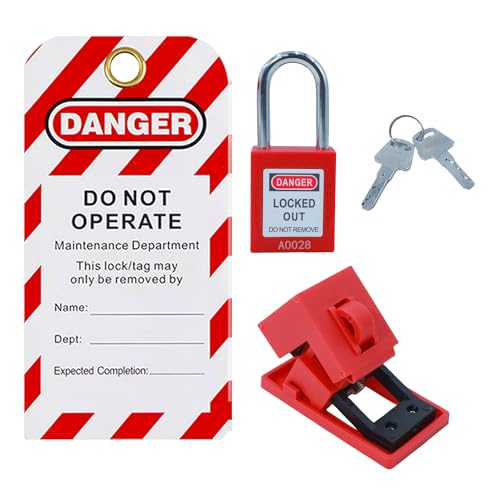
Featuring a compact clamp-on design, this AuRandoo kit fits single-pole breakers (20-50 amp) and handles up to 16.5 mm wide. It is compatible with Square D panels and standard 120V-277V systems. The rugged red polypropylene and nylon construction resists corrosion and electrical hazards, making it suitable for factory floors, automotive workshops, and other demanding environments. The set includes OSHA-compliant lockout tags and a safety padlock, enabling rapid deployment in multi-person lockout scenarios while maintaining clear hazard communication for workers.
PILISPARK Circuit Breaker Lockout

PILISPARK offers a compact lockout kit designed for standard single and double toggles on 110-240V circuits. The device locks the breaker simply by rotating the thumb and closing the clamping handle, providing a straightforward operation suitable for busy maintenance environments. The kit’s small footprint (about the size of a finger) makes it easy to store and deploy across multiple panels. It includes an extra padlock to support an added layer of security and easier management of lockout records in teams that require rapid, repeatable releases after maintenance tasks conclude.
Buying Guide
Key purchase considerations help ensure the right lockout solution for a given facility and crew. These factors apply across the five products above and similar devices.
- Panel compatibility: Verify handle width, toggle style, and panel height to ensure the lockout device will clamp securely without interfering with the panel door or adjacent equipment.
- Voltage range and breaker type: Most standard lockouts cover 120V-277V systems and single-pole breakers; for 3-phase or higher-capacity panels, confirm compatibility and whether multi-pole devices are needed.
- Lockout hardware and tags: OSHA-compliant tags and padlocks simplify hazard communication and allow teams to implement multi-point lockout across shifts. Consider whether a kit includes locks and tags or requires separate purchases.
- Durability and material: Oil, heat, and chemical resistance matter in industrial environments. Powder-coated metals and reinforced polymers offer longer service life in harsh settings.
- Ease of use and speed: Lockout devices should enable quick installation and removal to minimize downtime while maintaining safety. Clamp-on designs and intuitive thumb-turn mechanisms are common advantages.
- Multi-user readiness: For teams, look for devices that support multiple padlocks and standardized tags so several workers can apply or remove lockout in sequence while preserving system safety.
- Storage and maintenance: Compact devices or kits with integrated pads or clips simplify storage near work areas and reduce the chance of misplacement during audits.
- Compliance alignment: Ensure the chosen products align with OSHA Lockout/Tagout standards and internal safety procedures, including training materials that accompany the devices.
In practice, facilities often combine a primary lockout device for panel doors with clamp-on breaker lockouts to cover diverse maintenance scenarios. The best approach is to assess panel types, typical maintenance tasks, and team size to select a mix of devices that offers reliable protection and straightforward compliance.