Finding the right 220V electric water heater means balancing wattage, installation needs, and space. This guide highlights five reliable 220V options, focusing on who each model suits best and why it stands out. It’s ideal for apartments, small homes, cabins, and under-sink setups where space and efficiency matter.
Summary table of selected products:
| Product | Best For | Key Feature | Limitations |
|---|---|---|---|
| OVAS HOO Instant Hot Water Heater | Under-sink or RV use | 5500W, 220V; adjustable °C/°F | Requires 4mm² wiring and ≥32A breaker |
| sanheshun 6000W Tankless Heater | Bathrooms and kitchens needing compact unit | LED display; waterproof; multiple protections | Black finish; installation specifics not listed |
| GE 18 Gallon Versatile Lowboy | Small homes with space constraints | Adjustable thermostat; drain valve | Point-of-use style; limited heat capacity for larger households |
| Rheem 8kW 240V Tankless | Compact, point-of-use needs | Self-modulating power; digital temp display | Up to ~1.95 GPM may limit simultaneous uses |
| A…PUS 4.5kW Compact Heater | Apartment sinks and under-sink installs | LED touchscreen; ultra-compact | Lower wattage limits flow on high-demand uses |
| NCPYZO 7000W 240V | High-demand under-sink needs | LED display; smart self-modulation | Higher power requires robust electrical setup |
| EcoSmart ECO 11 | Space-saving, energy-conscious homes | Self-modulating technology; compact | 13 kW model is not this; efficiency depends on usage |
Instant Hot Water Heater Electric 5500W 220V – OVAS HOO

This 5500W tankless unit runs on 220V and is designed for on-demand hot water at the sink, shower, or RV use. It supports a 4mm² wiring setup and requires a breaker of at least 32A. The control setup lets users switch between Celsius and Fahrenheit and select a temperature range from 86°F to 131°F. Best for buyers who need fast, on-demand water in compact spaces and are comfortable with a higher-amperage installation.
Best for: Under-sink or portable installations where a robust, high-wattage unit is suitable. Better for users who value precise temperature control and remote operation compatibility is not specified but a remote is mentioned in product name.
Limitation: Installation requires proper electrical provisions (4mm² wiring and ≥32A breaker). Verify compatibility with existing circuits before purchase.
Electric Tankless Water Heater 6000W 220V
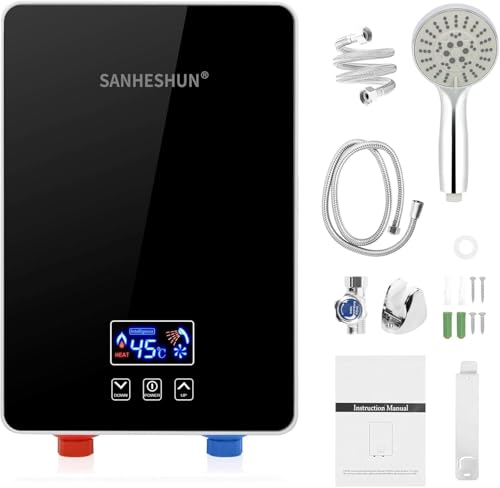
This 6000W tankless heater features an LED digital display and multiple safety protections including leakage protection and IPX4 waterproof design. It’s suitable for quick hot water in bathrooms or kitchens, with simple installation for sinks. The unit emphasizes energy-saving operation and no exhaust, making it a solid pick for single-point use where space is a premium.
Best for: Homeowners needing an under-sink solution with clear temperature readout and strong safety features. Choose this if you want a compact, self-contained unit with robust protection.
Limitation: Specific installation requirements are not detailed; confirm mounting space and inlet/outlet compatibility with existing plumbing before purchase.
GE Appliances 18 Gallon Versatile Water Heater

The GE Lowboy model is designed to fit tight spaces while providing hot water for a small household. It offers adjustable thermostat and a convenient drain valve, simplifying maintenance and temperature control. This point-of-use option is ideal for compact homes or apartments that need a reliable, easy-to-install solution.
Best for: Small households or apartments where space is at a premium and a traditional tank is not feasible. Choose this for simple setup and straightforward temperature management.
Limitation: With a smaller capacity, it may not support simultaneous hot water needs in larger households or high-demand scenarios.
Rheem 8kW 240V Tankless Electric Water Heater
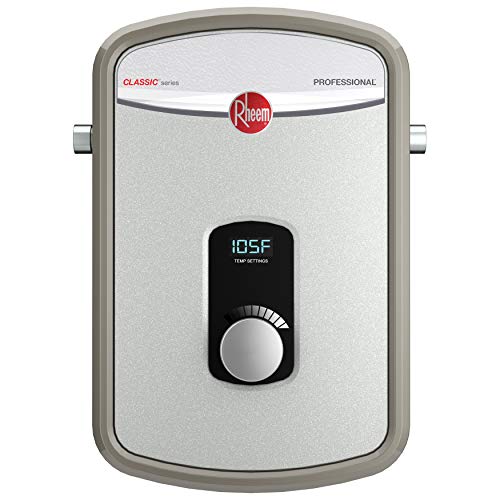
This Rheem model uses self-modulating power control with an adjustable digital temperature display. With an 8kW rating, it supports up to 1.95 GPM, making it suitable for light to moderate hot water needs at a single point of use. Its self-modulation helps reduce energy consumption by matching power to demand.
Best for: Users needing a balance of power and efficiency for limited hot water tasks, such as a single bathroom or a kitchen sink. Choose this if you want digital temperature readouts and energy-aware operation.
Limitation: Flow rate may limit simultaneous hot water usage; verify your faucet demands before selecting a unit.
APUS Tankless Water Heater 4500W 240V
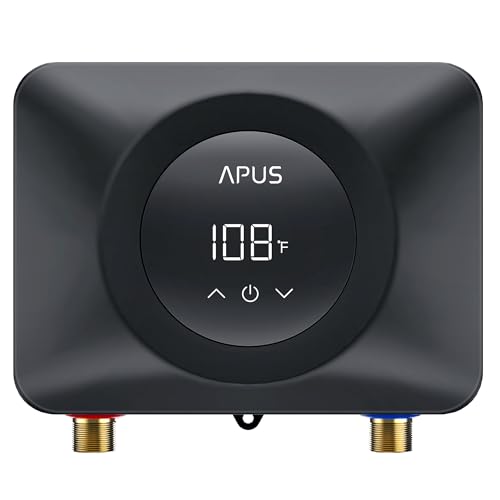
The APUS 4.5kW unit delivers on-demand hot water with a compact footprint, making it ideal for under-sink installations in apartments or small kitchens. It features LED digital display for temperature control and emphasizes energy efficiency by heating water only when needed. The design aims to fit cramped spaces while providing reliable hot water for sinks or dishwashing.
Best for: Single-point use where space is tight and a modest wattage suffices. Choose this if you want a compact control interface and straightforward installation.
Limitation: Lower wattage means lower flow at higher temperature demands; plan for modest hot water requirements per use.
Buying Guide – Key Considerations For 220V Tankless Water Heaters
When choosing a 220V electric water heater, consider size, installation requirements, and typical hot water needs. Safety features, energy efficiency, and practical use cases help you pick the best fit.
- Know your space: Under-sink and wall-mounted units save space but may require professional wiring. Check cabinet dimensions and available clearance for venting and plumbing connections.
- Watts and flow: Higher wattage (e.g., 5500W–7000W) generally increases hot water flow, but it also demands a dedicated 32A or higher circuit. Confirm existing electrical capacity before purchasing.
- Temperature control: Look for units offering precise temperature adjustment and a clear display. A digital or LED readout helps monitor settings and prevents scalding.
- Safety features: Leakage protection, dry-fire protection, and IP-rated waterproofing improve reliability in damp areas like kitchens and bathrooms.
- Space usage vs. capacity: Tankless options provide on-demand heating with minimal standby losses. Tank-style lowboys can be easier to install in tight spaces but have fixed storage capacity.
- Maintenance: Devices with simple drain valves or straightforward access panels simplify routine maintenance and longevity.
- Single-point vs. whole-house: Point-of-use units are ideal for one sink or shower; whole-house units support multiple fixtures but require higher power and more complex sizing.
FAQ
- What is the typical voltage for these heaters?
Most listed models operate at 220V or 240V, designed for residential or compact-use settings.
- Do these units require professional wiring?
Yes. Many models require dedicated circuits (for example, 32A or higher) and proper electrical connections. Consult a licensed electrician before installing.
- Can these heaters supply hot water to multiple fixtures at once?
Tankless point-of-use models usually serve a single fixture efficiently. For multiple fixtures, check the flow rate (GPM) and system sizing to avoid temperature drops.
- Are there safety features I should prioritize?
Leakage protection, dry-heat protection, automatic shutoff, and IPX ratings help protect installations in kitchens and bathrooms.
- What maintenance is required?
Regular inspection of connections and the drain valve, plus periodic flushing as recommended by the manufacturer, helps prolong performance.
- Which model is best for a tight apartment space?
Compact, under-sink or low-profile tankless models are preferable for tight spaces, offering flexible installation options and space savings.