Answering the need for reliable electrical measurement and noise data, this guide highlights five versatile data loggers. These devices suit professionals performing electrical diagnostics, noise monitoring, and energy audits, as well as enthusiasts gathering long‑term data. Each option is chosen for clear data export, reliable recording, and suitable sampling options to match different use cases.
Here is a quick summary of the selected products to compare capabilities at a glance:
| Product | Best For | Key Feature |
|---|---|---|
| Decibel Meter Data Logger, Gain Express | Noise monitoring in offices, classrooms, and neighborhoods | 3100 data records, 30–130 dB range, USB data export |
| Triplett ACDL200 Dual Input True RMS Datalogger | Electrical engineers needing dual-channel data capture | 256k measurements, flexible sampling 1s–24h |
| Supco LCV LOGiT Current & Voltage Data Logger | Real-time AC monitoring with high data capacity | 0–500 V AC, 10,750 data points |
| ennoLogic eS528L Decibel Meter & Recorder | Neighborhood and workplace noise assessment | Hours/days of recording, 30–130 dB range |
| PCE-MFM 2400 EMF Meter with Data Logger | EMF safety surveys across environments | Measures E/H/B fields with 3-axis probe |
Decibel Meter Data Logger With Recording

Best for: Noise monitoring in classrooms, offices, or neighborhoods where data export and time-stamped readings are needed. This meter records up to 3100 data points and supports USB data transfer for analysis on Windows 7–11. It features a multi‑color alarm display for quick on-site interpretation and offers a 30–130 dB(A) and 35–130 dB(C) range with ±1.5 dB accuracy.
Why selected: Combines clear numerical and graphical displays with a reliable alarm system, making it easier to document and discuss noise levels in disputes or audits. The built-in data logging and PC export enable long-term trend analysis.
Caution: Battery life is up to about 8 hours on a full charge; plan for charging during extended monitoring.
Triplett ACDL200 Dual Input True RMS Datalogger

Best for: Engineers needing dual-channel measurements of TRMS voltage and current with a long data record; suitable for monitoring equipment like motors or power circuits. Supports a wide sampling range from 1 second to 24 hours and large data storage.
Why selected: Dual input capability and high data capacity enable comprehensive profiling of power events and equipment behavior over time. The device supports flexible data capture for complex electrical systems.
Caution: The device uses a single‑unit data channel option on certain configurations; verify intended channel pairing matches your monitoring scenario before use.
Supco LCV LOGiT Current and Voltage Data Logger

Best for: Real-time monitoring of single-phase AC systems with real-time data capture and long-term storage. It combines a voltage tester and current probe for simultaneous measurement, helping analyze compressor and fan run cycles.
Why selected: The wide voltage range (0–500 V AC) and high data capacity support thorough analysis of electrical performance. It’s well suited to ongoing system monitoring and fault detection.
Caution: Complex setup may require basic electrical knowledge to ensure correct probe placement and data interpretation.
ennoLogic eS528L Decibel Meter & Recorder
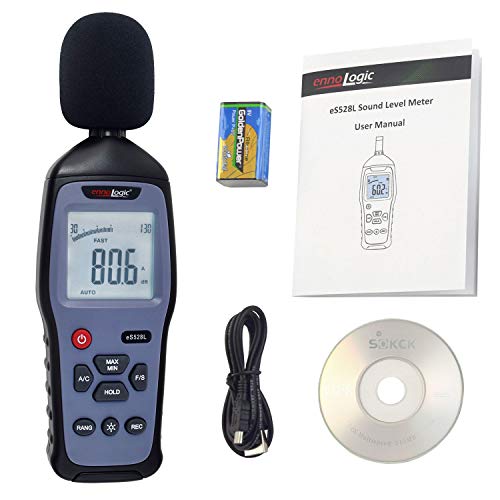
Best for: Environments where long-term noise data is needed for workplace safety, neighborhood discussions, or compliance checks. It records sound levels hours or days for later review.
Why selected: The device emphasizes practical noise data with a Type 2 standard approach and supports extended recording to build compelling evidence for noise level assessments.
Caution: Accuracy is ±1.5 dB; interpret small changes cautiously and consider repeat measurements for confirmation.
PCE-MFM 2400 EMF Meter With Data Logger

Best for: EMF safety surveys and multi-axis field measurements in diverse environments. The meter provides measures of electric, magnetic, and possibly electromagnetic fields with a three-axis probe and data logging.
Why selected: The inclusion of multi-axis measurement supports comprehensive exposure mapping. It’s designed for safety audits where precise EMF data helps evaluate potential exposure risks.
Caution: Data interpretation may require understanding of field orientation; ensure proper probe alignment during measurements.
Buying Guide
What should I consider when choosing an electric meter data logger?
Look at measurement types: voltage/current, EMF, or sound levels. Choose a device that captures the required parameter with appropriate accuracy and reporting options.
Data storage and export: Prefer meters with built-in data logging capacity and easy export to common formats for analysis with standard software.
Sampling rate and duration: Select a logger with flexible sampling intervals (seconds to hours) and sufficient battery life for your monitoring period.
Display and alarms: A clear LCD with graphical displays and audible/visual alarms helps quick on-site interpretation without always exporting data.
What scenarios fit a single-channel vs dual-channel logger?
Single-channel loggers are often sufficient for focused assessments like noise monitoring or one-measurement electrical tests. Dual-channel loggers are better for comparing two related signals (for example, voltage vs. current) over the same period to identify correlations.
How important is data retention and compatibility?
Higher data point limits allow longer monitoring without gaps. Compatibility with Windows versions and common data formats reduces conversion work during analysis.
What are common limitations to watch for?
Battery life may limit extended tests; plan charging or external power. Some meters may have limited sampling options or require specific software for export. Accuracy varies by environment and calibration status.
How do you interpret decibel meter data?
Use the dB scales (A-weighted or C-weighted) to contextualize exposure and noise impact. Compare recorded peaks with applicable noise ordinances or occupational safety guidelines for meaningful conclusions.
What questions should I ask before buying?
- What measurement range and accuracy are required for my application?
- How many data points can be stored, and how easy is data export?
- Is the device suitable for the environment (indoor, outdoor, industrial) where it will be used?
- Does the device support long-term monitoring or only short-term checks?
FAQ
- What is the typical use case for a data logger in electrical work?
Used to record voltage, current, or EMF over time to identify trends, peak events, and equipment behavior.
- How long can most loggers store data without exporting?
Storage capacity varies; some devices store thousands of points, enough for hours to days, depending on sampling rate.
- Can decibel meters log data continuously?
Yes, many models support hours or days of recording with data export for later analysis.
- Are dual-channel loggers better than single-channel ones?
Dual-channel models enable simultaneous monitoring of two signals, which helps in correlation analysis.
- Do these devices require special software?
Some offer PC connectivity for data export; check compatibility with your OS version and preferred analysis tools.