For HVAC professionals, a reliable dual-port manometer and pressure switch tester is essential for diagnosing gas pressures, static pressures, and dynamic changes in systems. This guide highlights five top-rated testers, detailing their capabilities, portability, and data handling. Readers will find objective comparisons to help select tools that balance accuracy, ease of use, and durability for field work.
| Product | Brand | Primary Use |
|---|---|---|
| Fieldpiece SDMN6 | Fieldpiece | Pressure switch testing; dual-display readouts; rugged field tool |
| Fieldpiece JL3KM2 | Fieldpiece | Long-range wireless manometer; multi-readouts; static and gas pressures |
| Leaton Digital Manometer (PT520) | Leaton | Multi-unit pressure readings; data logging; wide adapter compatibility |
| LUTIFIX PT530 / PT520 family | LUTIFIX | Dual-port measurement; adapters; data storage and locking |
| EHDIS Dual-Port HVAC Meter | EHDIS | Digital manometer; differential and single-port readings; gas testing |
Fieldpiece SDMN6 Pressure Switch Tester
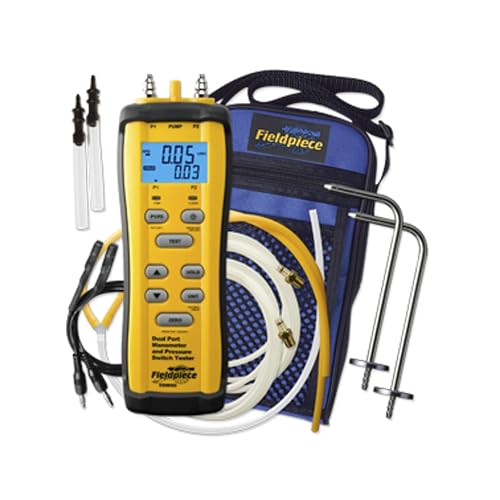
The Fieldpiece SDMN6 combines essential pressure testing functions with user-friendly controls. It measures gas pressure, static pressure, and differential pressure, making it suitable for testing and adjusting pressure switches in HVAC systems. Key features include a backlit dual display for clear readings in dim environments, a zero adjust button for precision, and a rugged rubber boot for field durability. A magnetic hanger aids convenient placement, and auto power-off helps conserve battery life during long jobs. This device emphasizes portability without sacrificing measurement versatility.
Fieldpiece Job Link System Dual Port Kit JL3KM2

The Fieldpiece JL3KM2 Job Link System delivers a long-range wireless solution for static, gas, and draft pressure readings. Its standout capability is a 1000-foot wireless range, enabling readings from strategic locations on complex systems. The kit supports measuring, viewing, and recording multiple readings—up to eight simultaneously—in real time. It includes a switchable P1–P2 indicator for accurate, stable measurements and supports single, dual, or multiport configurations. This makes it especially useful on larger installations or when hose routing is challenging.
LUTIFIX PT530 Dual-Port HVAC Manometer

The LUTIFIX PT530 offers a versatile dual-port platform with a broad range of adapters to fit different pipe diameters. It supports 10 measurement units and stores up to 29 data sets with data locking and reset options. The device can record maximum and minimum values, enabling post-test analysis. Its 100–300 kPa range and ±0.25% FS accuracy make it suitable for diagnosing negative and positive pressure scenarios in automotive, HVAC, and industrial settings. A backlit display enhances readability in the field.
Leaton Digital Manometer PT520

The Leaton PT520 is a multi-range digital manometer designed for HVAC and related applications. It offers a broad selectable range, a large LCD with backlight, and a compact handheld form factor. Features include high repeatability and linearity metrics, and a measured range of up to ±20.68 kPa / ±2.999 psi with accuracy around ±0.3% FSO. The device is well-suited for diagnosing air-handling systems, gas lines, and ventilation networks, with emphasis on ease of readability in varied lighting conditions. It supports data logging and USB-style data handling through its operational design.
EHDIS Manometer Digital Dual-Port Tester

The EHDIS dual-port manometer focuses on fast, accurate measurements for single-port and differential pressure readings. It is tailored for HVAC and gas systems, offering an ultra-low-power sensor and a 32-bit MCU with a 24-bit ADC for precise data capture. Usability benefits include straightforward operation, a readable display, and applicability to gas pressure testing on domestic boilers and vented appliances. Its selectable pressure range of ±2.999 psi and repeatability of ±0.2% ensure dependable field measurements across typical HVAC tasks.
Buying Guide: Key Considerations For Selecting A Dual-Port Manometer And Pressure Switch Tester
- Measurement range and accuracy: Look for devices covering the pressure ranges typical to your work (±2.999 psi to ±300 kPa) with accuracy around ±0.2–0.3% FSO for trustworthy readings.
- Ports and adapters: A good kit includes multiple adapters and both single and dual-port capabilities to fit various ductwork, manifolds, and piping diameters.
- Display and readability: Backlit LCDs and dual displays help readings in dim environments common in service calls and basements.
- Data handling: Features like data logging, storage of multiple test sets, and the ability to lock data or export data support field reporting and analysis.
- Wireless vs wired: Wireless models (like JL3KM2) reduce hose clutter and improve positioning, while wired models excel in low-latency measurements.
- Durability and portability: Rugged housings, protective boots, magnetic hangers, and compact form factors improve field reliability and ease of transport.
- Power management: Auto power-off and energy-efficient designs extend battery life during long service sessions.
Manufacturers commonly provide comprehensive tool ecosystems, where dual-port manometers integrate with broader HVAC diagnostic lines. When selecting, compare data handling capabilities, the breadth of compatible adapters, and whether the unit supports recording and reviewing historical pressure trends. For contractors working on larger installations or with complex ductwork routes, models with long-range wireless or multiport capabilities can offer practical advantages by delivering real-time readings from distant or hard-to-reach locations. Always verify compatibility with your existing equipment and the specific test scenarios you encounter most often.
Across the five highlighted tools, users can expect reliable measurement performance, varying degrees of portability, and robust feature sets designed to streamline diagnostic tasks. By aligning tool features with job requirements—such as static vs. differential readings, data logging needs, and the physical constraints of job sites—HVAC professionals can choose the tester that best supports accurate, efficient service work.