Choosing a reliable DC-to-DC charger is essential for keeping LiFePO4 battery banks healthy in vehicles, boats, and off-grid setups. Below, five top-performing DC-DC chargers are highlighted, each optimized for LiFePO4 chemistry and multi-battery configurations. The selection emphasizes smart charging, safety protections, and compatibility with various battery types, so you can pick a model that matches your power needs and travel lifestyle.
| Product | Brand | Key Benefit | Battery Compatibility |
|---|---|---|---|
| Renogy DC to DC Charger 12V 60A Lifepo4 | Renogy | Three-stage smart charging with robust protections | LiFePO4, AGM, Gel, Flooded |
| Renogy DC to DC Charger with MPPT 12V 40A | Renogy | MPPT integration for solar/alternator efficiency | LiFePO4, Gel, Flooded, SLA |
| Renogy DC to DC Charger 12V 20A | Renogy | One-touch LiFePO4 activation and engine-start aware | LiFePO4, AGM, Gel, Flooded |
| RENOGY REGO 12V 60A DC-DC Charger | RENOGY REGO | Universal auto-detects battery chemistry; fast 60A charging | LiFePO4, AGM, Gel, Flooded |
| RENOGY REGO 12V 20A DC-DC Charger | RENOGY REGO | Starter-isolated startup detection with LiFePO4 activation | LiFePO4, AGM, Gel, Flooded |
Renogy 60A LiFePO4 DC-DC Charger (On-Board Marine/RV)
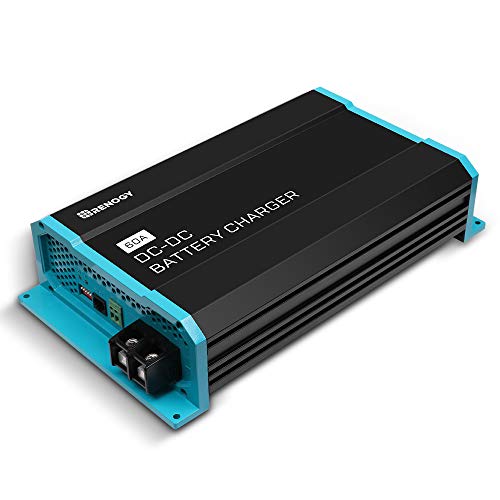
The Renogy 60A DC-DC charger is designed to transfer energy from the vehicle’s starter battery to a house battery bank, supporting LiFePO4, AGM, Gel, and Flooded configurations. Its 3-stage charging — Bulk, Boost, and Float — aims for maximum efficiency and a full, safe charge of the LiFePO4 pack. Built-in protections cover over-voltage, over-temperature, and reverse polarity, helping to avoid common charging issues in harsh environments. The unit also isolates input and output to prevent cross-talk between power sources and battery banks. This makes it suitable for RVs, boats, and off-road vehicles that rely on consistent, reliable charging on the go.
Users benefit from a robust, automotive-grade solution that keeps house batteries healthy during long trips or off-grid stays. While the charger focuses on LiFePO4 compatibility, it remains versatile enough to handle multiple battery chemistries, reducing the need for separate chargers in mixed-power setups. Installation is typically straightforward in motorhomes, trailers, or boats with a dedicated auxiliary battery system.
Renogy 40A DC-DC MPPT Charger With Solar Input

This charger combines DC-DC battery charging with an MPPT input option, enabling efficient energy management from solar panels or alternators. With two charging options, the charger prioritizes DC input but can switch modes automatically when input voltage dips below a threshold, preserving battery health and system performance. It supports LiFePO4, Gel, Flooded, and Sealed Lead Acid batteries, and its adaptive 4-stage charging logic (Bulk, Absorption, Float, Equalization) optimizes voltage and current for each chemistry. The unit is engineered for RVs, boats, and off-grid systems that rely on multiple power sources, delivering safer, more reliable battery management on the move.
Key strengths include its solar integration, which helps maximize limited solar harvest while on trips, and its protective features that guard against reverse polarity and other common faults. The accompanying installation is generally straightforward for DIY setups, though some configurations may require careful routing of solar and alternator inputs to avoid interference.
Renogy 12V 20A DC-DC Charger With LiFePO4 Activation

This compact Renogy unit features built-in alternator detection, ensuring charging only when the engine runs and protecting the starter battery while recharging the house bank. It emphasizes a simple, safe setup with a two-tier internal layout that maintains separation between input/output terminals to minimize short-circuit risk in RVs and boats. The LiFePO4 activation option provides a one-tap control to enable or disable activation, granting users direct control over when the house battery begins charging. It is well-suited for small to mid-size dual-battery configurations where easy installation and preventive safeguards are priorities.
Though lighter in capacity than higher-amperage models, the 20A unit is a practical choice for tight spaces or moderate LiFePO4 use. It emphasizes reliability, ease of use, and robust safety features to protect both the starter and house batteries during typical vehicle or vessel use.
Renogy 40A DC-DC Charger With LiFePO4 Activation

This Renogy model focuses on LiFePO4 activation and multi-chemistry compatibility, offering a dual-mode design that adapts to solar, alternator, or DC sources. Its LiFePO4 activation is easily controlled via a straightforward On/Off interaction, empowering users to optimize battery health and charging efficiency. The charger’s sturdier footprint makes it suitable for RVs, boats, and off-grid setups where solid protection against reverse polarity, over-voltage, under-voltage, and over-temperature is essential. Aimed at users who want flexible, reliable multi-source charging, this unit helps ensure the house battery stays fully charged without compromising the starter battery.
RENOGY REGO 60A DC-DC Charger With LiFePO4 Activation

The REGO 60A model operates as a universal 12V to 12V DC-DC charger, auto-detecting battery chemistry and delivering appropriate voltage for LiFePO4, AGM, Gel, and Flooded batteries. It promises faster charging with its 60A output, which can significantly shorten recharge times for larger house battery banks. The design emphasizes a “Zero Starter Drain” feature and smart engine-start protection to safeguard the vehicle’s starter battery when the engine starts. This is ideal for dual-battery trucks, sailboats, and off-grid campers who require rapid, safe charging from multiple power sources while preserving the health of both battery banks.
RENOGY REGO 20A DC-DC Charger With LiFePO4 Activation
This 20A REGO unit includes LiFePO4 activation and smart charging strategies, designed for safe, compact installations in RVs, boats, and other vehicles. Like the larger REGO models, it features an input/output isolation approach to reduce the risk of short circuits and a one-tap LiFePO4 activation for user-controlled battery status. The compact form factor and straightforward setup make it a suitable choice for smaller battery banks or spaces with limited room. Users gain a dependable, low-profile charger that still supports a range of chemistries and a reliable startup protection mechanism.
Buying Guide: How To Choose A DC-DC LiFePO4 Charger
- Battery chemistry and compatibility: Look for chargers that explicitly support LiFePO4 alongside other chemistries (AGM, Gel, Flooded). Auto-detection or clearly stated compatibility helps prevent mismatched charging that could harm the battery.
- Amperage and charging profile: Higher amperage (e.g., 40–60A) suits larger LiFePO4 banks and frequent driving. For smaller setups, 20A models may suffice. Ensure the charger uses a multi-stage charging profile (Bulk, Absorption/Boost, Float) for LiFePO4 safety and longevity.
- Activation and startup protections: LiFePO4 activation features and engine-start protection help prevent unwanted charging during startup, protecting the starter battery and extending overall system life.
- Input sources: Chargers that support MPPT solar input or alternate power sources provide flexibility for off-grid or mixed-power systems. Auto-switching modes can maximize efficiency when sources vary.
- Safety features: Prioritize over-voltage, over-temperature, reverse polarity, and short-circuit protections, as well as input/output isolation to prevent cross-talk and damage to components in tight vehicle installations.
- Installation footprint and wiring: Choose units with compact footprints and simple mounting designs for RVs, boats, and other confined spaces. Verify wiring requirements and terminal spacing to reduce the risk of shorts.
- Monitoring and control: Some models offer Bluetooth or app-based monitoring via VictronConnect or similar ecosystems, enabling real-time status checks and adjustments from a mobile device.
- Durability and environmental rating: All-weather, marine-grade, or waterproof designs are beneficial for vehicles exposed to vibration, vibrations, humidity, and outdoor conditions.
When choosing, align the charger’s amperage with your battery bank size and anticipated runtime. For frequent driving and larger LiFePO4 systems, a 40–60A charger provides faster replenishment. For compact setups or seasonal use, a 20A option with LiFePO4 activation can be sufficient while offering reliable protection. If solar availability is a consideration, select models with MPPT input and multi-source compatibility to maximize energy harvesting and battery health in diverse conditions.