Finding a reliable all-in-one RV solar kit helps ensure your adventures stay off-grid without sacrificing comfort. This guide highlights five top complete RV solar kits, covering different power needs, inverter options, and assembly complexity. Each kit includes solar panels, a charge controller, and essential cabling to get you generating clean energy quickly. Use the summary table below to compare core specs at a glance.
Summary Of Selected Products
| Product | Brand | Power (Approx.) | Controller Type | Included Batteries / Inverter | Key Benefit |
|---|---|---|---|---|---|
| ECO-WORTHY 200W Kit (PV Panels + PWM) | ECO-WORTHY | 200 W | 30A PWM | Basic system for RVs and campers | Simple, affordable off-grid power |
| ECO-WORTHY 200W Complete Solar Panel Starter Kit | ECO-WORTHY | 200 W | Charge Controller (PWM) | 1x 12.8V 100Ah Li battery + 1100W inverter | All-in-one package for beginners |
| Giandel 200W Solar Kit | Giandel | 200 W | 20A PWM | Storage rack included | Portable, foldable design for travel |
| Renogy 400W Premium Kit | Renogy | 400 W | MPPT 40A | Includes adapter kit, brackets | High efficiency and scalable for larger rigs |
| Renogy 200W Starter Kit | Renogy | 200 W | 30A PWM | Includes 100Ah Li battery + 600W inverter | Balanced starter option |
ECO-WORTHY 200W Solar Panel Kit With PWM Controller

The ECO-WORTHY 200 Watts 12V/24V solar panel kit provides a practical entry point for RV owners seeking reliable daily output. With an efficient monocrystalline panel and a 30A PWM charge controller, this kit is designed to maintain power levels during typical RV trips. It is positioned for robust outdoor use, featuring a corrosion-resistant aluminum frame and a weather-tolerant IP65 junction box. The compact size supports installation on most RV awnings or trailer roofs, delivering up to 800Wh per day under bright sun. The kit’s 21.5% efficiency edge helps it perform well in mid-latitude conditions, making it a sensible choice for weekend travelers and full-timers alike. For those prioritizing durability and straightforward setup, this ECO-WORTHY option is a reliable baseline.”
ECO-WORTHY 200W Complete RV Kit With Battery And Inverter

This all-in-one package is designed for RV travelers who want a turnkey solution. It bundles two 100W panels, a 12.8V 100Ah lithium battery, an 1100W inverter, and a 30A PWM charge controller. The setup promises a daily output around 800Wh, with the capacity to store roughly 1.28kWh, suitable for powering essentials such as lights, charging electronics, and small appliances. Installation is presented as newbie-friendly, with a four-step process that guides users from panel connections to inverter loading. It targets RVers who prefer a single purchase rather than sourcing components separately, ensuring compatibility and quick deployment.”
Giandel 200W Kit: Foldable Panel With Inverter

Giandel’s solar kit emphasizes portability and outdoor readiness. The foldable 200W solar panel pairs with a 2200W inverter and a 20A PWM charge controller. A patented battery storage rack adds practical organization for field use, making the setup well-suited for campers, outdoor enthusiasts, and RV owners who need quick, on-site power for camping gear, small appliances, and lighting. The foldable design reduces roof rack or storage footprint, while the integrated rack helps keep cables and batteries organized for rapid deployment at a campsite or remote location. This kit is ideal for users prioritizing mobility without sacrificing power output.
Renogy 400W Premium Kit With MPPT Controller

The Renogy 400W Premium Kit is built around four high-efficiency 100W panels and a 40A MPPT controller. The kit’s efficiency is enhanced by EL-tested Grade A+ cells, a low-iron glass surface, and a sturdy aluminum frame designed to resist high wind and snow loads. The MPPT controller improves energy harvest through more precise tracking, which can provide higher real-world daily outputs compared to PWM systems. The included mounting hardware simplifies installation on RVs or stationary setups, and the kit’s expansion potential makes it a strong choice for travelers who anticipate upgrading their solar array as power needs grow. A robust warranty supports long-term reliability.”
Renogy 200W Starter Kit With Battery And Inverter
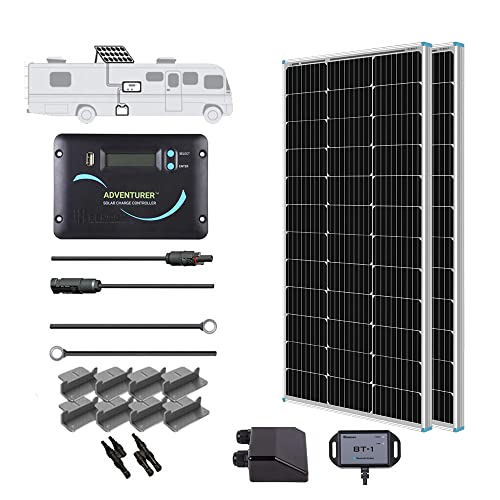
This 200W starter kit is balanced for smaller RVs or teams seeking a compact but capable off-grid solution. It includes two 100W panels, a 12.8V 100Ah lithium battery, a 600W inverter, and a 30A PWM controller. The system is designed to deliver roughly 1000Wh per day under optimal sunlight, making it suitable for powering essential devices like TVs, fans, infotainment systems, lighting, and small kitchen appliances. The included lithium battery brings longer cycle life and better depth of discharge than typical lead-acid options, helping owners maximize available energy. It’s a practical choice for first-time solar adopters who want a dependable, scalable setup.”
Buying Guide: Key Purchase Considerations For A Complete RV Solar Kit
When choosing a complete RV solar kit, consider how you plan to use the system, along with weather, roof space, and future expansion. The following factors help compare options objectively:
- Power needs and daily usage: Estimate your typical daily watt-hours (Wh) usage. Choose a kit with enough panel wattage and battery capacity to cover your needs, plus a buffer for cloudy days.
- Panel type and efficiency: Monocrystalline panels deliver higher efficiency and space efficiency, which matters for limited RV roof real estate. Look for efficiency around 22% or higher for best performance in varied conditions.
- Charge controller type: PWM controllers are cost-effective and simple for smaller systems, while MPPT controllers improve energy harvest, especially in cooler or cloudy conditions, and scale better with larger arrays.
- Battery chemistry and life: Lithium batteries offer higher energy density and deeper cycles than lead-acid. Consider cycle life, weight, and space when selecting a battery system.
- Inverter capacity: An inverter converts DC to AC for household appliances. Match inverter wattage to your anticipated loads, and verify peak surge capacity for devices like refrigerators or microwaves.
- Durability and weather resistance: RV environments demand panels and enclosures that withstand wind, rain, and road vibrations. Look for IP ratings, frame strength, and mounting hardware quality.
- Installation complexity: Some kits are ready to install with minimal wiring, while others require more hands-on setup. Choose based on your comfort with electrical work and the availability of professional help.
- Expandability: If you expect growing energy needs, select a kit that scales—additional panels, higher-capacity controllers, or larger batteries can be added down the line.
- Warranty and support: A longer warranty and responsive technical support are valuable for peace of mind on long trips or remote locations.
In practice, for RV users seeking a balance of cost, ease of use, and expandability, a mid-range 200–400W kit with an MPPT controller and a lithium battery tends to offer the best long-term value. For full-time campers or larger rigs, a premium 400W kit with an MPPT controller and a higher-capacity battery may be the better investment, especially with future expansion in mind.
All five products above present credible paths to reliable off-grid power. Whether you prioritize a compact, portable setup or a more robust system designed for extended stays, selecting the right combination of panels, controller, battery, and inverter will determine how well your RV solar kit meets your travel lifestyle.