Find reliable AC motor controllers for electric vehicles and DIY projects. This guide highlights five strong options for EVs or brushed-m motor projects, focusing on suitability for different buyer needs. Whether you’re upgrading a golf cart, building an EV, or controlling a brushed motor, these picks balance compatibility, ease of installation, and clear wiring. The top choices below are best for enthusiasts seeking easy setup, robust speed control, and clear terminal layouts.
| Product | Best For | Voltage Range | Notes |
|---|---|---|---|
| Navitas DC to AC Conversion Kit for Star EV Golf Carts | Golf cart upgrades; simple install | 48V | Includes 5KW AC motor and TAC2 controller |
| EV Car Controller MC3526/MC3528 Series (60V/72V) | EVs needing universal terminal layout | 48–72V | Clear markings; easy wiring |
| EV Car Controller MC3623/MC3624 Series | 60V/72V EV controllers | 60–72V | Universal U/V/W terminals |
| CDMALL AC Motor Speed Controller (Brushed Motors) | DIY projects with AC brushed motors | 120V | Real-time LED display; 15A overload protection |
| ReeMoo/IGEYAPA 120V Brushed Controllers | General brushed motor control | 110–120V | LED display; overload protection |
Navitas DC to AC Conversion Kit for Star EV Golf Carts
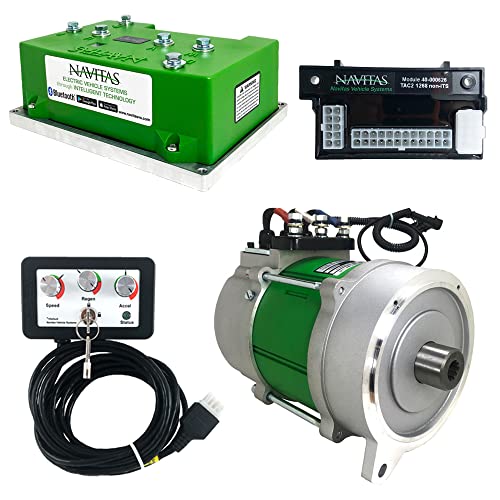
Best for golf cart enthusiasts looking to upgrade from legacy DC drives. Includes a 5KW AC motor and TAC2 600A controller, aimed at improving efficiency and torque out of the box. The kit’s small footprint supports straightforward installation with minimal modifications in many Star EV configurations. Choose this if you want a ready-to-run AC upgrade with less DIY wiring.
Best for: Golf cart owners who want more miles per charge and higher performance with simple installation.
Caution: Verify compatibility with your specific Star EV model to ensure mounting and wiring fitment without adaptations.
EV Car Controller MC3526/MC3527/MC3528 Series (MC3526-48V)

Best for users who need a universal terminal approach with straightforward 48–72V AC motor control. The MC3526/27/28 family emphasizes universal U, V, W motor phase connections and clearly marked terminals, aiding quick setup. This option suits DIY EVs and light-duty conversions where predictable wiring is valued.
Best for: EV builders seeking flexible voltage support and clear terminal layouts.
Caution: Ensure your motor is compatible with U/V/W terminal schemes and confirm mounting points fit your enclosure.
EV Car Controller MC3526/MC3527/MC3528 Series (MC3526-60V)
Best for mid-range EV setups requiring stable speed control at 60V–72V. The controller series maintains universal terminations and straightforward B+/B- connections for simple installation. It’s a practical pick for those upgrading from DC systems to AC while preserving a familiar wiring approach.
Best for: Builders upgrading voltage range with reliable, easy wiring.
Caution: Check motor compatibility with the higher voltage tier to avoid overloading components not rated for 60V/72V.
CDMALL AC Motor Speed Controller for Brushed Motors
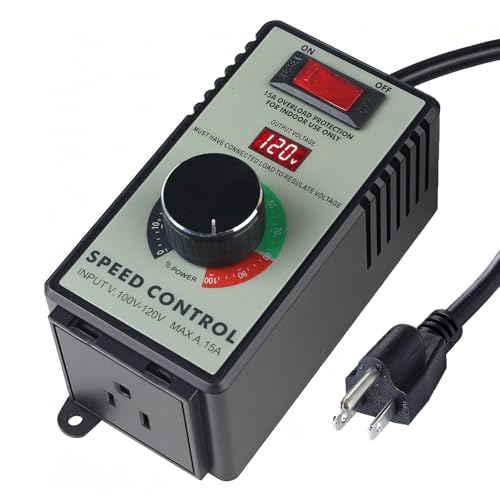
Best for DIY fans working with 120V brushed motors in moderate loads. Features include an LED voltage display and real-time monitoring, along with electronic overload protection. A suitable choice for duct fans, routers, and smaller motors where precise speed control is needed. Consider this when you want clear feedback and a resettable circuit breaker for easier maintenance.
Best for: Projects requiring on-device voltage readout and built-in overload protection.
Caution: Not compatible with brushless or DC motors; verify motor type before purchase.
EV Car Controller MC3623/MC3624 (60V/72V)

Best for 60V–72V electric vehicle setups needing dependable speed and simple installation. The MC3623/MC3624 family emphasizes universal terminals and clear mounting points for ease of assembly. This option suits DIY EVs or conversions where a robust, straightforward control solution is important.
Best for: Builders who prioritize easy wiring and compatibility across 60V/72V systems.
Caution: Confirm motor compatibility with the controller’s voltage rating to prevent performance issues.
Buying Guide
Key considerations when choosing an EV AC motor controller
- Voltage range and motor compatibility: Confirm the controller’s voltage rating matches your motor and battery pack (e.g., 48V, 60V, 72V).
- Terminal layout: Look for universal U/V/W terminals or clearly labeled B+ and B- connections for easier DIY installation.
- Protection features: Prioritize models with overload protection or resettable breakers to simplify maintenance and protect components.
- Display and feedback: Real-time LED voltage displays help you dial in speeds and track power delivery during setup.
- Application fit: Choose between controllers designed for golf carts, EV conversions, or general brushed-motor projects based on your use-case.
- Installation footprint: Small or modular controllers reduce fitment challenges in compact enclosures.
FAQ
- What is the difference between AC and DC motor controllers for EVs?
– AC controllers regulate alternating current motors for smoother torque and efficiency, while DC controllers manage direct current motors and may require different components. - Is a universal terminal layout important?
– Yes, universal U/V/W terminals simplify wiring across different motor models and reduce custom wiring needs. - Can I use a 120V controller for a 48V system?
– No; ensure voltage compatibility to avoid underpowered or damaged motors. - Do these controllers include installation accessories?
– Some kits include mounting hardware or modules; verify product listings for included components. - What safety considerations exist for high-current controllers?
– Use proper fusing, wiring gauges, and enclosure protection; avoid exposed terminals and ensure adequate cooling where required. - Is LED display essential for operation?
– It helps with precise speed tuning and monitoring, but is not strictly required for basic operation.