Direct answer: for 110V induction or brushed motor setups, the 5 selected controllers offer reliable speed regulation, overload protection, and clear readouts to help you match device performance to tasks. This guide highlights which controller suits your motor type, from 110V induction gear motors to brushed fans and routers. It also explains key features to compare, so you can choose confidently whether you’re a hobbyist, small workshop, or professional maker.
Summary of top products (quick reference)
| Product | Best For | Voltage | Current | Key Feature |
|---|---|---|---|---|
| VXIVXIV 0.09KW 110V | Induction gear motor users | 110V AC | Not specified | Reversible LED-ready control |
| CDMALL AC Motor Speed Controller | Brushed motors & inline duct fans | 120V AC | 15A | Real-time LED voltage display; overload protection |
| ReeMoo AC Motor Speed Controller | Routers, drills, fans | 110-120V AC | 15A peak | LED display; resettable breaker |
| IGEYAPA 100V-120V Controller | General 120V motors | 110-120V AC | Max 15A | Protective shell; LED readout |
| QWORK 110V 400W Knob Controller | Brushed DC motors (90V DC) | 110V AC input | 400W max | Two-pack; forward/reverse |
Best Budget 110V Induction Motor Speed Controller (VXIVXIV)

This controller is designed for 110V induction gear motors and offers reversible operation via a switch. It uses potentiometer-based, infinite control to set the motor output speed within the motor’s specified range. Best for users who need directional control and smooth speed adjustments in 110V gear motors. Caution: verify your motor interface compatibility before purchasing to avoid waste.
Who it’s best for: hobbyists and small workshop owners using 110V induction gear motors that require easy speed adjustments and direction control.
Limitations to note: does not specify a maximum continuous current or overload protection; ensure your motor’s current draw stays within safe operating limits.
Best with Real-Time LED Readout: CDMALL 120V Brushed Motor Controller
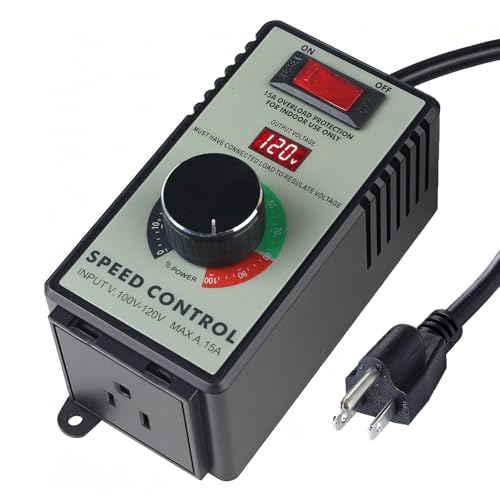
This unit is built for brushed AC motors up to 120V and up to 15A, with a real-time LED voltage display. It’s designed for devices like inline duct fans, ceiling fans, routers, and drills. The 15A circuit breaker provides overload protection with a reset, simplifying setup for intermittent use. Best for projects where precise voltage readouts improve control accuracy. Caution: not compatible with brushless motors, DC motors, or appliances with electronic control boards.
Who it’s best for: users needing a visible voltage readout and straightforward overload protection in a 120V brushed-motor setup.
Best All-Around: ReeMoo 120V Brushed Motor Controller

This controller targets brushed motors at 110-120V with a peak rating of 15A and continuous rating around 8A. It includes a clear LED display to show output voltage as you adjust speed and a resettable overload protection feature. It’s suitable for routers, drills, fans, and small woodworking tools. Best for users who need predictable speed steps and a protective reset option. Caution: startup current can exceed running current, potentially tripping the breaker if heavily loaded.
Who it’s best for: makers who operate brushed-motor devices where a simple dial, LED readout, and protection matter most.
Best Adjustable 100V–120V Controller: IGEYAPA

This 100V-120V controller supports up to 15A and offers multi-protection features, including surge and overvoltage protections. It has an LED display to monitor voltage in real time and a durable ABS shell. It’s appropriate for a range of 120V motors, including tools and small machines. Best for users who want a robust enclosure and clear voltage feedback. Caution: ensure your motor stays within the listed resistive/inductive load ranges to avoid overheating.
Who it’s best for: professionals or enthusiasts seeking a sturdy 120V controller with clear readouts and solid protection features.
Best Value Two-Pack: QWORK Knob Controllers

This two-pack provides knob-controlled speed regulation for 90V DC motors or similar setups. It supports forward and reverse operations, which can be valuable for machinery requiring bidirectional control. It’s best for compact projects or spares in a workshop. Caution: designed for 90V DC motors; using with incompatible motors may result in suboptimal performance or damage.
Buying Guide: How To Choose An AC Motor Speed Controller
- Motor type compatibility: Confirm whether your motor is brushed, brushless, induction, or a dedicated 110V/120V gear motor. Controllers labeled for brushed motors are not suitable for induction or DC-only devices.
- Voltage and current ratings: Match input voltage to your supply (110V vs 120V) and stay within continuous current limits to avoid overheating.
- Protection features: Look for overload protection, resettable breakers, surge protection, and overvoltage protection to safeguard equipment.
- Readouts and UI: Real-time LED displays help you set precise speeds and monitor output voltage, especially useful for sensitive equipment.
- Direction control: If your application requires forward/reverse, choose a model with a dedicated direction switch or bidirectional capability.
- Enclosure and safety: Consider shell material (ABS vs metal) and mounting options, especially in dusty or workshop environments.
- Load characteristics: Inductive loads (motors and fans) behave differently from resistive loads; ensure the controller supports your load type and wattage.
Frequently Asked Questions
- Can I use a DC motor with these controllers? Not typically. Most controllers in this list target AC motors, especially brushed AC motors. Verify motor type before purchase.
- What is a real-time voltage display good for? It lets you verify the exact voltage delivered to the motor, helping you dial in precise speeds and predict performance.
- What happens if the current exceeds the limit? A resettable breaker will cut power to protect the controller and motor; you can reset after reducing load.
- Is a higher wattage rating always better? Not always. Choose a rating that matches or slightly exceeds your motor’s continuous wattage and startup surge to avoid nuisance tripping.
- Do I need reverse capability? If your project requires bidirectional operation (for example, certain machinery or feed systems), choose a model with a forward/reverse option.
- How do I verify compatibility? Check motor type, voltage, current ratings, and load characteristics against the controller’s specifications before buying.