Looking for an accurate AC/DC current probe to extend your oscilloscope or multimeter? This guide covers five top options suited for different needs—from high-current automotive work to precision lab measurements. Each pick is analyzed for best use cases, limitations, and why it stands out for specific buyers.
| Product | Best For | Current Range | Notes |
|---|---|---|---|
| Hantek CC-65 | General-purpose measurements with DSO compatibility | 20 mA to 65 A | Budget-friendly; BNC-compatible |
| SainSmart Micsig CP503B | High precision, lab-grade work | 5 A / 30 A | DC~50 MHz bandwidth; auto degassing and zeroing |
| OWON CP024 | Broad automotive and bench testing | 4 A, 40 A, 200 A, 300–400 A | 9V battery, easy range switching |
| Pico Technology TA167 | High-current AC/DC with wide range | Up to 2000 A | Dual-range, BNC connector |
| BTMETER BT-605A | Versatile DMM companion probe | AC/DC up to 600 A | Easy use with select DMMs; 1 mV = 1 A output guidance |
Hantek CC-65 AC/DC Current Clamp Meter Transducer

The Hantek CC-65 AC/DC current clamp provides a wide measurement range from 20 mA to 65 A. It is designed to work with digital multimeters and oscilloscopes via a BNC-type connector, enabling straightforward integration into existing test setups. Best for: hobbyists and technicians who need an economical, general-purpose clamp with good compatibility for DSO work. Limitation: may not match the ultra-high-frequency performance of dedicated high-bandwidth probes.
SainSmart Micsig CP503B High Precision Current Probe

The CP503B delivers high precision measurements with a bandwidth of DC to 50 MHz and a current range of 5 A/30 A, with typical DC accuracy around ±1%. It features an auto degassing and zeroing function, plus an overload indicator for safe operation. Best for: lab or bench setups where accurate, reliable current readings are critical. Caution: ensure your oscilloscope can accept the probe’s interface and zeroing routines to maximize accuracy.
Micsig CP2100A Oscilloscope Probe

The CP2100A is a compact current probe with automatic and manual zero adjustment modes, offering bandwidth up to 800 kHz and a 10 A/100 A range. It is designed to be powered by the oscilloscope’s USB port, removing the need for extra power supplies. Best for: portable field work or quick verification tasks where minimal setup is preferred. Caution: higher current ranges may demand careful calibration to maintain accuracy in broader bandwidth scenarios.
BTMETER BT-605A AC/DC 600A Clamp-on Probe
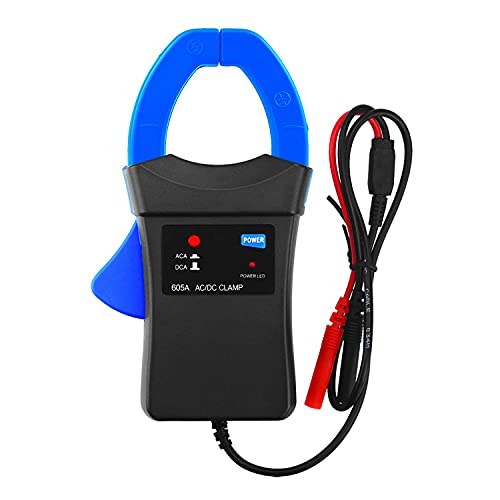
The BT-605A clamps around a conductor to measure AC or DC current up to 600 A, designed to pair with various digital multimeters. It provides an output in mV corresponding to the measured current, simplifying compatibility. Best for: users who need a robust high-current probe for automotive or industrial testing. Caution: performance may vary with non-designed meters; ensure the meter’s input configuration matches the probe output for accurate readings.
Buying Guide: Key Considerations for AC/DC Current Probes
- Measurement Range and Bandwidth: Choose a probe whose range covers your expected currents and whose bandwidth accommodates your signal frequency. Lab work often requires higher bandwidth, while general purpose tasks may suffice with lower bandwidth.
- Output and Compatibility: Verify how the probe interfaces with your oscilloscope or DMM (BNC, USB-powered, etc.). Consider whether you need an external power source or if USB power is sufficient.
- Accuracy and Calibration: Look for specified DC accuracy and AC accuracy across the intended frequency range. Auto zeroing and demagnetization features can simplify use and improve stability.
- Ease of Use: Features like auto degassing, wide open jaws, and clear overload indicators help reduce setup time and measurement errors.
- Portability and Form Factor: For fieldwork, prioritize compact, light probes with easy handling and reliable connectors.
FAQ
- What is the difference between AC and DC current probes?
AC current probes respond to alternating current and may include bandwidth limits; DC probes measure steady currents, often with higher precision for DC signals. Many probes offer both AC/DC measurement modes.
- How do I choose the right current range?
Match the probe’s maximum current to your typical measurements. If you frequently exceed the range, choose a higher-range model to avoid saturation and inaccuracies.
- Can I use these probes with any oscilloscope?
Most probes use standard interfaces like BNC or USB power. Check your oscilloscope’s input type and power options to ensure compatibility.
- What cautions should I observe when using high-current probes?
Avoid exceeding the stated range, and keep leads and connectors clear of high-voltage exposures. Proper zeroing and range selection help maintain accuracy.
- Are auto zeroing and degassing important features?
Yes. Auto zeroing reduces offset errors, and degassing prevents gas buildup that can affect measurement stability in some probes.