Answering the common search intent for converting 60Hz power to 50Hz for appliances, this guide highlights practical options and who each product best serves. The top picks are suitable for homes, workshops, and light commercial setups where devices expect 50Hz input. The following selections focus on reliability, clear output options, and safety protections. A quick buying table at the start helps you compare key specs at a glance.
| Product | Best For | Key Benefit |
|---|---|---|
| GoHz 500VA 60Hz to 50Hz | Light household use | Compact, stable sine output |
| GoHz 5kVA 240V 50Hz to 120V 60Hz | Mid-duty loads | Higher power, robust protection |
| Angisy 2.2KW 380V 3-Phase | Three-phase equipment | 3-phase to 3-phase conversion |
| GoHz 5kVA 50/60Hz Bidirectional | Versatile worldwide devices | Pure sine wave, built-in transformer |
| RCVDVUAJ 11kW Variants | Industrial style needs | Higher power with inverter features |
GoHz 500VA 60Hz to 50Hz Static Converter

Brand: GoHz. This 500VA single-phase converter accepts 120V inputs with 50 Hz or 60 Hz operation, producing a 120V/240V output in selectable ranges. It is suitable for small household appliances that require 50Hz input. Best for light-duty tasks where compact size matters.
Best for: small home devices, compact electronics, and travel-adapted setups that need 50Hz operation without heavy equipment. The unit includes overload and short-circuit protection and alarm features to safeguard connected devices.
Caution: Output current is limited (about 4.2A on the 120V setting); avoid running high-powered or inductive loads for long periods.
Angisy 2.2KW 380V 3-Phase Frequency Converter (50Hz to 60Hz)

Brand: QMLXHYZZS. A 2.2KW three-phase frequency converter designed for 50Hz to 60Hz operation on 380V inputs. This model is best for equipment that runs on three-phase power and needs strict frequency alignment. It supports both directions for 50Hz/60Hz interchangeability in a three-phase setup.
Best for: three-phase machines or workshops that operate on 380V and require reliable 50/60Hz switching. Limitations include complexity and wiring requirements typical of three-phase drives.
GoHz 5kVA Frequency Converter (50Hz to 60Hz)
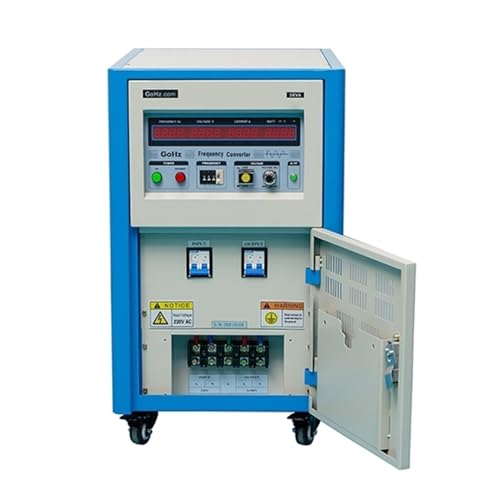
Brand: GoHz. A higher-power option, this 5kVA static sine wave converter handles 240V input at 50Hz or 60Hz and outputs 110V/120V at the alternative frequency. It includes overload, short circuit, and over-temperature protections with alarm signaling. Best for mid-to-high power loads that still require 50Hz/60Hz compatibility.
Best for: larger appliances or small workshop tools that demand more current and stable frequency conversion. Caution: power requirement is significant; ensure proper cooling and electrical clearances.
XVKPQUJA 11kW 50/60Hz to 380V Three-Phase Converter

Brand: XVKPQUJA. A high-capacity device designed to convert 50/60Hz on a single 220V input to three-phase 380V output. This model targets industrial or heavy-duty workshop use where three-phase power is needed at a different frequency. Best for critical, high-load applications that require precise frequency control.
Best for: industrial drives and large motors that need robust frequency conversion. Limitation: installation typically requires professional electrical work and compliant enclosure space.
RCVDVUAJ 11kW 50/60Hz Two Inverter Variants
Brand: RCVDVUAJ. This line includes 11kW variants that provide single-phase 220V inputs with three-phase 380V outputs in drive configurations. Best for applications needing substantial power in mixed-frequency contexts. It emphasizes inverter-based control and flexible frequency translation.
Best for: heavy-duty motor control and production line devices needing consistent 50Hz/60Hz operation across multi-phase outputs. Limitation: higher cost and more complex setup than smaller converters.
Buying Guide
What should you consider when choosing a 60Hz to 50Hz frequency converter?
- Power requirements: Match the converter’s VA/kW rating to your load. Under-sizing leads to tripping or unstable output.
- Input and output voltage: Verify whether you need 120V, 220V, or 240V input/output, and confirm the target frequency (50Hz or 60Hz).
- Load type: Inductive loads (motors, pumps) behave differently from resistive loads (lamps, heaters). Pure sine output helps protect sensitive electronics.
- Protection features: Overload, short-circuit, temperature, and power-failure protections increase reliability for continuous operation.
- Configuration: Some devices are bidirectional or support multiple input/output voltage ranges. Choose based on whether you need 50Hz to 60Hz flexibility for various devices.
- Installation considerations: Three-phase models require appropriate wiring and, in some cases, professional installation.
Practical comparison tips
- Best for compact, light-duty use: GoHz 500VA 60Hz to 50Hz.
- Better for higher loads and endurance: GoHz 5kVA 240V 50Hz to 120V 60Hz.
- Choose this if you operate three-phase equipment on 380V: Angisy 2.2KW 380V model.
- Choose this for broad frequency flexibility and built-in transformation: GoHz 5kVA bidirectional variant.
- Avoid if you need ultra-high reliability in industrial-scale production: consider larger, purpose-built drives and consult an electrician.
Frequently Asked Questions
- What is a frequency converter used for? – It changes the input frequency and voltage to match device requirements not supported by your regional power standard.
- Can I run 60Hz devices on a 50Hz supply? – Yes, with a compatible frequency converter that supports that direction of conversion and suitable output voltage.
- Do these converters protect devices from voltage spikes? – Most include protection against overload and short circuits, but you should also use proper surge protection for sensitive equipment.
- Are three-phase converters necessary for household use? – They are not usually required for typical home devices; they are more common for motors and heavy equipment in workshops.
- Is professional installation recommended? – For three-phase or high-power models, professional wiring is advised to ensure safety and compliance.
- Do these units alter wattage? – Converters manage frequency and voltage; however, efficiency losses can occur, especially under heavy loads.