Looking for a reliable 60 Amp marine battery charger? This guide highlights top 60A chargers for boats, RVs, and marine systems. It helps you choose based on battery type support, multi-bank charging, and smart features. The top picks are best for different buyers: long-range cruisers wanting robust multi-bank charging, small- to mid-size vessels needing versatility, and off-grid setups requiring wide input ranges. Below is a quick comparison table of the five selected models.
| Product | Best For | Key Benefit | Battery Type Support |
|---|---|---|---|
| ProMariner ProNautic 1260P | All-around multi-bank charging | 12 selectable profiles, distributed-on-demand | lead-acid, AGM, most hybrids |
| Sterling ProCharge Ultra 1260 | Global use, multiple bank management | 11 charge curves, auto float/maintenance | LiFePO4, GEL, AGM, flooded |
| Victron Energy Centaur | Global travelers needing reliable auto-ranging input | 4-hour timer, temperature sensing | Multiple chemistries |
| Renogy DC to DC Charger 60A | DC-DC charging for dual-battery systems | 3-stage charging, LiFePO4 compatible | AGM, Flooded, Gel, Lithium |
| RENOGY REGO 60A DC-DC | Universal battery management on the go | Auto-detects chemistry, fast charging | LiFePO4, AGM, Gel, Flooded |
The following sections detail five top picks. Each entry explains who benefits most, why it was selected, and any practical limitations to consider before purchase.
ProMariner ProNautic 1260P: 60A, 3-Bank Marine Charger

The ProMariner ProNautic 1260P is designed for boats requiring robust multi-bank charging with digital precision. It supports 12 selectable four-stage profiles, including charge, condition, auto-maintain, and recondition, plus distributed-on-demand technology that automatically directs capacity to the most needed bank or any combination. Best for boaters who want advanced programming and flexible bank management for seasonal usage or mixed battery chemistries. Caution: ensure your installation location supports its mounting and wiring requirements for three banks.
Sterling ProCharge Ultra 1260 12V, 60 Amps

The Sterling ProCharge Ultra 1260 shines for travelers who need a wide input range and multiple charge curves. It includes 11 pre-programmed profiles (including LiFePO4, GEL, AGM, Calcium, and Flooded Lead Acid) and a 4-step charging profile with float/energy-save after charging. Two digital meters show current and voltage, and three isolated outputs help direct charging as needed. Best for users who value straightforward setup and global compatibility. Limitation: some users may prefer more than three outputs in larger systems.
Victron Energy Centaur 12V 60A 3-Bank

The Victron Centaur 60A 3-bank charger is ideal for travelers who need reliable auto-ranging input from 90-265VAC worldwide. Its internal temperature sensing helps keep components within safe limits, reducing the risk of overheating. It charges at a bulk rate until it falls to 70% of rated amps, then switches to a 4-hour timer before finishing at float. Best for global voyagers who want adaptive charging based on ambient conditions. Limitation: detailed manual programming may be less intuitive for casual users.
Renogy DC to DC Charger 60A Lifepo4
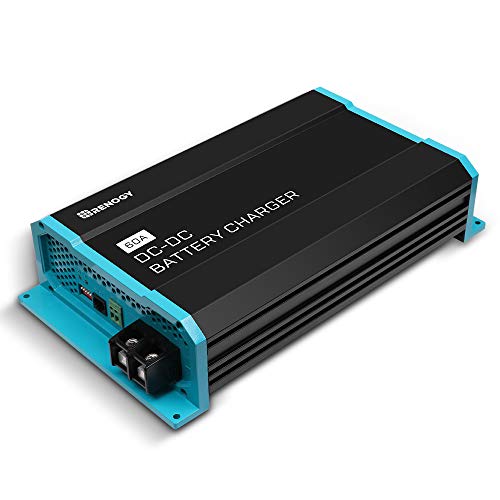
Renogy’s 60A DC-to-DC charger is designed for marine, RV, and off-grid installs, supporting multiple battery types with smart three-stage charging (Bulk, Boost, Float). It’s suitable for dual-battery systems where the house and starting batteries must be charged from the alternator. Best for users seeking a versatile charger that works with AGM, Flooded, Gel, and Lithium. Limitation: some users may require additional components for optimal LiFePO4 activation in certain setups.
RENOGY REGO 60A DC-DC Charger

RENOGY REGO 60A DC-DC charger offers universal battery management by auto-detecting chemistry (LiFePO4/AGM/Gel/Flooded) and delivering 60A turbo charging for RVs, boats, and dual-battery systems. It provides fast charging while protecting against overvoltage, over-temperature, and reverse polarity. Best for users who travel with mixed battery chemistries and need a single, robust DC-DC solution. Limitation: the advanced features rely on correct wiring and battery configurations to maximize performance.
Buying Guide
What should I consider before buying a 60A marine charger?
Key factors include battery type support, number of banks, input voltage range, and whether you need a DC-DC charger or an AC-powered unit. Multi-bank chargers simplify maintenance for boats with several battery banks. If you regularly use lithium batteries, prioritize models with LiFePO4 support and proper charging profiles.
Is AC or DC input more suitable for boats?
AC-input chargers are common and easy to install on boats with shore power. DC-DC chargers connect to the boat’s alternator or auxiliary power and are ideal for live-aboard vessels or RVs that run off a battery bank. Choose based on where you’ll most often source power.
How important are charging profiles and temperature management?
Smart profiles optimize battery life by controlling charge stages and reconditioning cycles. Temperature sensing helps prevent overheating and extends battery life. If your vessel operates in hot climates or fluctuating temperatures, these features offer tangible benefits.
What battery types should I expect to support?
Modern 60A marine chargers commonly support lead-acid (flooded, AGM, Gel) and lithium chemistries. Always verify compatibility with your specific batteries, especially LiFePO4, which requires careful activation and proper voltage settings.
What about installation and maintenance?
Look for compact form factors, clear wiring diagrams, and robust protection features (over-voltage, over-temperature, short-circuit). Consider manufacturer support and whether the unit provides remote monitoring or easy-to-read meters for quick checks at the dock.
How do I compare performance between models?
Compare the number of banks, the available charge profiles, float/maintenance modes, and whether there are automatic distribution features (distributing charging power among banks). For boats with multiple battery systems, a model with flexible distribution can simplify management and improve overall performance.
Frequently Asked Questions
- What is a 60A marine charger best suited for? Boats with multiple battery banks, RVs, and off-grid marine setups requiring strong, multi-bank charging and flexible battery chemistries.
- Can these chargers handle lithium batteries? Yes, many models support LiFePO4 or other lithium chemistries, often with dedicated profiles or auto-detection. Check each model’s compatibility.
- Do I need an AC input or a DC-DC charger for a boat? It depends on your power source. Shore power favors AC-input units; engine- or alternator-based charging benefits from DC-DC units.
- What is the advantage of temperature sensing? It helps prevent overheating and maintains safe charging currents in hot or variable environments, improving longevity.
- How important are charge profiles? Profiles optimize charging for different battery chemistries and usage patterns, extending life and performance.
- Are three-bank chargers sufficient for most boats? For many vessels, three banks cover starting, house, and auxiliary systems. Larger boats may benefit from additional banks or flexible distribution features.