Choosing a 40 amp marine battery charger ensures fast, reliable charging for multiple batteries while at sea or dockside. The right model supports multiple battery chemistries, protects against overcharging, and adapts to harsh marine environments. Below, five top options are analyzed for performance, durability, and ease of use, helping you select a charger that keeps your boat’s power system ready for every voyage.
| Product | Brand | Bank Count | Total Output |
|---|---|---|---|
| NOCO Genius GENPRO10X4 | NOCO | 4 | 40A |
| FORM Fusion 10X4 | FORM | 4 | 40A |
| ProMariner 63140 ProNauticP | ProMariner | 4 | 40A |
| KAISAL 4 Bank 12V | KAISAL | 4 | 40A |
| Xantrex TRUEcharge3 804-1240-10 | Xantrex | 3 | 40A |
NOCO Genius GENPRO10X4: 4-Bank, 40A Onboard Charger
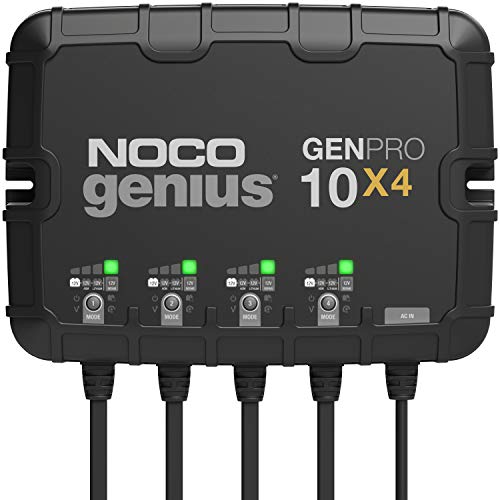
The GENPRO10X4 delivers 40 amps total with 10 amps per bank, making it capable of simultaneously charging four 12V batteries in marine, starter, and deep-cycle systems. It’s notably compact for its power, designed to withstand harsh marine environments, and offers selectable charging modes tailored to lead-acid and lithium chemistries. Independent banks enable precise charging while maintaining critical systems on a vessel.
Key features include multi-bank independence, 12V, 12V AGM, and 12V Lithium charging modes, plus a dedicated 12V Repair Mode. Temperature compensation helps optimize charging in changing conditions, and overcharge protection adds a layer of safety on deck. For boaters juggling multiple battery banks, this model provides a balance of power, reliability, and space efficiency.
Practical notes: installation flexibility is enhanced by compact dimensions; consider space behind the battery locker or near the engine compartment. The device is designed for lead-acid and lithium batteries, with the capacity to maintain batteries during long absences on the water. As with all high-amperage onboard chargers, ensure proper ventilation and fusing per marine electrical standards.
Battery Charger 40A, 12V/24V Lead Acid Smart Battery Charger

This all-in-one charger supports 12V lead-acid and 24V systems (not suitable for 24V LiFePO4). It offers a 6-stage charging process and includes a repair mode to recondition idle or aged batteries. With its integrated trickle charge, it aims to maintain battery health over winter storage or long periods without use.
The device is portable and emphasizes safety with smart charging logic that prevents overcharging. It is suitable for boats that operate in mixed electrical environments, including cars and motorcycles as backup charging options. Users should confirm compatibility with their specific battery chemistries before relying on it as a primary charger in demanding marine settings.
Consider this model if you need a versatile, all-in-one charger that covers reconditioning and maintenance across common 12V and 24V lead-acid systems, while accepting some constraints on lithium chemistries compared to dedicated LiFePO4-capable units.
ProMariner 63140 ProNauticP Series 1240P

The ProNauticP 1240P is a 12V, 40-amp charger designed for marine use with four-stage profiles that cover charging, conditioning, maintaining, and reconditioning. It includes an automatic dockside power mode to support onboard lighting and appliances, and it is configured to work with flooded lead-acid batteries, with selectable AGM or GEL options. The model is designed to be energy-efficient, reducing onboard power draw while maintaining battery readiness.
Operational flexibility is enhanced by an auto-ranging global AC input (100-250VAC) so it can be used at various marinas worldwide. The ProNauticP series emphasizes compact, durable construction intended for harsh environmental exposure. It’s a strong choice for boaters who want reliable 12V charging with robust protection features and straightforward setup for multiple battery banks on larger vessels.
When integrating this charger, consider shore power availability, voltage stability at the dock, and whether your boat’s electrical layout can accommodate four independent charging channels without cross-interference between banks.
KAISAL 4 Bank Marine Battery Charger

The KAISAL model offers four independently charged channels with 10A per bank, delivering a total of 40A. It supports multiple battery types, including LiFePO4 and other lithium chemistries, as well as lead-acid variants. The charger features IP68 waterproofing and a 14.6V reference for LiFePO4 chemistry, ensuring durable performance in wet marine environments. Independent channels help avoid cross-bank interference while charging different battery types on a single vessel.
Charging curves adapt to battery chemistry via intelligent electronics, switching between CC, CV, and float modes as needed. The auto-restart capability keeps batteries topped off after a discharge, and the four-bank design is well-suited for boats with multiple battery banks (engine, house, trolling motor, and spares). Installation considerations include ensuring compatible wiring, proper venting, and matching shore power availability to the 90V-240V input range.
For mariners seeking a rugged, all-around marine charger with broad chemistry support and independent banks, KAISAL provides solid performance with durable construction designed for ongoing saltwater use.
Xantrex TRUEcharge3 804-1240-10

The TRUEcharge3 is a three-bank charger with a total output of 40A, designed for easy hardwired installation and flexible operation. It features multi-stage charging with lithium, flooded, gel, and AGM compatibility, and offers parallel stacking to increase current capacity for larger battery banks. A remote panel (required for stacking) provides convenient access to charging status and settings from a distance.
Universal input voltage (95-265 VAC) makes it adaptable to different regions, while the charger’s intelligent sensing helps optimize charging across various battery types. The model emphasizes reliability for marine use, ensuring critical systems stay charged without overloading electrical circuits. When planning a cabin or cockpit electrical system, consider how parallel stacking could maximize charging capacity for a larger boat with many battery demands.
Buying Guide: Key Considerations For 40A Marine Chargers
Purpose and compatibility: Match charger type to your battery chemistries (lead-acid, AGM, GEL, LiFePO4, NCM) and ensure the device supports your boat’s voltage (12V or 24V) and battery count. Independent banks provide precise, simultaneous charging, but verify each model’s compatibility with your specific bank configuration.
Water and environmental resistance: Marine environments demand IP ratings and weatherproofing. Choose chargers with waterproof housing, corrosion resistance, and cold-weather performance to maintain reliability in salt air, spray, and humidity.
Charging profiles and modes: Look for multi-stage charging, recovery or repair modes for aged batteries, and automatic maintenance or float features to keep batteries topped off during storage. Lithium compatibility is a growing requirement for modern boats; ensure the charger correctly handles LiFePO4 and other Li-based chemistries.
Safety features: Overcharge protection, temperature compensation, short-circuit protection, and alarms or indicators help prevent battery damage and electrical hazards on board. Proper venting and secure mounting are also important for safe operation in confined spaces.
Installation and flexibility: Consider the ease of installation, the availability of mounting space, wiring harness length, and whether the units support parallel stacking to multiply current output when needed. Global voltage acceptance is beneficial for mariners who travel or dock internationally.
Maintenance and longevity: A charger with reliable electronics, robust components, and a maintenance mode helps maximize battery life and reduce downtime. Review product warranties and service options when selecting a 40A marine charger for long-term use.
Overall, the best 40A marine battery charger balances fast, safe charging with durability in a saltwater environment, while offering flexibility across battery chemistries and bank configurations. Choose a model that aligns with your vessel’s electrical layout, expected operating conditions, and future battery upgrades.