For technicians and engineers working with current loops, a reliable 4-20 mA loop calibrator is essential. This guide highlights top picks that balance accuracy, ease of use, and rugged design. Each product is suitable for calibrating transmitters, PLCs, and HVAC instrumentation, and includes features like built-in loop supplies, precise current generation, and multiple output ranges. Read on to compare capabilities and find the best fit for your application.
| Product | Brand | Key Feature |
|---|---|---|
| DTI-SG100+ Signal Generator | DLTEREN | 4-20 mA with 0-10 V output |
| eC370T Volt mA Thermocouple Calibrator | ennoLogic | 0-20 V, 4-20 mA, thermocouple ranges |
| RUOSHUI 05S 4-20mA Loop Calibrator | GuliTech | 0-24 V loop supply, high accuracy |
| Fluke 789 ProcessMeter | Fluke | Measure, source, simulate 4-20 mA with loop supply |
| Jadeshay 4-20mA Generator | Jadeshay | Two-wire current loop signal generation |
These selections cover a range of budgets and needs—from compact field tools to robust, multi-function meters. The following sections provide detailed overviews of each model, including build, output capabilities, and typical use cases to help you choose confidently.
DTI-SG100+ Signal Generator Process Calibrator

The DTI-SG100+ is a signal calibrator designed for 4-20 mA loops with an additional 0-10 V output. It provides a compact solution for field calibration of transmitters and loop-powered devices. Built to operate in typical HVAC and process control environments, it supports straightforward setup for generating test signals and monitoring loop behavior. This model emphasizes portability and reliable signal generation in a single unit, useful for quick diagnostics and routine maintenance tasks.
eC370T Volt mA Thermocouple Calibrator
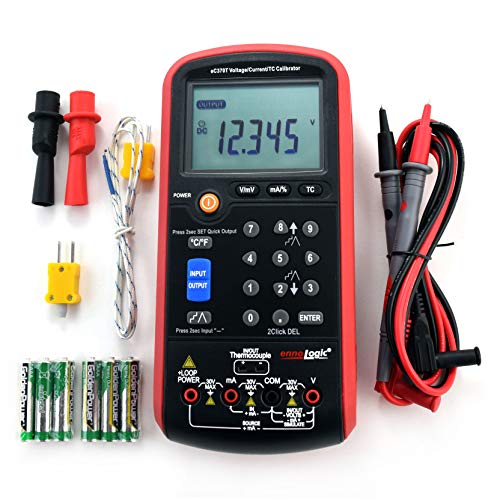
The eC370T offers a versatile signal generator for current (mA), voltage, and thermocouple testing. It supports 0-20 V and 4-20 mA outputs, plus mV and temperature ranges, making it suitable for calibrating transmitters, controls, PLCs, and HVAC sensors. A numeric keypad and hotkey programming streamline frequent tests, while a built-in 24 V loop supply simplifies testing 2-wire devices without external power. It combines precise readings with flexible output options for comprehensive loop calibration tasks.
GuliTech RUOSHUI 05S 4-20mA Loop Calibrator

The RUOSHUI 05S model provides a concise solution for 4-20 mA calibration with a built-in 24 V loop supply. It supports basic measurement modes and current display in Am and Am% formats, along with a visible LCD for straightforward interpretation. This device is well-suited for technicians needing a reliable, economical tool to simulate transmitters and verify loop integrity in field settings and on the shop floor.
Fluke 789 ProcessMeter

Fluke’s 789 ProcessMeter combines comprehensive DMM capabilities with the ability to source and simulate 4-20 mA signals, plus a built-in 24 V loop supply. Its rugged design, reliable overload protection (1000 V on V and Ohms, 150 V on mA), and a long-lasting battery offer dependable performance for field service and maintenance. The large LCD with backlight enhances readability in challenging environments, and the device supports precise test signals for calibrating transmitters and instrumentation.
Jadeshay 4-20mA Two-Wire Generator

The Jadeshay unit provides a two-wire loop signal generator with it’s 4-20 mA output and an extended 3-21 mA range. It features a clear LCD display and a rotary encoder for precise, smooth adjustments. The device emphasizes calibration flexibility with linear output calibration options, making it suitable for calibrating transmitters, PLCs, and various sensors in industrial control scenarios. This model is valued for its straightforward operation and practical output control.
TOPCHANCES Upgrade MR Signal Calibrator

The TOPCHANCES MR calibrator emphasizes an upgraded design with 4-20 mA and 0-10 V output capabilities, plus improved display features for easy reading of output values. The device highlights portability and user-friendly operation, with a USB-C or micro USB charging interface and long standby energy efficiency. It provides a practical solution for field technicians who require reliable loop simulation and quick verification of process instrumentation in a compact package.
Buying Guide: Key Considerations For Selecting A 4-20mA Loop Calibrator
- Output range and versatility: Look for devices offering 4-20 mA plus voltage outputs (0-10 V or higher) to cover a broad range of transmitters and sensors.
- Loop supply: A built-in loop supply (commonly 24 V) enables testing without external power, saving time in the field.
- Accuracy and resolution: Check stated accuracy (often a percentage or in microamps) and display resolution for reliable calibration results in demanding environments.
- Measurement functions: Some units combine DMM features, thermocouple calibration, and temperature sensing; choose according to the instrumentation you service.
- User interface: Numeric keypads, hotkeys, LCD readability, and intuitive controls reduce setup time during calibration tasks.
- Durability and portability: For field use, select rugged housings with long battery life and manageable weight.
- Connectivity and data: Consider units with data logging, USB or USB-C charging, and easy data transfer for documentation and compliance.
- Price-to-performance balance: Higher-end meters (like Fluke) provide robust features and support, while economical models suffice for routine calibrations.
- Support and accessories: Availability of replacement parts, spare fuses, and calibration certificates contributes to long-term reliability.
When selecting, map your typical workflows to the features that matter most: field portability, required output ranges, and whether you need simultaneous measuring and sourcing. If your work involves high-precision thermocouple readings in addition to current loops, a model with thermocouple support and a built-in loop supply can simplify setups. For shop-floor calibration tasks, a compact device with a clear display and straightforward controls may improve efficiency. Finally, consider brand reliability and available service options to ensure long-term calibration performance.