Choosing a 3500-watt solar inverter involves balancing power needs, battery type, and system setup. The following 5 units represent common off-grid and backup scenarios, from hybrid inverters with built-in MPPT to pure sine wave inverters suitable for RVs, cabins, and home energy storage. Each section highlights how the unit handles continuous and peak loads, charging, and protection features to help you compare quickly.
| Product | Brand | Key Strength | MPPT/Charging | Best For |
|---|---|---|---|---|
| VEVOR Hybrid Solar Inverter, 3500W | VEVOR | All-in-one inverter and controller | 100A MPPT | Off-grid systems |
| CELYYPU 3500W Pure Sine Wave Inverter | CELYYPU | Remote LCD with dual display | Extended protections | RV and home backup |
| ECO-WORTHY 3500W Pure Sine Wave Inverter Charger (48V) | ECO-WORTHY | 3-in-1 with 80A MPPT | Up to 80A PV, 120A hybrid | Off-grid storage |
| TVNIKD 3500W Power Inverter (12V to 110V) | TVNIKD | Multiple outlets with LCD | 24V/12V adaptable | Vehicle and mobile solar |
| LiTime 3500W Pure Sine Wave Inverter Charger (48V) | LiTime | UPS built-in with MPPT | 4 charging modes | Home energy storage |
VEVOR Hybrid Solar Inverter, 3500W, 24V System
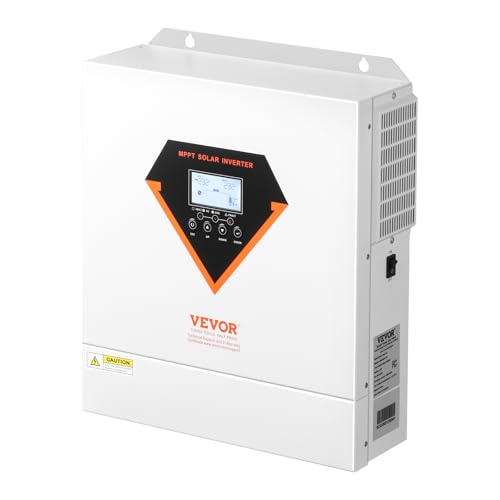
The VEVOR 3500W model combines an inverter and MPPT controller in a single chassis, delivering a robust 220/230V AC pure sine wave output for off-grid solar setups. It targets 24V battery systems and supports lithium and lead-acid chemistries, with an activation function optimized for lithium batteries. The built-in 100A MPPT controller enables efficient solar charging and flexible array integration. With a wide DC input window (60V–500V) and a peak output potential of 4000W, it offers scalable solar energy conversion for cabins, remote homes, or large RV installations. Safety protections guard against common faults.
Features to note include: 2-in-1 design, high-efficiency MPPT, and compatibility with multiple battery types. When sizing the load, consider simultaneous usage of appliances such as refrigerators, pumps, and electronics. The inverter’s efficiency and surge capacity help handle startup currents without undue voltage droop. Installation should follow manufacturer guidelines for wiring and grounding to maximize performance and safety.
CELYYPU 3500 Watt Pure Sine Wave Inverter

The CELYYPU 3500W inverter converts 12V DC to 110/120V AC with a peak of 7000W, delivering a stable pure sine wave. It emphasizes a low no-load loss and efficiency above 91%, helping protect sensitive electronics from irregular power. An intelligent LCD dual display, connected via a long wired remote, presents input/output voltages, battery status, load, and other operating states for troubleshooting on the fly. The unit includes comprehensive safety protections—under/over voltage, overtemperature, overload, short circuit, and reverse connection—paired with a durable enclosure for portability and resilience in mobile or fixed installations.
Ideal uses feature RVs, homes, or emergency kits where reliable power with minimal noise and clean waveform is essential. Consider pairing with a suitable 12V battery bank and ensuring proper ventilation for continuous operation. The included LCD display helps maintain awareness of system health without external meters.
ECO-WORTHY 3500W Pure Sine Wave Inverter Charger (48V)

This ECO-WORTHY model is a 3-in-1 inverter charger designed for 48V battery banks, delivering up to 120A battery charging and 4400W PV input capacity. It supports four charging modes—PV-priority, utility-priority, hybrid, and solar-only—along with parallel operation for higher power demands (up to 21 kW in multi-unit setups). The unit handles single-phase or split-phase configurations, making it suitable for off-grid homes, cabins, or backup systems. With a 20ms UPS function, it aims to minimize interruption during grid outages and maintain critical loads.
When evaluating this inverter, assess the available PV array size and the practicality of parallel installations. The device’s 145V DC max open-circuit voltage and high PV input capacity provide flexibility for expanding your solar investment, but ensure compatibility with your battery chemistry and local electrical codes.
TVNIKD 3500W Power Inverter for Vehicles

The TVNIKD unit is designed for mobile and off-grid use, converting 12V DC from automotive or solar batteries into 110V AC with a 3500W continuous rating and 7000W peak. It provides four AC outlets along with USB ports and a remote LCD to monitor battery status. The updated LCD helps users verify voltage levels and load conditions, and the unit automatically shuts down if the load exceeds its capacity, protecting connected devices from damage. Suitable for camping, RV trips, or emergency preparedness, it supports a wide range of appliances within its maximum output.
Consider the installation context: 12V systems typically power vehicles or portable solar arrays. Ensure proper ventilation and fuse sizing are in place. The unit’s dynamic overload protection and concise display help maintain reliability in on-the-go scenarios where monitoring access may be limited.
LiTime 3500W Pure Sine Wave Inverter with 48V UPS

The LiTime 3500W inverter combines an MPPT charge controller and inverter in a single 48V platform, delivering a peak surge up to 6000W for short periods. It features a built-in UPS, enabling seamless transitions during outages with milliseconds of backup power for critical electronics. Four charging modes—Solar Only, Utility Priority, Solar Priority, and Hybrid—offer flexible energy management. The unit supports a wide range of 48V batteries, including lead-acid and lithium options, making it suitable for home energy storage, off-grid cabins, or microgrids.
Key considerations include ensuring adequate solar input for continuous charging, confirming battery compatibility, and planning for the UPS behavior during longer outages. This model supports practical expansion as solar capacity grows or load profiles change over time.
ECO-WORTHY 3500W 48V Inverter with MPPT

This ECO-WORTHY 3500W 48V model is a versatile 3-in-1 inverter charger with an 80A MPPT controller and support for parallel operation up to six units. It accommodates 4 charging modes (PV-priority, utility-priority, hybrid, solar-only) and three operating modes (PV-priority, utility-priority, battery-priority). The design targets off-grid houses, storage systems, and multi-unit installations where higher power is needed without sacrificing waveform quality. The unit’s 20ms UPS adds reliability for essential loads during grid instability.
For system designers, parallel capability offers a path to scale capacity with relatively straightforward wiring. Monitor PV array voltage, battery health, and inverter temperature to maintain performance over time.
Buying Guide: Key Purchase Considerations for 3500W Inverters
- System type: Decide between pure sine wave and modified sine wave. Pure sine wave is preferred for sensitive electronics, medical devices, and appliances with motors or the need for clean power.
- Voltage and battery compatibility: Match the inverter’s DC input (12V, 24V, or 48V) to your battery bank. Confirm supported chemistries (lead-acid, Li-ion, LiFePO4) and the MPPT controller’s current rating for efficient charging.
- MPPT performance: Higher MPPT current allows faster solar charging and better efficiency in shaded or cloudy conditions. Check maximum PV input power and open-circuit voltage ratings.
- Protection features: Look for over/under voltage, short-circuit, overload, over-temperature, reverse polarity, and anti-backfeed protections. A robust cooling system helps maintain performance in hot climates.
- UPS and load handling: If backup power is critical, assess whether the unit supports uninterruptible power supply with fast transition and how long it can sustain essential loads during outages.
- Parallel capability: For larger or expandable systems, ensure the inverter supports parallel connections with other units and confirm maximum combined output power.
- Physical design and installation: Consider enclosure durability, mounting options, ventilation needs, and cable/wire sizing according to electrical codes and local regulations.
- Remote monitoring and displays: LCD or remote monitoring helps track voltage, battery state, load, and system health, reducing troubleshooting time in off-grid contexts.
- Cost and warranty: Compare total system costs, including batteries, panels, and controllers, and review warranty terms and service support for long-term reliability.
- Use-case alignment: Match the inverter’s surge capacity to essential loads (refrigerators, water pumps, HVAC components) and ensure a smooth transition between energy sources during outages.
In selecting a 3500W inverter, prioritize how it integrates with your battery bank, solar array, and any backup power needs. A well-chosen unit supports efficient solar charging, reliable power during outages, and safe, codes-compliant installation in homes, RVs, cabins, or vehicles.